Nirma Uni-Gota Flyover and Narmada Canal Flyover Expansion to Be Completed by July-End; Karnavati Club-YMCA Flyover to Be Built by Dec; Completion of Work to Ease Traffic Congestion
Work on two new flyovers near Nirma University and Karnavati Club, along with the expansion of the flyover over the Narmada canal on the 44.3-km S G Highway, is expected to be completed by the year end, bringing relief to thousands of commuters.
The Nirma University-to-Gota flyover and the widening of the Narmada canal flyover are likely to be ready by July end, while the flyover connecting YMCA Club to Karnavati Club is scheduled for completion by December.
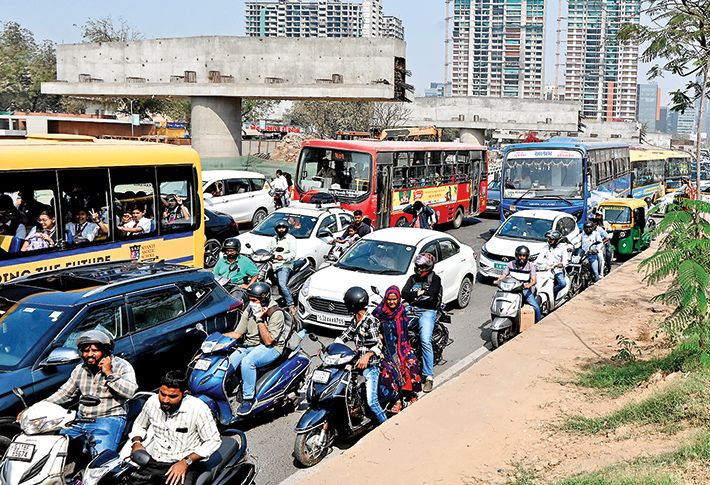
Ambitious projects have been undertaken to improve connectivity between Ahmedabad and Gandhinagar ahead of the Commonwealth Games in 2030. The overall S G Highway development project is estimated to cost around Rs 1,000 crore. These stretches are among the most critical, carrying heavy passenger traffic between the twin cities. Ongoing construction has led to severe congestion, with commuters taking up to 40 to 45 minutes to cross these sections during peak hours.
It was stated that the highway will be converted into a six-lane, signal-free corridor. The plan includes closing 10 existing cuts and eight traffic signals, replacing them with U-turns to reduce travel time.
The highway will have three lanes on each side and is set to be developed as an iconic road. Additionally, service roads will be upgraded with amenities such as footpaths, tree plantations, kiosks, cycle tracks, toilets and EV charging stations.
Meanwhile, a proposal has been made to widen the Narmada canal bridge between Bhat Circle in Ahmedabad and Koba Circle in Gandhinagar to 12 lanes. Two parallel bridges on either side of the existing road have been proposed to ensure seamless connectivity from Gandhinagar to SVP International Airport.
The project is estimated to cost Rs 37.33 crore. Under the proposal, two parallel bridges, each approximately 1,000 metres long and 15 metres wide, will be constructed alongside the current bridge.
To facilitate construction within the canal, a specialised pontoon method will be used. This involves floating, boat-like platforms to enable heavy-duty piling and provide strong foundational support for the structures.
Nirma University
Nirma University is a private university located in Ahmedabad, Gujarat, India, founded in 2003. It was established to provide high-quality education in fields like engineering, management, pharmacy, and law. The university has grown from its initial institutes to become a prominent institution known for its academic programs and modern campus.
Narmada Canal
The Narmada Canal is a major irrigation system in western India, primarily in Gujarat, stemming from the Sardar Sarovar Dam on the Narmada River. Its construction, a massive ongoing project since the late 20th century, aims to provide water to drought-prone regions for agriculture and drinking. It represents a significant feat of engineering intended to transform the region’s water security and economy.
<h3 class="text-lg
Nirma University
Nirma University is a private university located in Ahmedabad, Gujarat, India, founded in 2003 by the Nirma Education and Research Foundation. It was established through the vision of industrialist Dr. Karsanbhai K. Patel, the founder of the Nirma Group, to provide high-quality education in fields like engineering, management, pharmacy, and law. The institution has grown from its initial institutes to a full-fledged university, known for its modern campus and emphasis on professional and technical education.
Narmada Canal
The Narmada Canal is a major irrigation system in western India, primarily in Gujarat, stemming from the Sardar Sarovar Dam on the Narmada River. Its construction, which began in the late 20th century, was a central and often controversial part of the larger Narmada Valley Development Project aimed at providing water to drought-prone regions. Today, it is a vital infrastructure network supplying water for agriculture, drinking, and industry across hundreds of villages and towns.
Karnavati Club
The Karnavati Club is a prominent private social club in Ahmedabad, India, established in 1944 during the British Raj era. It was founded by a group of local industrialists and professionals, and its name “Karnavati” is the ancient name for the city of Ahmedabad itself. Today, it is known for its extensive recreational facilities and as a prestigious social hub for the city’s elite.
YMCA Club
The YMCA (Young Men’s Christian Association) is a worldwide organization founded in London in 1844 to provide healthy activities and housing for young men during the Industrial Revolution. Today, it operates in over 120 countries as a community-focused nonprofit, offering fitness facilities, sports programs, childcare, and social services to people of all ages, backgrounds, and faiths.
S G Highway
S G Highway is a major arterial road in Ahmedabad, Gujarat, India, named after Sardar Vallabhbhai Patel, a key leader in the Indian independence movement (with “Sardar” and “Gujarat” forming the “S G”). Originally developed on the city’s western outskirts, it has transformed since the 1990s into a premier commercial and business corridor, symbolizing Ahmedabad’s modern economic growth.
SVP International Airport
**SVP International Airport** is the primary airport serving the city of Varanasi in Uttar Pradesh, India. Originally known as Varanasi Airport, it was renamed in 2020 in honor of Lal Bahadur Shastri, India’s second Prime Minister, whose popular slogan was “Jai Jawan Jai Kisan” (Hail the Soldier, Hail the Farmer). The airport has been modernized into an international gateway, reflecting Varanasi’s status as a major spiritual and cultural hub.
Bhat Circle
“Bhat Circle” is a major traffic roundabout and landmark in the city of Hubli, in the Indian state of Karnataka. It is named after the prominent Bhat family of the region and serves as a central hub connecting several important roads. While primarily a modern transportation junction, its name reflects the local history and influence of the Bhat community in the area’s development.
Koba Circle
The Koba Circle is a prehistoric stone circle located in the Gambia, believed to have been constructed between the 8th and 12th centuries AD. It is part of the wider Senegambian stone circles, a UNESCO World Heritage site, and is thought to be a burial ground for ancient rulers or a ceremonial site. The site consists of laterite pillars arranged in a circle, with its exact origins and purpose still partly shrouded in mystery.