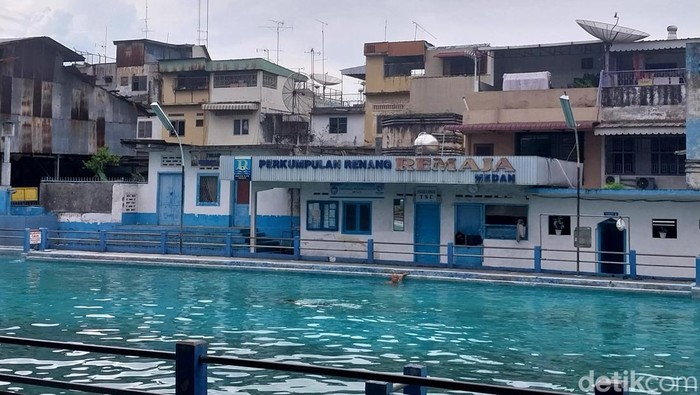
Medan –
The Paradiso Swimming Pool is a sports facility in the city of Medan. It holds a long historical legacy as the first and oldest swimming pool in Medan.
This swimming pool is located at Jalan Sisingamangaraja No.6. Its existence bears witness to the city’s development since the colonial era. It is explained that this pool was originally known as the Medan Zwembad.
“It is true, the Paradiso Swimming Pool is the first and oldest swimming pool in the city of Medan. Originally, this pool was named Medan Zwembad,” it was stated.
It was recounted that the construction of the pool began in 1924 in an area formerly known as Jalan Radja (Radja Straat). The construction process was considered unique as it involved various parties.
“This swimming pool was first built in 1924, and is located on Jln. Radja (Radja Straat). The construction process was quite unique, because the existence of this pool was inseparable from the roles of the Colonial Government, the Ajer Bersih Company, and the Sultan of Deli himself,” it was said.
Furthermore, it was explained that the idea for its construction had actually emerged as early as 1918, but was only realized several years later.
“The construction of this pool was initiated by G. Van Altena in 1922, after a previous plan initiated by the Delian Bathing and Swimming Association (Medansche Zwemvereeniging), the Medan City Council, and the Ajer Bersih Company in 1918 failed to materialize,” was the explanation.
In the initial stage, the pool utilized a reservoir or holding tank for surplus clean water belonging to the city government (Gemeente Medan), which had been simply renovated. As public interest grew, various updates were made to beautify and expand the pool area.
Renovations were recorded in 1925, 1927, 1928, and 1930, then continued in 1935 under architect Rostenburg with contractor Bennink and Co. Development did not stop there. In 1938, renovation was carried out again under the leadership of architect Groenewegen and was completed in 1940.
These various updates indicate the high level of public interest in this swimming facility at that time.
However, behind its grandeur, this pool also reflected the social realities of the colonial era. Although not exclusively for the nobility, the users of this facility were dominated by Europeans. In fact, the local native population at that time was not permitted to use the facility.
Citing a study in a thesis titled “Medansche Zwembad, The First Swimming Pool in the City of Medan (1924-1942)”, this pool became one of the favorite recreational centers for Dutch and other European citizens, both those living in Medan and outside the Gemeente Medan area. Visitors were charged different rates based on categories, such as members, non-members, and daily tickets.
These restrictive rules did not only apply at the Medan Zwembad, but also at various public facilities built by the colonial government at that time. Today, with the changing times, the Paradiso Swimming Pool is open to the general public and remains a part of Medan’s historical heritage that can still be enjoyed to this day.
Paradiso Swimming Pool
The Paradiso Swimming Pool, located in the Swiss Alps near St. Moritz, is a famous open-air pool known for its stunning alpine backdrop. Historically, it was built in the 1930s as part of the Kulm Hotel’s spa facilities, reflecting the era’s grand hotel tourism and the popularity of winter sports and wellness in the Engadin region.
Medan Zwembad
“Medan Zwembad” is a public swimming pool complex located in Medan, Indonesia, built during the Dutch colonial period in the early 20th century. It represents a historical example of colonial-era recreational architecture and infrastructure, serving as a popular local leisure site for decades. Today, it remains a functional pool, offering a glimpse into the city’s historical urban development.
Jalan Sisingamangaraja No.6
Jalan Sisingamangaraja No.6 is the address of the iconic **Hotel Indonesia Kempinski** in Jakarta. Originally opened in 1962 as the luxurious **Hotel Indonesia**, it was a landmark project by Indonesia’s first president, Sukarno, to host visitors for the 1962 Asian Games and symbolize the nation’s modernity. Today, the restored hotel stands as a national cultural heritage site, representing a pivotal era in Jakarta’s post-independence development.
Jalan Radja (Radja Straat)
Jalan Radja (Radja Straat) is a historic street in the heart of Jakarta, Indonesia, originally constructed by the Dutch colonial administration in the early 19th century. It was a prestigious boulevard lined with government buildings and elite residences, serving as a central axis of the colonial capital, Batavia. Today, known as Jalan Veteran, it remains a significant thoroughfare near the presidential palace, reflecting the city’s layered colonial and national history.
Colonial Government
The term “Colonial Government” broadly refers to the administrative systems established by imperial powers to control their overseas territories. These governments, which varied from direct rule by appointed officials to indirect rule through local elites, were central to the economic exploitation and cultural imposition of the colonial era. Their legacies, often marked by imposed borders and institutional frameworks, continue to shape the political and social landscapes of former colonies today.
Ajer Bersih Company
Based on available information, “Ajer Bersih Company” does not appear to be a widely recognized historical place or cultural site. It is likely a modern business name, potentially for a water or cleaning service company (“Ajer Bersih” translates to “Clean Water” in Indonesian/Malay). Without specific historical or cultural context, a summary of its significance as a landmark cannot be provided.
Sultan of Deli
The Sultanate of Deli was a Malay kingdom founded in 1632 in what is now North Sumatra, Indonesia. It emerged as a powerful and wealthy polity due to its strategic control over the Strait of Malacca and the export of pepper and other commodities. While the sultanate’s political power declined under Dutch colonial rule, the royal line continues to exist today as a cultural institution.
Medansche Zwembad
“Medansche Zwembad” refers to the Medemblik swimming pool in the Netherlands. It was a notable public bath and swimming facility, historically significant for providing recreational and hygienic amenities to the local community in the 20th century. While not an ancient monument, it represents an important part of the town’s social and architectural heritage.