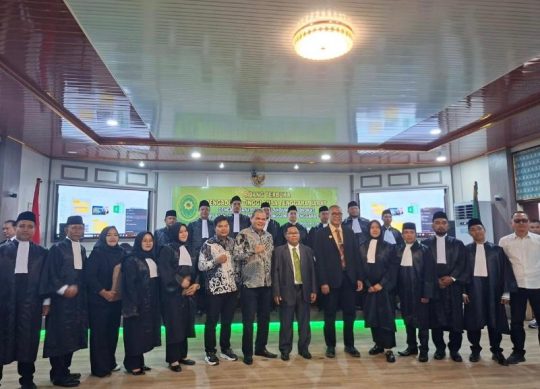
Mataram – The Chairman of the Indonesian Advocates Movement Council urged the Minister of Hajj and Umrah to be cautious in proposing the idea of a “Hajj Ticket War” as it could create injustice and unrest.
Speaking during the inauguration and swearing-in of new lawyers at the West Nusa Tenggara High Court, the Chairman reminded the Government not to easily propose ideas without thorough consideration and mature thought.
It was stated that the ‘Hajj Ticket War’ refers to the scramble for Hajj tickets outside the regular Hajj departure scheme. While the waiting period for regular Hajj can reach 10 to 20 years, the “Hajj Ticket War” would operate on a “first come, first served” basis.
According to the Chairman, the statement or idea from the Minister of Hajj could not only cause unrest but could also be dangerous and create injustice for two reasons.
First, the government’s implementation of the Hajj pilgrimage has often caused crucial problems and injured the sense of justice among prospective pilgrims. Several times in the past, officials responsible for Hajj affairs, namely several Ministers of Religion, have been implicated in corruption.
Ministers implicated in corruption cases related to Hajj implementation include Said Agil Husin Almunawar, Suryadharma Ali, and Yaqut Cholil Qoumas when the pilgrimage journey was managed by the Ministry of Religious Affairs.
According to the Chairman, the implementation of Hajj and Umrah journeys has often gone wrong, even victimizing thousands of people, and the government has neglected to find solutions.
For example, the First Travel case, which affected 63,000 pilgrims who failed to depart, and the government has not provided any solution since the Ministry of Religion was held by Lukman Hakim Syaifudin, Fachrul Razi, Yaqut Cholil Qoumas, Nazaruddin Umar, and up to the current Minister of Hajj.
Even assets from First Travel, which came from pilgrims’ money, were returned to the state, and the government remained silent. All those Ministers could do nothing, in other words, were powerless.
Another example is Abu Tours, whose number of victims also reached tens of thousands. There are no solutions for any of them, even though there is a state constitutional responsibility involved.
“Why do I say there is a state constitutional responsibility regarding the failure or non-departure of 63 thousand Umrah pilgrims? Because the Government must be just. First Travel is a Limited Liability Company that obtained a license from the Government and provided a guarantee deposit to the Government for sending Umrah pilgrims,” said the Chairman.
“But why does the Government wash its hands when problems arise? Why is the treatment different, for example, towards PT Lapindo whose victims were compensated by the Government. PT Bank Century and PT Jiwasraya were bailed out. But why were the victims of PT First Travel not compensated?” he added.
Second, the idea from the Minister of Hajj to introduce a “Hajj Ticket War” could create injustice and unhealthy competition because a scramble would occur, meaning whoever has money and connections would get the Hajj ticket. Exactly like scrambling for concert tickets, depending on who has money and connections.
The Chairman, who also serves as a lawyer for thousands of First Travel Umrah pilgrim victims, further urged the government to focus on improving the implementation of Hajj and Umrah in terms of regulations, human resources, institutions, and overall service.
“This is important so that pilgrims who will perform Hajj or Umrah are guaranteed safety, comfort, and in terms of health protection implementation, from their home country, during the journey to the holy land, until returning home,” he said.
In another part, he also reminded the lawyers to always maintain their mandate and integrity as law enforcers. Furthermore, he emphasized the importance of strengthening basic legal knowledge, practical knowledge, competence, networking, and mental resilience in carrying out duties as a lawyer.