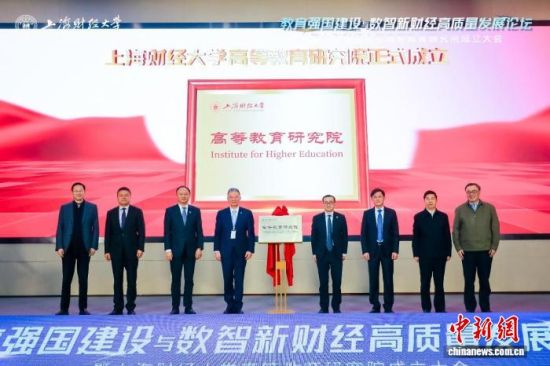
The Forum on Building a Strong Education Nation and the High-Quality Development of Digital-Intelligent New Finance & Economics, along with the inauguration ceremony for the Shanghai University of Finance and Economics (SUFE) Higher Education Research Institute, was held at SUFE.
The President of Shanghai University of Finance and Economics stated that the establishment of the SUFE Higher Education Research Institute (hereinafter referred to as the Institute) is a key strategic move by the university in response to the national strategy of building a strong education nation and based on its positioning of “Digital-Intelligent New Finance and Economics.” Leveraging the university’s deep expertise in areas like education finance and policy research, the Institute is positioned with “academics as the foundation, data as the engine, and policy as the application” at its core. It will focus on directions such as higher education reform and empirical research in education finance, aiming to build a bridge between academic research and policy practice, and to contribute replicable and scalable “SUFE solutions” to the construction of a strong education nation.
Attendees at the ceremony expressed their expectations. A Vice President of the China Association of Higher Education and an academician of the Chinese Academy of Sciences expressed hope that the Institute would become an important base for theoretical innovation in higher education, a think tank supporting reform and development, and a platform for academic exchange within the scholarly community. The Party Committee Secretary of the Central University of Finance and Economics stated a willingness to deepen collaboration with SUFE and other sister institutions to jointly inject momentum into high-quality educational development and the great cause of national rejuvenation. A Deputy Director of the Shanghai Municipal Education Commission expressed hope that the Institute would base its work on national strategies and Shanghai’s development needs, deepen distinctive research, and enhance research depth, adding that the Municipal Education Commission would continue to provide support for the Institute’s development.
The Party Committee Secretary of Shanghai University of Finance and Economics, who also serves as the Director of the Higher Education Research Institute, outlined the Institute’s future focus: providing decision-making consultation to serve the building of a strong education nation; expanding international cooperation to serve the opening-up of education; strengthening collaborative innovation to serve the development of digital finance and economics; and intensifying institutional research to serve the university’s internal governance. The Institute will establish a diverse and innovative operational mechanism. This includes forming research teams combining full-time and part-time researchers, organizing project teams oriented around specific problems; introducing a practice professor mechanism to promote the integration of industry, academia, research, and application; establishing a high-level expert committee to provide academic guidance; building an education think tank alliance mechanism to foster collaborative innovation; and setting up a special development fund to provide solid support for high-quality research.
During the keynote report session, several experts and scholars shared their insights. A senior professor in humanities and social sciences from Tsinghua University emphasized that the Institute needs to break through traditional research assumptions, strengthen theoretical innovation, closely align with the new requirements of finance and economics education and the new positioning of universities’ roles, and base its work on the new landscape where enterprises lead technological innovation to contribute unique research value. A lifetime professor from East China Normal University proposed that university scientific research should shift towards problem-oriented interdisciplinary integration and organized research, using institutional innovation to respond to the wave of new technological changes and serve the construction of the national innovation system.
The President of SUFE shared practical explorations around the “Digital-Intelligent New Finance and Economics Education System.” He pointed out that artificial intelligence is profoundly reshaping educational models, and that finance and economics universities need to shift towards competency and problem-oriented approaches. Using open education, scenario-driven methods, and the integration of industry and education as key levers, they should accelerate the construction of China’s own finance and economics knowledge system and create solutions that highlight SUFE’s distinctive characteristics.
At the first plenary meeting of the Institute’s Expert Committee held on the same day, participating experts suggested that the Institute should highlight its finance and economics characteristics, promote research paradigm innovation and the construction of a high-end think tank, create a recognizable academic brand, strengthen interdisciplinary team building, and form a strategy combining long-term and short-term research to chart a clear path for the Institute’s development.
Shanghai University of Finance and Economics stated that this conference established a high-level platform for academic exchange and collaborative innovation, and that the establishment of the Institute represents an important strategic layout for the university in the fields of higher education research and digital-intelligent new finance and economics. In the future, the Institute will gather top research talent from home and abroad, deepen interdisciplinary and inter-university cooperation, and strive to build a domestically leading academic highland, talent training base,