Chennai Vladivostok Corridor: Russia-India maritime trade corridor set to begin! Which sectors will benefit?
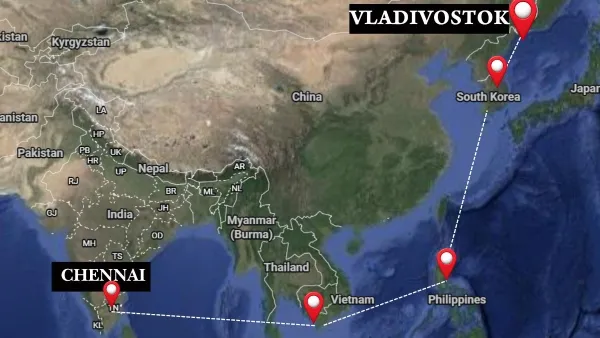
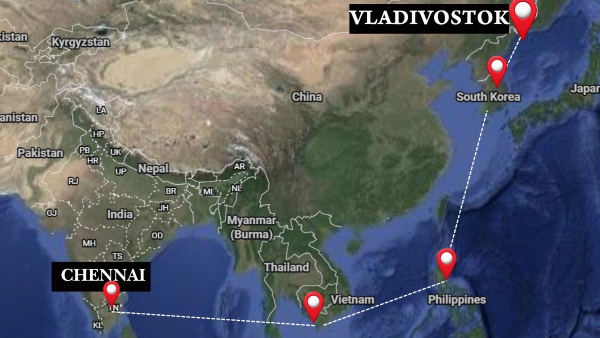
Chennai Vladivostok Corridor: Russia is currently working on developing the Chennai-Vladivostok maritime corridor, as the focus of India-Russia trade is now rapidly shifting towards South India. This new sea route will directly connect India’s southeastern coast with Russia’s Far East and provide importers-exporters with a much shorter and more effective logistics route.
Delivery Time to Drop from 40 to 24 Days
The biggest feature of this corridor is that it can reduce delivery time from over 40 days to about 24 days compared to existing long sea routes. This will provide major relief to exporters in warehousing and financial costs. Meanwhile, shipping and carrier companies will get the opportunity for a stable cargo flow and consistent income through a regular shipping line.
Why is This Route Important for India?
From a strategic point of view, the Chennai-Vladivostok corridor is extremely important. It was stated: “From a strategic perspective, this corridor is very necessary. We are working on starting it. It is not possible overnight, but implementing it is our responsibility.”
Which Sectors are in Focus?
It was further stated that Russia wants to make its trade with India more balanced, in which the role of South India is continuously increasing. Especially in areas like the modernization of Indian Railways, the energy sector, technology, and industry, South India has emerged as a strong partner.
Who Stands to Benefit?
For logistics operators, this maritime corridor could prove to be a strong and practical alternative. India’s southern states already possess a large industrial base, export clusters, and strong capabilities in engineering, pharma, and processing sectors.
Why is a Port-to-Port Corridor Successful?
A port-to-port corridor becomes easy and successful only when there are clear points of cargo generation at both ends and long-term regular contracts exist. Both these conditions appear to be met in the Chennai-Vladivostok route.
Already Strong Business Ties Between India and Russia
It was also noted that many Indian companies are already actively working with Russia. Particularly in sectors like pharmaceuticals, agriculture, healthcare, shipbuilding, and aircraft manufacturing, strong cooperation exists between the two countries.
A Better Alternative to Congested Routes
This new sea route could become an excellent alternative for those cargo flows that currently pass through long and congested routes. The shorter the route from sea to warehouse, the easier it will be to control prices in B2B contracts and ensure timely delivery.
Changing Demand for Logistics Services
As this corridor develops, the structure of demand for logistics services is also changing. The role of forwarding, port processing, insurance, and turnkey container services is increasing, as businesses now want “gate-to-gate” or fully guaranteed delivery.
What is Essential for Commercial Success
For the corridor to be commercially sustainable, projected cargo volume, a fixed schedule for ship arrivals and departures, and clear terms for return loading are extremely important. If this does not happen, tariff increases could negate the benefits gained from time savings.
A New Game-Changer for India-Russia Trade?
If the Chennai-Vladivostok corridor is brought into permanent and regular operation, it could become a new bilateral tool for reducing logistics risk and accelerating trade. Especially for companies that work with long production chains and expensive working capital, this corridor could prove to be a game-changer.
Chennai-Vladivostok maritime corridor
The Chennai-Vladivostok maritime corridor is a proposed shipping route connecting the Indian port of Chennai with Vladivostok, a major Russian port on the Pacific Ocean. The concept, revitalized during a 2019 India-Russia summit, aims to significantly reduce cargo transit time compared to the traditional route via the Suez Canal, enhancing bilateral trade and energy cooperation. Its history is rooted in Cold War-era trade links, which this modern initiative seeks to rebuild and expand for strategic and economic partnership in the Indo-Pacific region.
Chennai
Chennai, formerly known as Madras, is the capital of the Indian state of Tamil Nadu and a major cultural and economic hub on the Coromandel Coast. It was founded in 1639 as a British East India Company trading post, Fort St. George, which grew into a major colonial port city. Today, it is renowned for its classical arts, historic temples like the Kapaleeshwarar, and as a center for the Tamil film industry, Kollywood.
Vladivostok
Vladivostok is a major port city and the administrative center of Russia’s Primorsky Krai, located on the Pacific coast near the borders with China and North Korea. Founded as a military outpost in 1860, it later grew into a crucial naval base for the Russian Empire and the Soviet Union’s Pacific Fleet. Today, it serves as a key economic and cultural hub for the Russian Far East, known for its dramatic hills, the iconic Russky Island Bridge, and its role as the terminus of the Trans-Siberian Railway.
India
India is a vast South Asian nation with one of the world’s oldest continuous civilizations, dating back over 5,000 years to the Indus Valley. Its rich history is marked by the rise of major religions like Hinduism and Buddhism, successive empires, and British colonial rule before gaining independence in 1947. Today, it is a vibrant, diverse republic known for its profound cultural heritage, myriad languages, and iconic sites like the Taj Mahal.
Russia
Russia is a vast transcontinental nation with a rich and complex history, spanning over a millennium from the medieval Kievan Rus’ state, through the Tsardom of Russia and the Russian Empire, to the Soviet Union and its modern federal republic. Its cultural heritage is exemplified by iconic sites like the Kremlin and Red Square in Moscow, the historic center of Saint Petersburg, and numerous Orthodox churches, reflecting its deep historical, political, and artistic influences.
South India
South India is a culturally rich region of India, encompassing states like Tamil Nadu, Kerala, Karnataka, and Andhra Pradesh, known for its ancient Dravidian history and distinct languages. It is famed for its grand Hindu temple architecture, such as the Brihadeeswarar Temple in Thanjavur (built ~1010 CE) and the Meenakshi Temple in Madurai, which evolved over centuries from powerful dynasties like the Cholas, Cheras, and Vijayanagara Empire. The region also has a deep historical legacy in classical arts, spice trade, and unique traditions like Kathakali dance and Ayurveda.
Indian Railways
Indian Railways is a state-owned national railway system, founded in 1853 during British colonial rule with the first passenger train running between Bombay (Mumbai) and Thane. It has since grown into one of the world’s largest rail networks, spanning over 67,000 km and serving as a vital economic and social artery for modern India, connecting millions of people daily.
Far East
The term “Far East” is a historical Eurocentric designation for the easternmost regions of Asia, including countries like China, Japan, and Korea. It originated from the perspective of European explorers and traders during the Age of Exploration. Today, the term is often considered outdated, with more specific regional names like East Asia or Southeast Asia being preferred.