When discussing democracy as a system of good governance in Africa, its countries can be divided into three main blocs. The first bloc represents nations that have successfully established stable democratic experiences, such as South Africa, Botswana, Namibia, Ghana, and Senegal. The entrenchment of democracy in these countries is confirmed not only by the regular succession of electoral cycles but also by the ruling parties’ acknowledgment of their electoral losses and the rise of the opposition to the forefront, either as the governing power or controlling parliament, as happened in South Africa. This is a rare case on a continent still searching for itself when it comes to good governance.
The second bloc consists of those countries that use the formal procedures of democracy to cloak dictatorial situations that entrench the principle of one-man rule. In Cameroon, President Paul Biya won an eighth presidential term, approaching his 93rd year after ruling the country for 43 years. In Uganda, President Yoweri Museveni is preparing to run in elections, seeking his seventh presidential term.
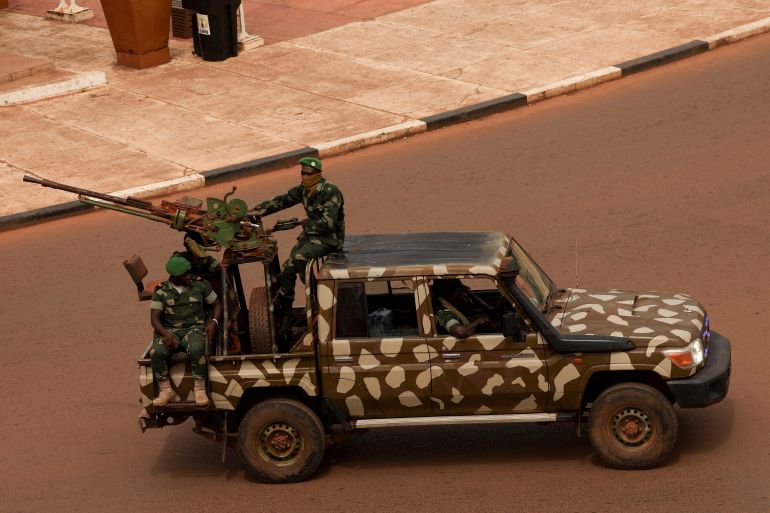
The third bloc is that which saw no need for any formal democratic procedures, where its military leadership decided the matter and seized power by force through a military coup. This is the bloc the analysis in this article will focus on.
Although the African Union sought to build a cohesive legislative framework to develop democratic experiences and combat unconstitutional changes of elected governments in its member states—through the adoption of the African Charter on Democracy, Elections and Governance in 2007—this rational endeavor did not prevent the successive occurrence of military coups and regime changes through violent military interventions.
Since 2007, the year the African Charter on Democracy was adopted, approximately 15 military moves have succeeded in seizing power, while other attempts have failed on a continent still searching for political stability and the foundations of good governance.
Following the wave of coups in the last five years, concentrated in Francophone countries, mostly from the Sahel region such as Mali, Guinea, Guinea-Bissau, Burkina Faso, Niger, Gabon, and Madagascar, the recurring question is: Why has this phenomenon not disappeared from the African continent? And why are military armies still deeply involved in political affairs in these countries, at a time when the world is witnessing a rapid shift towards values of freedom, justice, respect for human rights, and the peaceful transfer of power and wealth?
The quick answer some resort to, citing the weakness of penalties and sanctions imposed by the African Union’s Constitutive Act and Article 25 of the African Charter on Democracy—which suspends membership and bars coup perpetrators from participating in Union activities—is an incomplete and procedural answer at the same time.
The roots of this phenomenon go back to social, economic, and cultural reasons related to the failure of the nation-state after the colonial era, the extent of strategic confusion that befell the elite who inherited the colonizers in these countries, their weak deep awareness of the nature of the social structures that form the consciousness of African peoples, the inability to derive systems suitable for those social structures, and the failure to develop structures expressive of the reality of these societies and their culture extending into Africa’s ancient history.
From 2020 until now, eight military interventions have changed power in their countries. If we exclude Sudan due to its complex and compounded political crisis, common points can be observed in the remaining countries: Mali, Guinea, Burkina Faso, Niger, Gabon, Madagascar, and Guinea-Bissau, as follows:
All these countries are Francophone nations previously colonized by France. Although the colonial era theoretically ended since the 1960s, France maintained an influential military presence and an economic grip in these countries.
All these countries fall under the CFA franc zone, managed by France in 14 African countries, which accordingly requires these countries to deposit 50% of their foreign currency with it in exchange for guaranteeing a fixed exchange rate in these countries.
As a result of this unbalanced relationship, popular anger grew against the French presence in this region. This anger was directed towards national governments, viewed as guardians of French interests and working against the supreme national interests of their countries.
As popular anger peaked, armies intervened to seize power under national slogans seeking to restore national sovereignty and consolidate the national identity of the countries’ people away from domination and exploitation.
These military governments did not delay in expelling the French military presence. Within five years, French