Egyptian Foreign Minister emphasizes the necessity of a comprehensive political settlement in Libya under Libyan ownership.
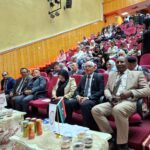
On the sidelines of the extraordinary session of the Council of Ministers of the Organization of Islamic Cooperation, held in Jeddah, Saudi Arabia, the Egyptian Foreign Minister met with his Tunisian counterpart.
During the meeting, the Egyptian Foreign Minister affirmed his country’s keenness to continue joint work with Tunisia, which contributes to enhancing the level of bilateral relations between the two countries in various fields.
Regarding regional developments, the meeting discussed a number of files of common interest, foremost of which are the developments of the situation in Libya. The Minister stressed the importance of combining regional and international efforts to reach a comprehensive political settlement with full Libyan ownership.
The Egyptian Foreign Minister clarified that the desired settlement should lead to holding presidential and parliamentary elections simultaneously as soon as possible, meeting the aspirations of the Libyan people for stability and building legitimate and unified institutions. He simultaneously emphasized the necessity of the withdrawal of all foreign forces, foreign fighters, and mercenaries from Libyan territory.
It was affirmed that achieving these goals would contribute to supporting security and stability in Libya and the region as a whole, reiterating full support for Libya’s unity and territorial integrity, and the rejection of any interventions affecting its national sovereignty.
The Egyptian Minister also stressed the importance of maintaining the regularity of meetings of the Libyan Neighboring Countries Mechanism, which includes Egypt, Tunisia, and Algeria, as an important framework for coordinating positions and exchanging views on supporting the Libyan political track, expressing his country’s aspiration to hold the next meeting of the mechanism at the earliest opportunity.
Organization of Islamic Cooperation
The Organization of Islamic Cooperation (OIC) is an international organization founded in 1969, following the burning of the Al-Aqsa Mosque in Jerusalem, with the primary aim of safeguarding the interests of the Muslim world. It is the second-largest intergovernmental organization after the UN, with 57 member states, and serves as a collective voice on issues like Palestinian rights, economic cooperation, and promoting Islamic solidarity.
Jeddah
Jeddah is a major port city on Saudi Arabia’s Red Sea coast, historically serving as the gateway for Muslim pilgrims traveling to Mecca. Its historic district, Al-Balad, features centuries-old coral stone houses and is a UNESCO World Heritage site, reflecting the city’s long-standing role as a vibrant trading and cultural hub. Today, it is a modern commercial center while actively preserving its unique architectural heritage.
Saudi Arabia
Saudi Arabia is a modern nation-state founded in 1932 by King Abdulaziz Al Saud, unifying the Arabian Peninsula’s central regions. It is the birthplace of Islam, home to the religion’s two holiest cities, Mecca and Medina, which have been central to Islamic history and pilgrimage for over 1,400 years. Today, it is a major global economic power due to its vast oil reserves and is undergoing significant social and economic transformation under its Vision 2030 initiative.
Egypt
Egypt, home to one of the world’s oldest civilizations, is famed for its iconic monuments like the Pyramids of Giza and the Great Sphinx, which date back over 4,500 years to the era of the pharaohs. Its rich history spans ancient kingdoms, Greco-Roman rule, and Islamic caliphates, all leaving a profound cultural and architectural legacy along the Nile River. Today, it remains a central destination for understanding early human development, religion, and statecraft.
Tunisia
Tunisia is a North African country with a rich history shaped by ancient civilizations, including the Phoenician city of Carthage and later Roman rule. Its cultural identity is a blend of Berber, Arab, Ottoman, and French influences, visible in its architecture, cuisine, and historic sites like the Medina of Tunis. Today, it is known as the birthplace of the Arab Spring and for its Mediterranean coastline and Saharan landscapes.
Libya
Libya is a North African country with a rich history rooted in ancient civilizations, most notably as the site of Phoenician, Greek, and Roman settlements along its Mediterranean coast. Its cultural landscape is profoundly shaped by its long history as part of various empires and its central role in the trans-Saharan trade routes. In the modern era, Libya gained independence in 1951 and experienced significant political changes throughout the 20th and 21st centuries.
Algeria
Algeria is a North African country with a rich history shaped by indigenous Berber cultures, successive empires like the Romans and Ottomans, and over a century of French colonial rule before gaining independence in 1962. Its cultural sites include the well-preserved Roman ruins of Timgad and Djémila, as well as the historic Casbah of Algiers, a UNESCO World Heritage site. The nation’s diverse heritage is also reflected in its traditional music, cuisine, and architecture, blending Arab, Berber, and Mediterranean influences.
Libyan Neighboring Countries Mechanism
The “Libyan Neighboring Countries Mechanism” is not a physical place or cultural site, but a diplomatic initiative. It refers to a forum established by Libya’s neighboring nations—Algeria, Chad, Egypt, Niger, Sudan, and Tunisia—to support political dialogue and stability in Libya following its 2011 civil war. The mechanism aims to coordinate regional efforts to mediate conflicts and promote a peaceful, Libyan-led political transition.