Elementary Education Revolution: Public Schools Implement Flexible MEME Curriculum and AI-Based Talent DNA Testing
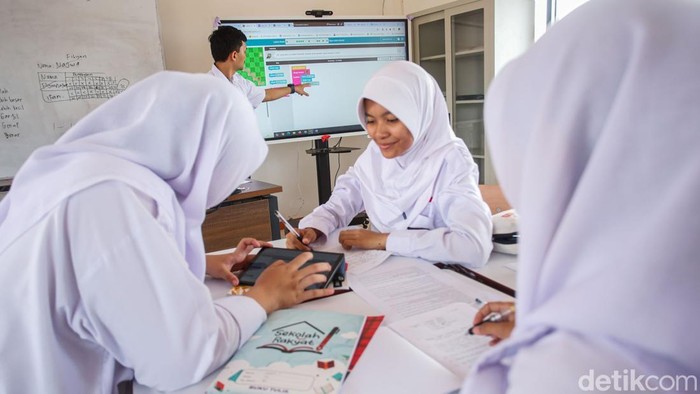
The Indonesian government has launched the Sekolah Rakyat program as a strategic initiative to realize the Asta Cita agenda, focusing on equal access to free education and the early preparation of equitable Human Resources (HR). This program emphasizes a flexible and innovative educational model oriented towards each student’s individual potential.
The core curriculum to be implemented is the Multi-Entry, Multi-Exit (MEME) model.
“So, the principle in this Sekolah Rakyat system is that the curriculum follows a multi-entry, multi-exit model, which provides flexibility for students to enter at any time and complete their studies according to their capabilities.”
Technology Integration for Potential Mapping
This flexible curriculum will be uniquely integrated with advanced technology. Sekolah Rakyat will use an AI-based DNA Talent Test to map students’ interests and talents from an early age. The results of this test will serve as the primary guide for teachers and principals in directing a student’s educational path, whether for continuing to the next level of study or entering the workforce.
To ensure readiness for implementing this potential-based education model, the government has equipped 2,500 Sekolah Rakyat teachers and principals through an intensive training program.
National Launch in South Kalimantan
The culmination of these preparations is the National Launch of Sekolah Rakyat, to be held on January 12, 2026 at the Balai Besar Pendidikan Pelatihan Kesejahteraan Sosial (BBPPKS) in Banjarbaru, South Kalimantan.
The launch event, carrying the theme “Cerdas Bersama, Tumbuh Setara” (“Smart Together, Grow Equally”), will feature a joint prayer, a theatrical performance by students, and a direct review of educational facilities. This launch affirms the position of Sekolah Rakyat as the government’s long-term strategy for strengthening national education.
Sekolah Rakyat
“Sekolah Rakyat” (People’s School) was the primary school system established across Indonesia following independence in 1945, replacing the Dutch colonial education structure. It was a key national project to provide basic literacy and citizenship education to the masses, embodying the spirit of the new republic and aiming to unify the diverse population through a common Indonesian language and curriculum.
Asta Cita
Asta Cita is an archaeological site in the Lazio region of Italy, identified as the ancient city of **Axia**. It was a significant settlement of the **Latin people** before being absorbed into the Roman Republic around the 4th century BCE. The remains include polygonal masonry walls and a temple podium, offering insight into pre-Roman Italic culture.
Multi-Entry, Multi-Exit (MEME)
“Multi-Entry, Multi-Exit (MEME)” is not a specific place or cultural site, but rather a term used in transportation and urban planning. It refers to a system, often in public transit or pedestrian networks, designed with multiple access and exit points to improve flow and accessibility. The concept has been applied historically in the design of efficient stations, markets, and modern transit hubs to reduce congestion.
AI-based DNA Talent Test
The “AI-based DNA Talent Test” is not a physical place or traditional cultural site, but a modern commercial service. It uses artificial intelligence to analyze genetic data, claiming to identify innate abilities or predispositions in individuals. Such services have emerged in the 21st century amid the growth of direct-to-consumer genetics, though they are often criticized by scientists for lacking robust evidence and promoting genetic determinism.
Balai Besar Pendidikan Pelatihan Kesejahteraan Sosial (BBPPKS)
The Balai Besar Pendidikan Pelatihan Kesejahteraan Sosial (BBPPKS) is a major training and education center in Indonesia focused on social welfare. It operates under the Ministry of Social Affairs and has a history of developing professional human resources to implement national social welfare programs. Its core mission is to enhance the competencies of social workers and other personnel to better serve vulnerable communities across the country.
Banjarbaru
Banjarbaru is a planned city in South Kalimantan, Indonesia, established in the late 1940s to replace Banjarmasin as the provincial capital. Its modern development was significantly shaped in the 1950s under President Sukarno’s vision, featuring wide boulevards and government complexes. Today, it serves as a major administrative and educational center for the region.
South Kalimantan
South Kalimantan is a province on the Indonesian island of Borneo, historically centered around the Banjar Sultanate which was established in the 16th century and became a significant Islamic and trading power. Today, it is known for its unique river-based culture along the Martapura and Barito rivers, its diamond and precious stone markets, and its vast peat swamp forests.
Cerdas Bersama, Tumbuh Setara
“Cerdas Bersama, Tumbuh Setara” (which translates to “Smart Together, Grow Equally”) is not a specific historical place or cultural site, but rather an Indonesian motto or slogan. It is commonly associated with educational initiatives and community programs in Indonesia that focus on collaborative learning and equitable development. The phrase reflects a modern societal goal rather than a location with a physical history.