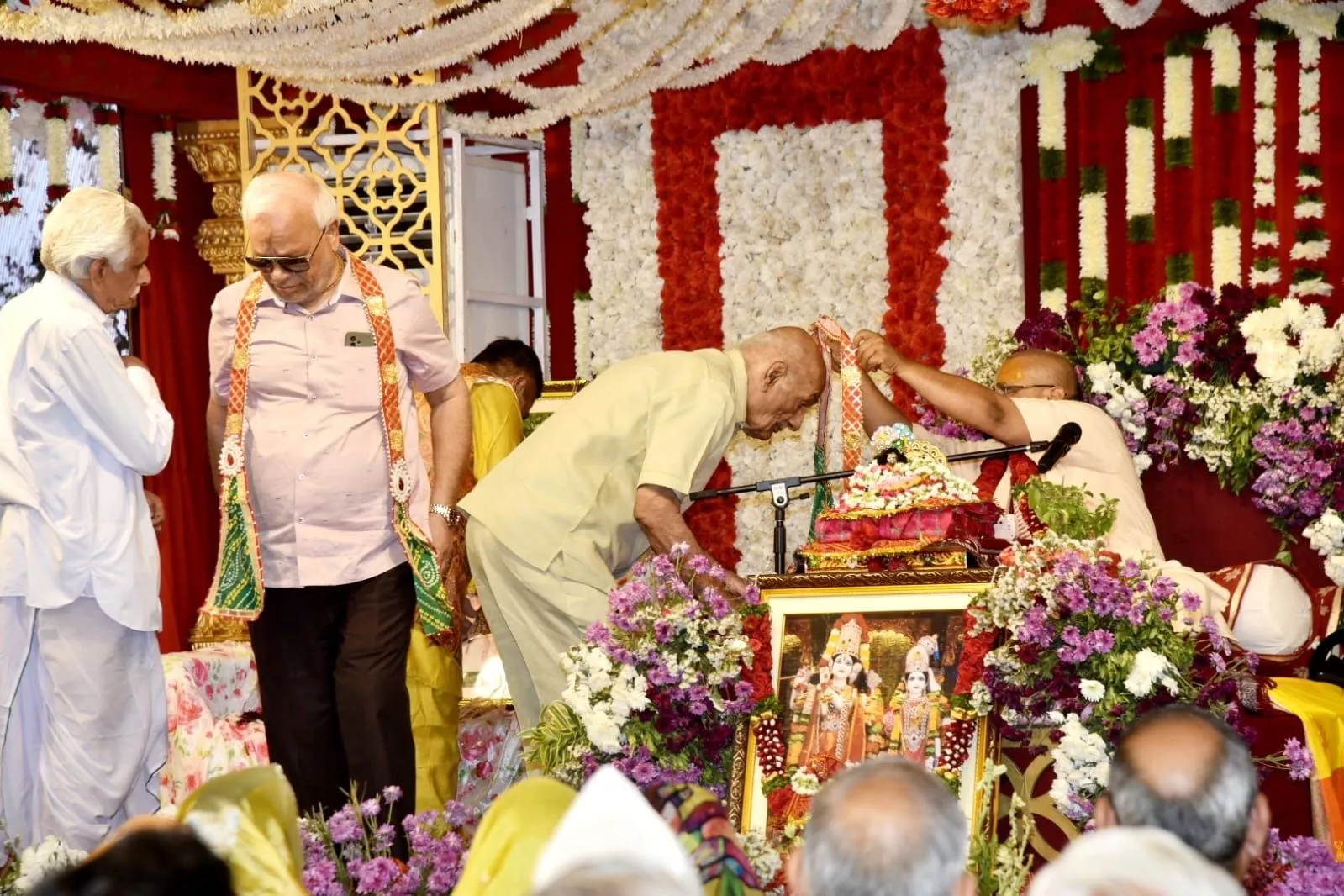
Listening to stories awakens devotion in the heart.
Hyderabad: The Shri Bhagavata Mahapurana is the form of the Lord who is affectionate to His devotees, and the Shri Bhagavad Gita is His voice. In the present age, there are also Gopis. In Kali Yuga, the term ‘Gopis’ refers to all devout listeners of Krishna’s stories, meaning all of us. Listening to the Katha by devotees awakens devotion in the heart and channels the grace of Shri Hari.
These sentiments were expressed on the fourth day of the Shri Bhagavata Katha, organized in memory of the late Jethmal and Ramkanwari Devi Tiwari (Balunda Wala) at the Shring Rishi Bhavan in Feelkhana, by the Kathavachak Tridandi Swami Bhakti Bhushan Bodhayan Maharaj. Maharaj said that the Lord still exists in the form of the Shri Bhagavata Mahapurana. One should absorb its essence into life and progress towards self-welfare.
Bodhayan Maharaj, referencing the story of Gajendra and the crocodile, said that in the end, Gajendra calls out to Lord Vishnu, and the Lord, with His Sudarshana Chakra, kills the crocodile and liberates Gajendra. This episode symbolizes true devotion and surrender. Citing other mythological examples, Maharaj said that even if everyone in the world abandons someone, the Lord, moved by devotion, protects the devotee.
Also Read…
The Spiritual Significance of Ekadashi for Nourishing the Soul
The Lord never abandons one who remembers Him. Similarly, Lord Rama also embraced Vibhishana who sought His refuge. No one is more compassionate and merciful than the Lord. We too should strive to attain His refuge.
Bodhayanji said that, like exclusive devotees of the Lord such as Meera and Prahlad, the goal of our life should be to embrace devotion to the Lord. Explaining the glory of the Ekadashi fast, he said it is a spiritual observance. It increases mental strength and inner power. Just as food is necessary for the body’s growth, similarly, Ekadashi is a great fast for strengthening the soul. Observing it yields the fruit of all fasts.
The true meaning of fasting is to remove the mind’s negativities and focus it on the Lord. Maharaj said we should not be satisfied with worldly objects but strive to attain the philosopher’s stone that is the Lord’s grace. Narrating the story of the Vamana avatar, he said when Vamana arrived at King Bali’s sacrificial site and asked for three paces of land as alms. King Bali, in the pride of his charity, promised to give three paces of land without thinking.
Thereafter, Vamana assumed a gigantic form and measured the entire Earth with one step and heaven with the second. When it was time to place the third step, Bali bowed his head. Vamana placed His foot on Bali’s head and granted him salvation. The story conveys that offering one’s all in devotion and charity pleases the Lord and grants liberation. Today’s Katha celebrated the joyous festival of Shri Krishna’s birth.
Shri Bhagavata Mahapurana
The **Shri Bhagavata Mahapurana** is not a physical place but one of Hinduism’s most important sacred texts, the *Bhagavata Purana*. Composed in Sanskrit, it is traditionally dated to around the 9th-10th century CE and focuses intensely on the devotion (*bhakti*) to Lord Vishnu, particularly through his avatar Krishna. Its most famous section, the *Bhagavad Gita*, and its narratives of Krishna’s life have profoundly shaped Hindu theology, arts, and culture for centuries.
Shri Bhagavad Gita
The **Shri Bhagavad Gita** is a 700-verse Hindu scripture that is part of the ancient Indian epic, the Mahabharata. It is presented as a dialogue between Prince Arjuna and his charioteer Lord Krishna, who serves as his spiritual guide, on a battlefield before the start of the Kurukshetra War. Composed in Sanskrit, its teachings on duty, righteousness, and devotion have made it a foundational and timeless philosophical text in Hinduism and beyond.
Shring Rishi Bhavan
“Shring Rishi Bhavan” is a spiritual and cultural center in Nepal, dedicated to the revered sage Shring Rishi, a figure from Hindu mythology associated with the Ramayana. It serves as a pilgrimage site and venue for religious ceremonies, built to honor the sage’s legacy and his connection to the local history and landscape.
Sudarshana Chakra
The Sudarshana Chakra is a divine spinning disc-like weapon wielded by the Hindu deity Vishnu, primarily as a symbol of the power to destroy evil and uphold cosmic order (dharma). According to Hindu scriptures like the Puranas, it was crafted by the architect-god Vishvakarma from the sun’s dust and given to Vishnu, most famously used to defeat demons and protect devotees. Today, it remains a powerful and ubiquitous icon in Hindu iconography, temples, and rituals, representing divine protection and the destruction of ignorance.
Ekadashi
“Ekadashi” is not a physical place or cultural site, but a significant observance in Hinduism. It refers to the eleventh day of each lunar fortnight in the Hindu calendar, a day dedicated to fasting, prayer, and spiritual practices. Its history is rooted in ancient Vedic and Puranic scriptures, where it is associated with Lord Vishnu and is believed to help in purifying the mind and body.
Vamana avatar
The Vamana avatar is a significant incarnation of the Hindu god Vishnu, depicted as a dwarf Brahmin. According to mythology, Vishnu took this form to subdue the benevolent but arrogant demon king Bali, ultimately restoring cosmic balance by reclaiming the three worlds. This story is primarily recounted in ancient texts like the Bhagavata Purana and symbolizes the triumph of humility and divine order over unchecked power.
King Bali
“King Bali” refers to the legendary benevolent asura (demon-king) from Hindu mythology, most famously associated with the story of Lord Vishnu’s Vamana avatar. According to the legend, Vishnu, in the form of a dwarf Brahmin, tricked the generous and powerful King Bali into granting him three paces of land, then expanded to cosmic size to reclaim the universe for the gods. While not a physical site, his story is a central theme in festivals like Onam in Kerala, which celebrates his annual return to his kingdom, symbolizing prosperity and righteousness.
Shri Krishna
Shri Krishna is a major deity in Hinduism, revered as the eighth avatar of Lord Vishnu and the central figure of the Bhagavad Gita. His life story, particularly his childhood in Vrindavan and his role in the epic Mahabharata, is celebrated in art, music, and festivals across India. While not a single physical site, major pilgrimage centers dedicated to him include the Krishna Janmasthan Temple in Mathura (his believed birthplace) and the Dwarkadhish Temple in Dwarka (his legendary kingdom).