The “Catalyst” operation conducted by INTERPOL and AFRIPOL authorities in six countries (Angola, Cameroon, Kenya, Namibia, Nigeria, South Sudan) between July and September 2025 resulted in 83 arrests and the freezing of approximately $260 million in cash and digital currencies.
Investigations in Angola and Kenya uncovered informal value transfer systems and digital asset service providers used to transfer gold profits to finance terrorism for recruitment and arming purposes.
Highlighting the increasing blurring of lines between organized crime and terrorism in sub-Saharan Africa, reports from Nigeria in October noted the arrest of prominent terrorist group members for managing cryptocurrency-based Ponzi schemes and cyber fraud operations targeting at least 17 countries worldwide, including Cameroon, Kenya, and Nigeria, to fund their terrorist activities.
In another INTERPOL-led operation involving 12 West African countries, authorities seized 17 weapons caches, dynamite sticks, and slow-burning fuses—materials used in both illegal gold mining and the manufacture of improvised explosive devices.
In Burkina Faso, two senior members of the terrorist group “Jama’at Nusrat al-Islam wal-Muslimin” (JNIM), wanted in connection with attacks that killed security personnel in Côte d’Ivoire in 2020, were arrested.
Terrorism and Organized Crime in Sub-Saharan Africa
Security dynamics and illicit economic activities in many African countries indicate a strong link between terrorism and cross-border organized crime in sub-Saharan Africa, where criminal activities such as drug and weapons trafficking provide funding and operational support to terrorist groups.
Recent statistics show that while the region accounted for over 50% of global terrorism fatalities in 2024, this aligns with the steady expansion of organized crime markets since 2019.
Crime trends in the region reveal that financial crimes, human trafficking, crimes involving the exploitation of non-renewable resources, counterfeit goods, and arms trafficking were the most prevalent until late 2025.
Furthermore, 92.5% of African countries show low resilience to these crimes. For example, the 2023 Organized Crime Index showed Burkina Faso scoring 8.5 (out of 10), Mali 7.9, and Niger 5.93. In Kenya, scores exceed the average in markets such as human trafficking (8.0 out of 10), arms trafficking (7.5), and cocaine trade (6.0).
These dynamics are evident in the Sahel region, where groups like “Jama’at Nusrat al-Islam wal-Muslimin” (al-Qaeda affiliated) and the “Islamic State in the Greater Sahara” (ISIS-affiliated) in Mali, Burkina Faso, and Niger extort populations and businesses, exploit illicit economies such as drug trafficking by imposing levies on shipments, and engage in kidnapping for ransom, cattle rustling, and illegal mining of precious minerals to purchase weapons and pay fighters amidst governance and security challenges in their areas of influence.
The growing relationship between organized crime and terrorism creates a situation where natural wealth undermines state effectiveness, with terrorist and armed groups establishing “parallel states” in remote mining areas, providing a distorted form of security to miners in exchange for “levies,” thereby replacing government authority.
Gold for Weapons
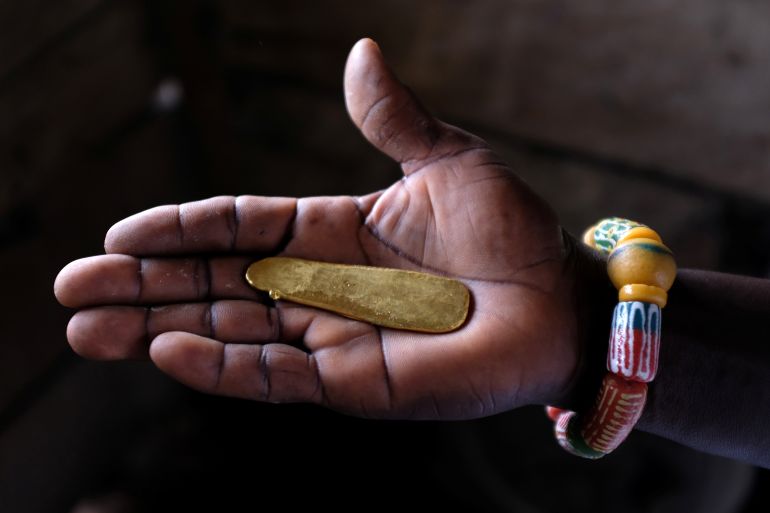
Traditional mining generates approximately $95 billion across Africa, with a significant portion of its proceeds being diverted by branches of al-Qaeda and the Islamic State in the Sahel region to rebuild their operational capabilities after losses in the Middle East. They trade illegally mined gold directly for weapons or sell it on the black market to finance arms purchases, exploiting the boom in artisanal mining amid high gold prices.
The “gold-for-weapons” phenomenon is concentrated in areas of Burkina Faso, Mali, and Niger, where informal gold deposits are widespread. Criminal networks finance extraction operations, drive out competitors, and launder mineral proceeds through hard-to-trace exports.
For instance, “Jama’at Nusrat al-Islam wal-Muslimin” controls traditional gold mines in southern Burkina Faso and western Mali, taxing miners in exchange for “protection.”
Additionally, bandits in northwestern Nigeria extract gold worth 300 million naira ($196,000) weekly, bartering it (between 33 and 39 grams of gold per AK-47 rifle) with their partners in hubs like “Bobo-Dioulasso” and “Ouagadougou” (