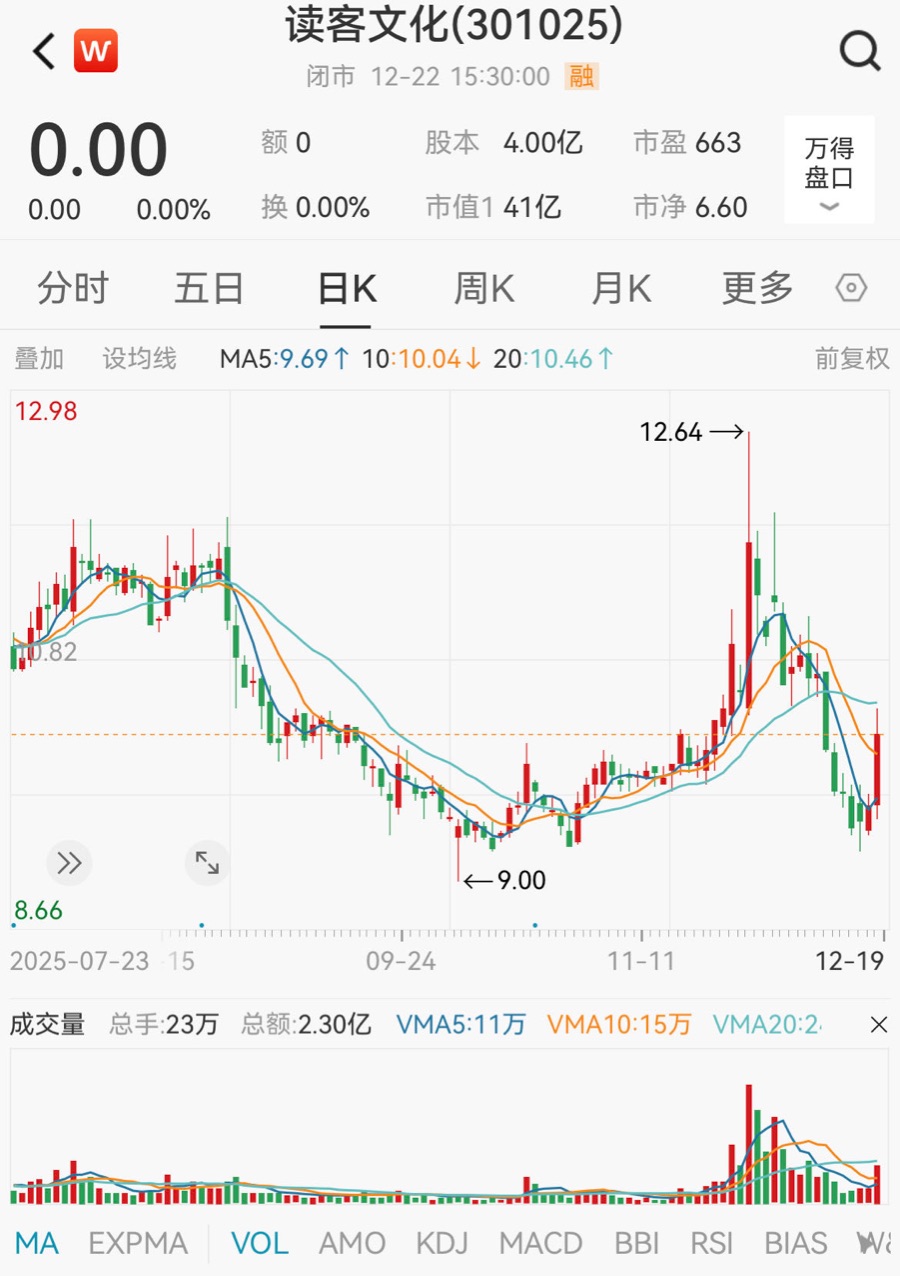
After the market closed on December 22, Dook Media (301025.SZ) announced that the company received a notice from its controlling shareholders and actual controllers, Hua Nan and Hua Shan, who are planning matters related to a change in the company’s control. To ensure fair information disclosure and avoid abnormal stock price fluctuations, the company’s shares have been suspended from trading since the market opened on December 22. The suspension is expected to last no more than 2 trading days. The specific plan for this transaction is still being formulated, and no formal agreement has been signed yet, so there is uncertainty.
Public information shows that Dook Media was established in 2006 with investment from Hua & Hua, founded by brothers Hua Nan and Hua Shan. Its main business is book planning and distribution, and it was listed on the ChiNext board in 2021. As of the end of the third quarter of 2025, Hua Nan directly held approximately 41.03% of Dook Media’s shares, while Hua Shan held 29.58%. The two are acting in concert and are the company’s actual controllers.
It is worth noting that the brothers Hua Nan and Hua Shan, who are planning this change of control, are better known as the founders of the well-known marketing consulting firm “Hua & Hua.” Not long ago, they became the focus of public attention due to their deep involvement in an online debate.
In September, well-known entrepreneur Luo Yonghao criticized Xibei Restaurant on Weibo, stating it was “almost entirely pre-made dishes yet so expensive,” pushing Xibei into the spotlight. As Xibei’s long-term brand strategy consulting partner, Hua Shan, founder of Hua & Hua, immediately posted on social media to support the client, repeatedly describing Luo Yonghao as a “malicious online commentator” and expressing support for Xibei founder Jia Guolong to “stand firm.”
The dispute escalated quickly. On September 14, Luo Yonghao publicly called out Hua Shan during a live stream, demanding an apology and stating, “If other companies use Hua & Hua in the future, people might start wondering if that brand has intellectual issues.” Facing pressure, the situation reversed rapidly the next day. On September 15, Luo Yonghao posted: “The boss of Hua & Hua has apologized to me, and this matter can be put to rest.” This public discussion about the right to know regarding “pre-made dishes” unexpectedly brought the behind-the-scenes brand consulting firm to the forefront and sparked debate about Hua & Hua’s client relationship management.
Regarding whether the planned change of control is related to the recent public attention on the actual controllers, a staff member who answered the phone stated, the specific reason for the planned change of control is not yet clear, and it is recommended to pay attention to subsequent announcements.
It is noteworthy that the brothers Hua Nan and Hua Shan replicated Hua & Hua’s “super symbol” strategy at Dook Media, creating bestsellers such as “The Tibet Code” and “Half-Hour Comic Series,” which once led the market. However, this industrialized publishing model has now shown its limitations.
Financial reports show that Dook Media’s revenue reached 519 million yuan in the year of its IPO in 2021, but then began to decline. In 2024, revenue fell 6.61% year-on-year to 406 million yuan. For the first three quarters of 2025, revenue further decreased to 257 million yuan, with the year-on-year decline widening to 12.19%.
The performance of net profit attributable to the parent company’s owners is even more dismal. It peaked at 67.2545 million yuan in 2021, turned into a loss of 3.2825 million yuan in 2023. For the first three quarters of 2025, the company’s net profit attributable to the parent company’s owners was 6.521 million yuan, while the net profit attributable to the parent company’s owners after deducting non-recurring gains and losses was only 310,700 yuan, a year-on-year decrease of 95.09%, indicating that profitability is almost exhausted.
Amid this trend, Dook Media’s executives and shareholders have been continuously reducing their holdings and cashing out. Earlier this year, Ningbo Dook Enterprise Management Partnership, an entity acting in concert with controlling shareholders and actual controllers Hua Nan and Hua Shan, announced a reduction in its holdings. Within three months, it sold 11.19 million shares through centralized bidding and block trades, cashing out approximately 114 million yuan. In early November, Ningbo Dook Enterprise Management Partnership sold another 4.108 million shares through an inquiry transfer, cashing out 34.3855 million yuan. Combined with previous reductions by former core executive Zhu Xiaoxiao
Dook Media
If you have more context or can confirm the correct spelling, I’d be happy to help research it for you. Alternatively, if you are referring to a media company, I could provide a summary based on that.
ChiNext board
Hua & Hua
Xibei Restaurant
The Tibet Code
Half-Hour Comic Series
Ningbo Dook Enterprise Management Partnership
Zhu Xiaoxiao
To provide an accurate summary, could you please double-check the spelling or provide additional context about this name?