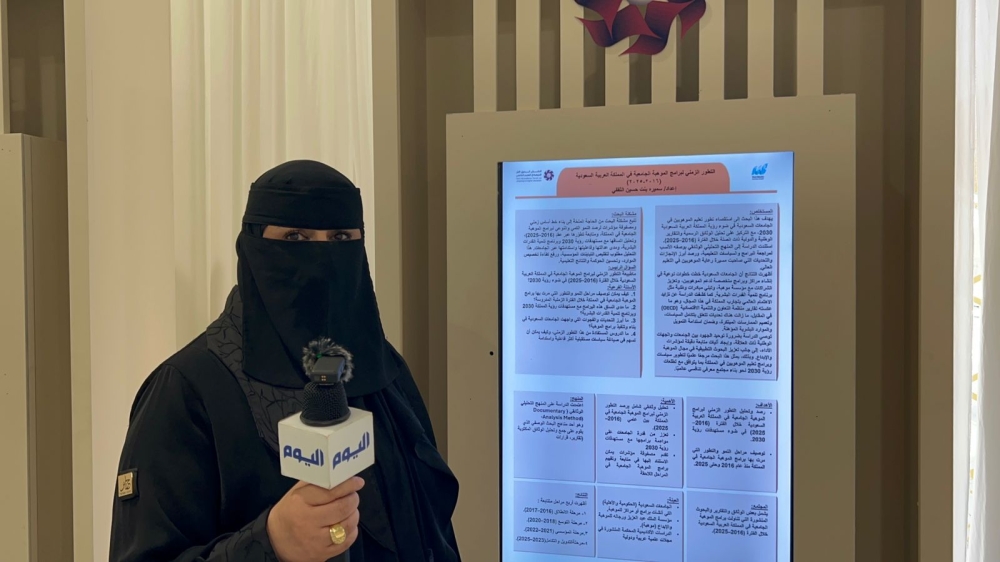
80% of university students rely on artificial intelligence, prompting educational authorities to intervene with ethical guidelines.
Recent academic studies have revealed that more than 80% of university students in Saudi Arabia directly rely on artificial intelligence technologies to complete their assignments. This has prompted the Ministry of Education to urgently intervene to fortify the educational field by integrating AI ethics into the core of the curriculum. The goal is to ensure a flexible learning environment that protects academic integrity and considers individual differences.
Implementing the AI Curriculum in Education
This official move came in response to a new reality imposed by technology. The official spokesperson for the Ministry of Education confirmed that the National Center for Curriculum began implementing an AI course two years ago at the secondary level for the computer science and engineering track. In the current academic year, an “Introduction to Artificial Intelligence” course has been included as an optional subject in the general track for third-year secondary students.
She added that AI concepts have been integrated into digital skills and technology courses, either as an independent unit, separate lessons, or by incorporating them into the context of lessons. They have also been included in student activities across all educational stages to provide students with practical training on AI tools and technologies.
Developing Research and Innovation Skills
She emphasized that educational plans have not merely introduced AI as content but have focused on developing critical thinking, research, and innovation skills. They aim to motivate students to use AI as a problem-solving tool, while simultaneously enhancing concepts of AI ethics. This is being done in cooperation with the Saudi Data and AI Authority (SDAIA), which has worked on reviewing and updating ethical principles related to this field.
To enable teachers to deliver these courses effectively, she pointed to the preparation of specialized training packages and the implementation of professional development programs in partnership with the National Institute for Educational Professional Development. Additionally, supporting tools are being provided via the “My School” platform to aid in applying these concepts in classrooms.
She confirmed that the Ministry of Education is working to provide a flexible learning environment that considers individual differences among students and supports their readiness for the future job market. This enhances the Kingdom’s position as a regional center for technology and innovation, driven by an ambitious vision led by AI from within Saudi classrooms.
Risks of Total Reliance on Artificial Intelligence
Meanwhile, a specialist in the economics of education sounded the alarm, citing research figures that revealed the vast majority of students now see AI as their primary refuge for completing academic assignments.
He explained that educational institutions are undergoing a radical transformation due to these technologies. Results from recent studies in Saudi universities show that over 80% of students have experienced a direct impact of AI on solving homework assignments. A significant proportion of them considered the experience positive, despite warnings about declining research and analytical skills.
Results of Various Studies
He pointed to a recent study which
Saudi Arabia
Saudi Arabia is a modern nation-state founded in 1932 by King Abdulaziz Al Saud, unifying the Arabian Peninsula’s central regions. It is the birthplace of Islam, home to the religion’s two holiest cities, Mecca and Medina, which have been spiritual and pilgrimage centers for over 1,400 years. Today, it is a major global economic power due to its vast oil reserves and is undergoing significant social and economic transformation under its Vision 2030 initiative.
Ministry of Education
The Ministry of Education is a government department responsible for national education policy, curriculum standards, and the administration of public schools. Its history is tied to the development of modern state systems, with many countries establishing formal ministries in the 19th or early 20th centuries to centralize and standardize education for all citizens. The specific founding date and historical milestones vary by nation, but its core mission universally focuses on shaping the national education system.
National Center for Curriculum
The National Center for Curriculum is a specialized institution in Saudi Arabia, established to develop and modernize educational curricula in line with national goals and global advancements. It plays a central role in shaping the educational content for K-12 schools, ensuring it aligns with the Kingdom’s Vision 2030 for a knowledge-based society.
Saudi Data and AI Authority (SDAIA)
The Saudi Data and AI Authority (SDAIA) is a government body established in 2019 by royal decree to lead Saudi Arabia’s national strategy in data and artificial intelligence. It oversees the National Data Management Office and the National Center for AI, aiming to drive the digital transformation goals of Vision 2030 by maximizing the value of data and fostering an AI-driven economy.
National Institute for Educational Professional Development
The National Institute for Educational Professional Development (NIEPD) is a key institution in Romania dedicated to the continuous training and professional development of teachers and educational staff. It was established to modernize the national education system, with its origins and structure shaped by post-1990 reforms aimed at aligning Romanian education with European standards. Its core mission is to design and implement professional development programs, certifications, and educational policies to enhance teaching quality across the country.
My School
“My School” refers to the educational institution an individual attends, so its specific history varies widely. Generally, schools are established to provide formal education and often reflect the educational philosophy and community needs of their founding era. Their history typically includes milestones like construction, expansions, and the evolution of their academic programs over time.
Kingdom
The term “Kingdom” is too broad for a specific summary, as it could refer to many historical or fictional realms. If referring to a general historical kingdom, it typically denotes a sovereign territory ruled by a monarch, with a history often involving dynastic rule, territorial expansion, and cultural development unique to its region and era. For a more precise summary, a specific example like the Kingdom of France, the Kingdom of Siam, or the fictional Kingdom of Gondor would be needed.