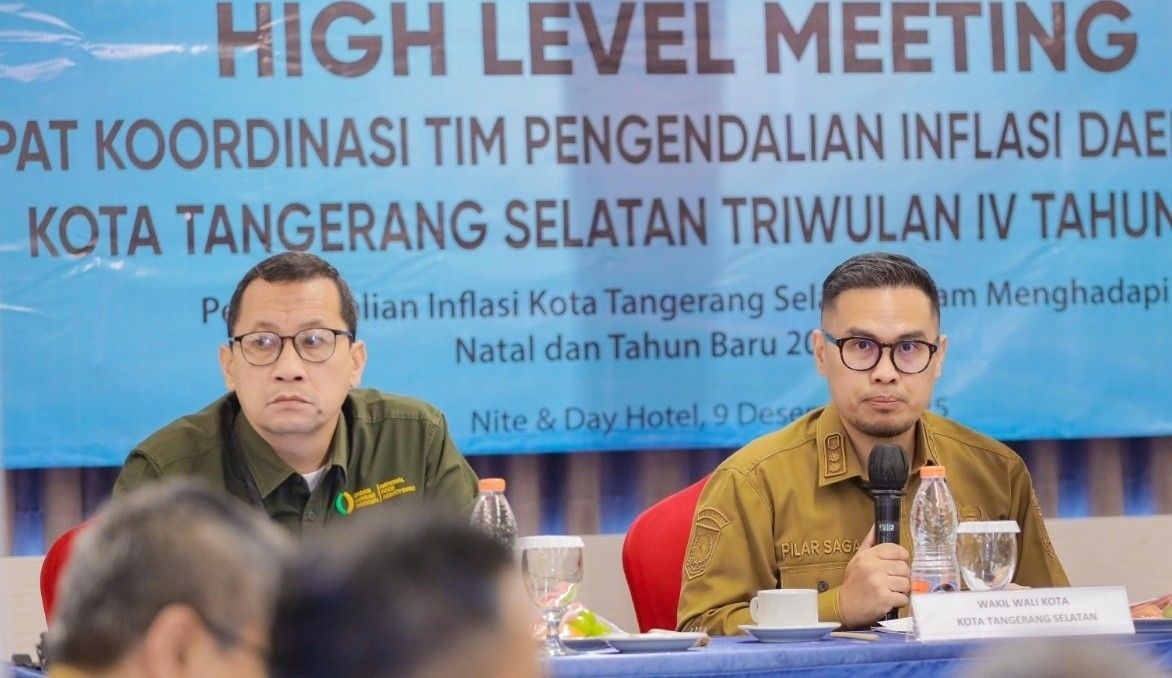
SOUTH TANGERANG CITY – The South Tangerang City Government has prepared a series of quick and measured steps to maintain food price stability ahead of the 2025 Christmas and 2026 New Year celebrations.
This was stated by the Deputy Mayor while opening the Regional Inflation Control Coordination Meeting in North Serpong.
According to the official, the year-end holiday period is always followed by a surge in demand for food supplies. Without prepared stock and smooth distribution, this situation can trigger price increases that directly impact people’s purchasing power.
“Currently, the South Tangerang City Government itself continues to strive to provide several forms of assistance related to social security for the community, and also cooperates with other institutions on how to boost public purchasing power,” the official said.
Therefore, the official requested all parties focus on implementing inflation control policies based on four strategies. First, ensuring price affordability through intensive market monitoring and the readiness of market operations and targeted cheap food exhibitions.
Second, guaranteeing the availability of strategic food supplies until the end of January 2026 is sufficient, including strengthening the effectiveness of the RW Mantap program as part of community food self-sufficiency, and establishing inter-regional coordination to ensure supply is not disrupted.
Securing Smooth Logistics Distribution
Third, securing smooth logistics distribution, especially during the year-end holidays when traffic congestion often occurs. The official reminded that South Tangerang is highly dependent on supplies from other regions such as Pandeglang, Serang, to Jakarta, so distribution routes must remain maintained.
“Then the fourth is effective communication. We need to provide accurate information and focus on socializing stock availability and prices, to dampen inflation expectations triggered by issues or rumors on social media,” explained the official.
It was emphasized that inflation control efforts are not only the government’s responsibility but require collaboration from all stakeholders, including law enforcement officials, business actors, and statistical agencies.
The official expressed hope that these various steps would be able to provide a sense of security for the community. Both economically and in terms of safety, so that the year-end celebrations in South Tangerang can proceed comfortably and joyfully.
“Let us prove that the city government is capable of providing a sense of security to the community, both in terms of safety and price stability, so that the Christmas and New Year celebrations can proceed solemnly, joyfully, and prosperously,” concluded the official.
JAKARTA – The Regent of Tangerang, together with the Tangerang Regency Indonesian Red Cross officials, handed over a humanitarian donation of IDR 1.5 billion to assist victims. The aid originated from the extended family of Tangerang Regency civil servants, the Family Welfare Movement, and the Association of Indonesian Village Governments. The handover was conducted at the Indonesian Red Cross Headquarters in Jakarta and was received directly by the Chairman of the Indonesian Red Cross.
On this occasion, the Regent explained that this donation drive was carried out as a form of concern from the people of Tangerang Regency for their brothers and sisters in Aceh, Medan, Padang, and other areas affected by the disaster.
“In accordance with the guidance from the Chairman of the Indonesian Red Cross, we together with the Red Cross, civil servants, the Family Welfare Movement, and the Association of Indonesian Village Governments have collected aid to ease the burden of our brothers and sisters in Sumatra. Today we bring the mandate of the extended family of Tangerang Regency, the first phase of aid amounting to IDR 1.5 billion,” said the Regent.
According to the official, the aid provided will continue. The Tangerang Regency Government has coordinated with the Indonesian Red Cross regarding the possibility of distributing the next phase of aid according to needs in the field. In addition to financial aid, the Tangerang Regency Government has also sent a number of Red Cross personnel to assist with emergency disaster management in several affected locations.
“This is a manifestation of togetherness and humanitarian concern. We hope conditions in Aceh, Padang, and Medan recover soon and the community can rise again. We will continue to strive for aid, both in the form of