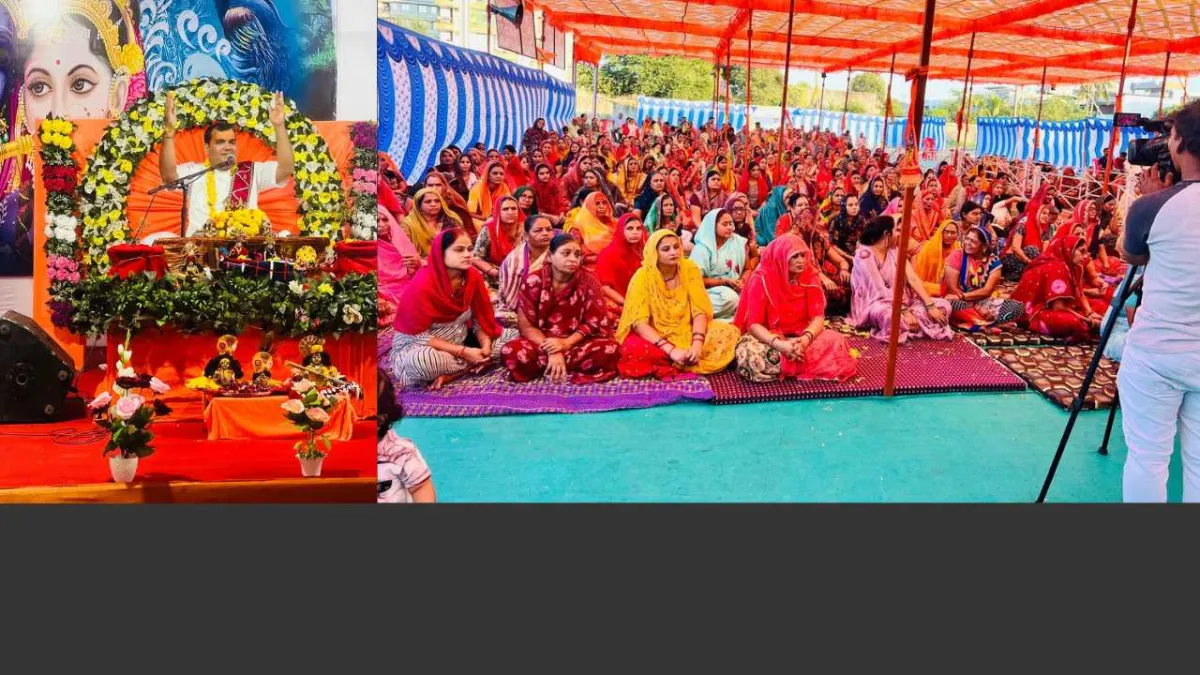
Maharaj Gives Message to Stay Away from the Evils of Kali Yuga
On the second day of the seven-day Shrimad Bhagavat Katha organized in Deladava village in front of South Indian School by Shri Radhe Mitra Mandal, Deladava Village (Dindoli) Surat, Katha Vyas Sandeepji Maharaj gave devotees the message to stay away from the dwelling places of Kali Yuga. He said that only through Satsang can a person’s true welfare be possible.
From the Vyas Peeth, Maharaj described the dwelling places of Kali Yuga in detail, explaining that gambling, alcohol, adultery, violence, and gold earned through dishonesty are where Kali Yuga resides. He called upon all devotees to stay away from these evils and walk the path of righteousness.
Maharaj also highlighted the serious consequences of insulting saints, saying that a person who insults saints can never attain peace and must suffer a terrible curse like King Parikshit. Explaining the essence of the Shrimad Bhagavat Katha, he said this scripture teaches us to treat others as we wish to be treated ourselves. He emphasized that it is necessary not only to listen to the Katha but to implement it in one’s life; only then does human life become meaningful.
During the Katha, Sandeepji Maharaj also gave an emotional description of the Bhishma Stuti. He explained that Bhishma Pitamah married his daughter, in the form of his intellect, to Lord Shri Krishna. He lay on a bed of arrows for six months and gave up his life when the sun entered the northern hemisphere.
Maharaj mentioned the dialogue between Lord Shri Krishna and Aunt Kunti, explaining that when the Lord asked Kunti to ask for something, she asked for sorrow. Kunti said that when sorrow comes, she would remember the Lord repeatedly, whereas with happiness she might forget Him. Following this, the story of Yudhishthir and the Pandavas’ ascent to heaven and the coronation of King Parikshit was also described.
Sandeepji Maharaj explained the destructive effects of bad company, saying that the company of bad people should be abandoned immediately, as such association can never be beneficial. He advised devotees to stay away from bad friends and bad habits. At the end of the Katha, Maharaj said that only through the sight of saints, Satsang, and service does discernment awaken, and devotion to God is not possible without faith, trust, and surrender.
Kali Yuga
“Kali Yuga” is not a physical place or cultural site, but a concept in Hindu cosmology. It is the fourth and current age in a cyclical world cycle, characterized as an era of conflict, spiritual decline, and strife. According to tradition, it began over 5,000 years ago following the death of Lord Krishna and is said to last for 432,000 years.
Shrimad Bhagavat Katha
“Shrimad Bhagavat Katha” is not a physical place but a revered Hindu scripture, the *Bhagavata Purana*, and the tradition of its ceremonial recitation and discourse. It primarily narrates the stories and teachings of Lord Vishnu, particularly in his incarnation as Krishna, emphasizing devotion (*bhakti*). The text, composed in Sanskrit centuries ago, is historically central to the Bhakti movement and is often expounded upon in multi-day religious gatherings to impart spiritual wisdom.
Vyas Peeth
Vyas Peeth is a revered Hindu pilgrimage site located in Tanahun District, Nepal, believed to be the hermitage where the sage Vyasa (Ved Vyas) composed the epic Mahabharata. It is considered a sacred spot for meditation and learning, attracting devotees and scholars. According to legend, the site dates back thousands of years to the Dvapara Yuga, directly linking it to this foundational period of Hindu scripture.
King Parikshit
King Parikshit is a legendary figure in Hindu tradition, best known as the Kuru king and grandson of Arjuna from the epic Mahabharata. While not a physical site, his name is associated with the ancient city of Hastinapur (in present-day Uttar Pradesh, India), where he is said to have ruled after the Kurukshetra war. According to scriptures, his death from a snake bite led to his son Janamejaya performing a great serpent sacrifice.
Bhishma Stuti
“Bhishma Stuti” refers to a famous hymn of praise dedicated to Lord Krishna, recited by the great warrior Bhishma from the Indian epic Mahabharata. It is found in the **Bhishma Parva** of the text, where Bhishma, lying on a bed of arrows, extols Krishna’s divine virtues and supreme nature just before his death. This stuti is a significant philosophical and devotional passage, highlighting Krishna’s role as the ultimate protector and the embodiment of divinity.
Bhishma Pitamah
“Bhishma Pitamah” is not a physical place but a revered character from the ancient Indian epic, the *Mahabharata*. He was a granduncle to both the Pandavas and Kauravas, known for his unwavering vow of celibacy and loyalty, and his legendary role as a commander in the Kurukshetra War. His name is synonymous with sacrifice, duty, and immense wisdom in Hindu tradition.
Lord Shri Krishna
Lord Shri Krishna is a central and revered deity in Hinduism, worshipped as the eighth avatar of Lord Vishnu. His life and teachings, primarily chronicled in the ancient Indian epic the Mahabharata and the Bhagavata Purana, are set in the region of Mathura, Vrindavan, and Dwarka in present-day India. He is celebrated for his divine childhood pastimes, his role as the charioteer and guide in the Bhagavad Gita, and his profound philosophical discourse on duty, righteousness, and devotion.
Aunt Kunti
“Aunt Kunti” is a revered local shrine in the town of Bantul, Yogyakarta, Indonesia, dedicated to a legendary Javanese spiritual figure believed to be a guardian spirit of the area. According to local folklore, she was a wise and protective woman, often associated with the spiritual history of the Parangtritis coast and the ancient Mataram Kingdom. The site remains a popular destination for pilgrims seeking blessings and is an example of the syncretism of Javanese Kejawen beliefs with broader Indonesian Islamic culture.