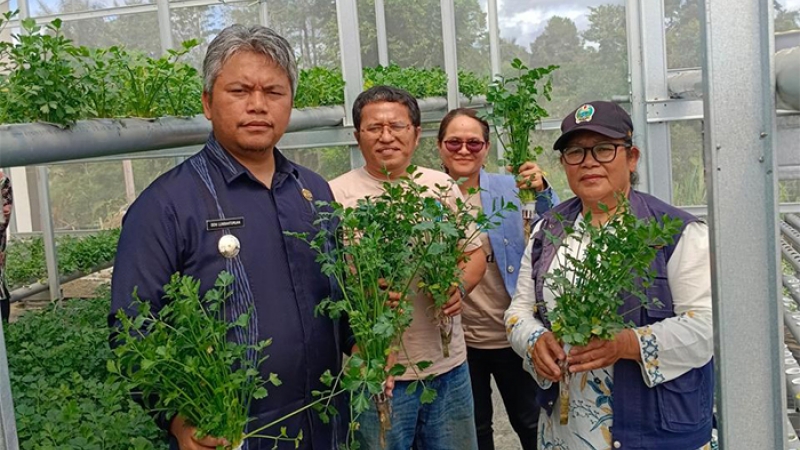
The Deputy Regent of North Tapanuli, accompanied by the Head of the Agriculture Service, the Head of the Manpower Service, the Pagaran District Head, and a representative from the Del Institute of Technology, opened the Training and First Harvest of Celery Plants in Banua Luhu Village, Pagaran District.
A Green House utilizing vertical hydroponic technology based on the Internet of Things (IoT) and solar energy was also inaugurated.
The 10×10 meter green house is designed to operate autonomously, from nutrient regulation to plant humidity monitoring.
With a capacity of 1,800 planting holes, this system can produce a harvest of up to 230 kilograms of celery, with a potential average yield of 130 grams per pot.
The Deputy Regent emphasized the importance of technology adoption for farmers. Farmers are encouraged to adopt such technology. With IoT-based hydroponic and solar energy technology, farming work will become easier, more efficient, and offer better economic prospects.
“There is no longer any reason for the younger generation to be reluctant to become farmers or to have to migrate to become factory workers outside the region,” said the Deputy Regent.
It was also emphasized that agricultural modernization is a crucial strategy to address climate challenges.
The green house is designed as a prototype for modern agriculture, as this kind of technology can withstand prolonged drought or rainy seasons and can serve as an example that can be replicated by other farmer groups.
This technology also has the potential to provide accurate data useful for future agricultural research and development.
The Deputy Regent added that cross-sector collaboration is essential to expand the positive impact of modern agricultural technology.
“I hope the Village-Owned Enterprise can adopt this technology and establish sustainable cooperation with the Del Institute of Technology, so that its benefits can be felt more widely by the community,” they stated.
The agenda continued with the signing of the Handover Report for the green house and its supporting equipment to the Roma Sejahtera Tani Farmer Group.
This handover process was then marked by a ribbon-cutting ceremony as a symbol of the inauguration of the technology-based green house.