Eighty Years After the War: A 93-Year-Old Third-Generation Japanese American’s Struggle—Teenage Internment, Repatriation, and the Enduring Question, “Who Am I?”
In the summer of 2025, Japan marks 80 years since the end of World War II. To avoid repeating the same mistakes, the guiding lights are the profound words of war survivors. We should listen carefully to each of their messages once again.
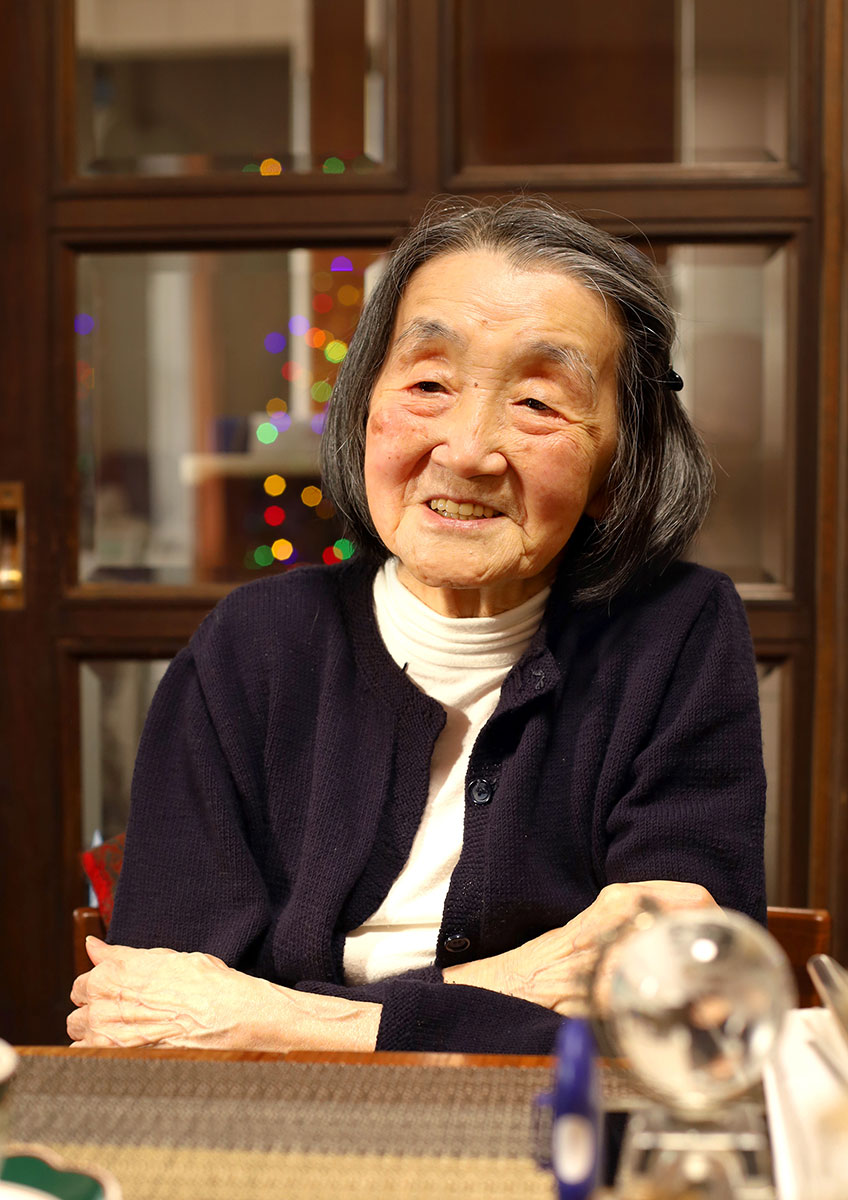
Reflecting on the struggles of adapting to a different culture, she recalled, “At my school in Ibaraki, I was scolded by seniors for not bowing properly.” At the time, she missed Canadian food so much that she sometimes ate butter by the chunk—here at her home in Tokyo.
“Even now, I’m not sure whether I’m Canadian or Japanese.” A third-generation Japanese-Canadian, she was born in Canada during World War II and held citizenship, yet was interned as an “enemy alien.” After the war, she was deported to Japan. She quietly recounts how her sense of identity was overturned in her early teens.
She was born in Vancouver, the largest city in British Columbia. “At Christmas, houses along the street would compete to decorate their trees.”
In elementary school, she shared a desk with white children and roller-skated down the hilly streets of her neighborhood. Her father, who worked for a lumber company, was a pitcher for the legendary Japanese-Canadian baseball team, the Vancouver Asahi, and also played saxophone in a band—a sociable man.
A Sudden Change in Status… Relocated Inland
World War II
World War II was a global conflict that lasted from 1939 to 1945, involving most of the world’s nations. It was primarily fought between the Axis powers (Germany, Italy, and Japan) and the Allies (led by the United Kingdom, the United States, and the Soviet Union). The war resulted in immense devastation, including the Holocaust, and ended with the Allied victory, reshaping the global political landscape and leading to the creation of the United Nations.
Ibaraki
Ibaraki is a prefecture located in the Kanto region of Japan, known for landmarks like the iconic Hitachi Seaside Park and the stunning Kairakuen Garden, one of Japan’s Three Great Gardens. Historically, it was part of the powerful Hitachi Province and is home to the revered Kashima Shrine, which is believed to have been founded in 660 BC. The prefecture also played a significant role in the modernization of Japan with the establishment of institutions like the first teacher’s training college in Mito.
Tokyo
Tokyo, originally a small fishing village called Edo, became Japan’s political center in 1603 when Tokugawa Ieyasu established his shogunate there. It was renamed Tokyo (“Eastern Capital”) in 1868 when the Emperor moved from Kyoto, beginning the Meiji Restoration. Today, it is a global metropolis known for its towering skyscrapers, historic temples, and vibrant pop culture.
Canada
Canada is a vast North American country with a rich history shaped by Indigenous cultures, French and British colonization, and subsequent waves of immigration. It became a self-governing dominion in 1867 and is now known for its diverse, multicultural society and stunning natural landscapes, from expansive forests and mountain ranges to the Arctic tundra.
Vancouver
Vancouver is a major coastal city in western Canada, founded as a settlement in the mid-19th century following earlier Indigenous habitation for thousands of years. It grew rapidly due to its strategic Pacific seaport and the late 19th-century transcontinental railway, evolving into a vibrant, multicultural metropolis renowned for its stunning natural setting between mountains and ocean.
British Columbia
British Columbia is a province on Canada’s west coast, known for its vast, rugged wilderness and vibrant coastal cities like Vancouver. Its modern history began with the arrival of British explorers in the late 18th century, and it joined the Canadian Confederation in 1871. The region’s culture and history are deeply shaped by its rich Indigenous heritage and its later development through the fur trade and gold rushes.
Vancouver Asahi
The Vancouver Asahi was a Japanese-Canadian baseball team formed in 1914 that became one of the most dominant amateur teams in Vancouver, British Columbia, known for their innovative “brain ball” strategy of using speed and bunting. The team was tragically disbanded in 1941 when its players, along with thousands of other Japanese Canadians, were interned and their property seized following Japan’s attack on Pearl Harbor. The legacy of the Asahi endures as a powerful symbol of the Japanese-Canadian community’s resilience and its contribution to Canadian sports culture.
Japanese-Canadian baseball team
The Japanese-Canadian baseball teams, most notably Vancouver’s Asahi, were formed in the early 20th century as a source of community pride and a way to navigate racial discrimination through sportsmanship. The original Asahi team became a dominant force in Vancouver’s leagues before being disbanded when its members were interned during World War II. Their legacy is celebrated as a powerful story of resilience and the use of sport to overcome social adversity.