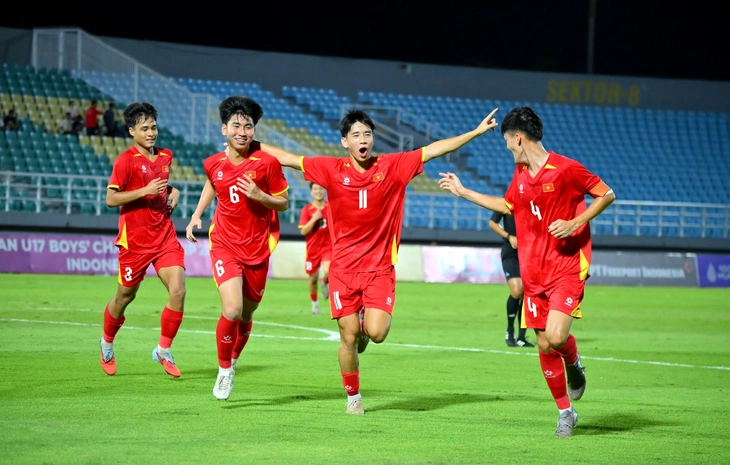
Following titles in 2006, 2010, and 2017, this marks the sixth time they have appeared in a championship final at the tournament.
Throughout the full 90 minutes of regulation time, U17 Vietnam displayed an attractive passing game, technical skill, and complete control of the match.
The squad barely allowed Malaysia any chance to score a consolation goal in the final.
This overwhelming dominance completely demoralized the young Malaysian players, especially during the final 30 minutes of the second half.
The superiority of the red-shirted players was early translated into three convincing goals. Quy Vuong broke the deadlock, before Van Duong shone brightly with a brace to seal a 3-0 victory for U17 Vietnam.
This win not only helped the team claim the championship but also lifted Vietnam past both Thailand and Australia to become the most successful team in the history of the Southeast Asian tournament with four titles.
This is a well-deserved reward for U17 Vietnam and also proves that Vietnam’s youth football development efforts in recent years have been heavily invested in.
The head coach of U17 Malaysia stated that he and his players will strive for “revenge” against U17 Vietnam in the 2026 ASEAN U17 Championship final.
ASEAN U17 Championship
The ASEAN U17 Championship is an annual youth football tournament organized by the ASEAN Football Federation (AFF) for national teams from Southeast Asia. First held in 2002, it serves as a key development platform for young players in the region and also functions as a qualifier for the AFC U-17 Asian Cup. The competition has been won by several nations, with Thailand and Vietnam among the most successful teams in its history.
Southeast Asia
Southeast Asia is a culturally and geographically diverse region comprising countries like Thailand, Vietnam, Indonesia, and the Philippines, with a history shaped by ancient kingdoms, trade routes, and colonial influences. Its cultural sites, such as Angkor Wat in Cambodia and Borobudur in Indonesia, reflect a rich blend of indigenous traditions, Hinduism, Buddhism, and later Islam, while its modern history includes struggles for independence and rapid economic development. Today, the region is known for its vibrant traditions, stunning landscapes, and dynamic cities.
Angkor Wat
Angkor Wat is a vast temple complex in Cambodia, originally built in the early 12th century as a Hindu temple dedicated to the god Vishnu by King Suryavarman II. Over time, it gradually transformed into a Buddhist temple, and it remains the largest religious monument in the world. The site is a symbol of Cambodia’s rich cultural heritage, appearing on the national flag, and is a UNESCO World Heritage site.
Borobudur
Borobudur is a massive 9th-century Mahayana Buddhist temple located in Central Java, Indonesia, built during the reign of the Sailendra Dynasty. It was constructed over roughly 75 years and features nine stacked platforms topped by a central dome, adorned with over 2,600 relief panels and 504 Buddha statues. Abandoned in the 14th century due to the decline of Buddhist kingdoms and volcanic eruptions, it was rediscovered in the 19th century and is now a UNESCO World Heritage site and a major pilgrimage destination.