Ho Chi Minh City has launched a universal health checkup program, aiming for every resident to receive a periodic health examination at least once a year.
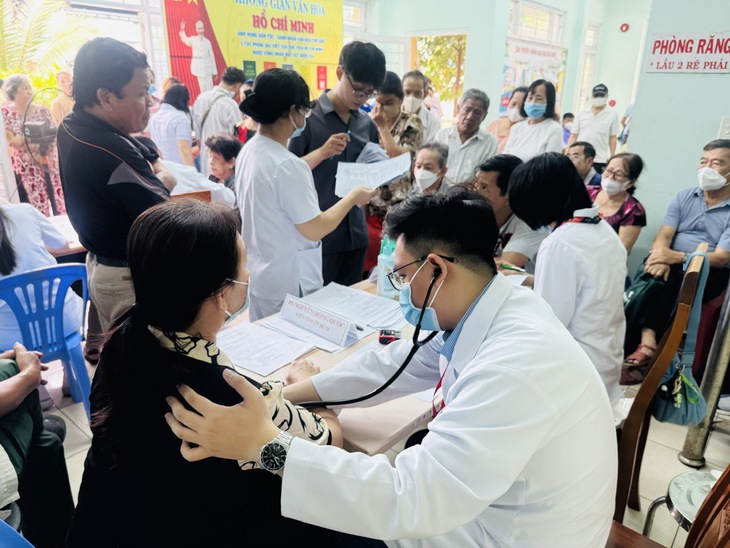
Hundreds of doctors gathered simultaneously in 168 wards, communes, and special zones to provide free medical examinations and disease screenings for residents directly in their communities.
Ho Chi Minh City is implementing large-scale public service programs such as free bus rides, free medical checkups, free use of public spaces, free libraries, and free drinking water from public fountains.
This demonstrates that Ho Chi Minh City is building a “welfare society” for all its people, a commendable and humane spirit.
Implementing the program simultaneously across 168 wards, communes, and special zones within a single day creates a strong movement effect. It raises residents’ awareness of taking care of their own health, and hospitals also have an opportunity to enhance their mission of serving the community.
But how can free medical checkups be directed effectively toward the right target groups?
In reality, a very large number of civil servants, employees, and workers receive annual checkups through their agencies, organizations, companies, and schools, and many residents have sufficient financial means to take care of their own health.
Therefore, in the immediate term, the universal free health checkup program should focus on a segment of the population that belongs to vulnerable groups.
These are elderly individuals living alone without pensions, the poor, people with disabilities, freelance workers without stable income, and those with long-term chronic diseases who may have a sense of resignation.
This will help this group understand their health status, detect early risks of dangerous diseases, and thus help them recognize ways to cope with risks and opportunities for a better life.
Furthermore, perhaps free annual health checkups for identified target groups could be conducted at hospitals by appointment, not necessarily concentrated in a single day but spread evenly throughout the year.
These individuals have their information in electronic health records, making it easy to interconnect and ensure they receive free service once a year.
Every day, all hospitals in Ho Chi Minh City and across the country are overloaded, reflecting that the health status of a large number of Vietnamese people has issues.
Therefore, health screening for the entire population, especially vulnerable groups, to help detect serious diseases such as cancer, cardiovascular disease, diabetes, bone and joint issues, and neurological disorders early, and to intervene early, will help patients improve their health and avoid overwhelming hospitals.
Ho Chi Minh City began its free health checkup program for residents in two phases in 2025 and 2026. This is a starting point, creating a very favorable foundation.
The Department of Health and hospitals, together with wards, communes, and special zones, will draw lessons and summarize for subsequent activities aimed at being more substantive, higher quality, and more effective.
Alongside the large-scale simultaneous implementation across 168 wards, communes, and special zones once or twice a year, implementing in-depth screening at hospitals is considered a supplementary solution to diversify and add flexibility to the program.
During the largest-ever free health screening campaign by Ho Chi Minh City on April 17, nearly 30,000 residents were examined, of which 19,088 cases had health issues (accounting for 64.3%).