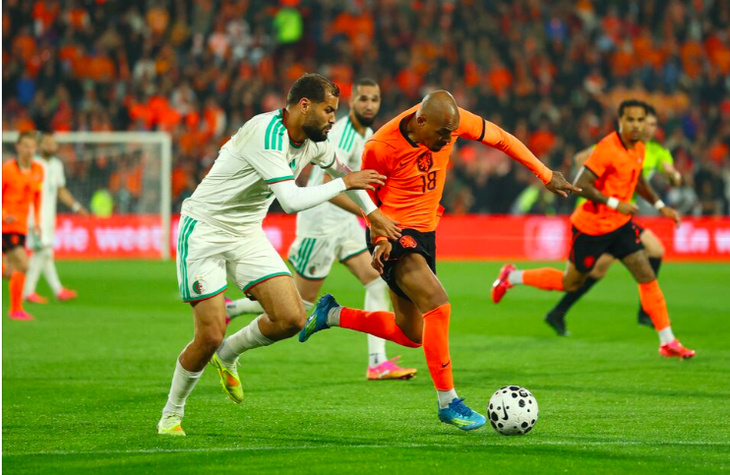
Netherlands allows Algeria to score in a friendly match before the 2026 World Cup.
On the morning of June 4, the Netherlands team caused concern among fans when they lost 0-1 to Algeria in a friendly match preparing for the 2026 World Cup.
This was a completely experimental match. However, coach Ronald Koeman partly shaped the squad with the appearance of key players in all three lines.
“The Orange Cyclone” started with a 4-3-3 formation, which is the specialty of coach Ronald Koeman. The idea of the 63-year-old strategist was to have Ryan Gravenberch, Tijani Reijnders, and Frenkie De Jong play together in midfield.
Up front, Cody Gakpo led the attack for the Netherlands. In terms of the game, the Netherlands was slightly superior to their African opponent.
However, the team of coach Ronald Koeman failed to take advantage of opportunities and allowed Algeria to score in the 86th minute. Anis Hadj Moussa was the scorer for Algeria, and that was the only goal of the match.
With this defeat, the Netherlands caused their fans to feel worried as the 2026 World Cup draws near. Holding many quality stars spread across all three lines, coach Ronald Koeman seems not to have created the expected cohesion.
At the 2026 World Cup, the Netherlands is in Group F with Japan, Sweden, and Tunisia. This is a difficult group for the Netherlands as all three opponents are formidable.
Meanwhile, Algeria is in Group J with Argentina, Austria, and Jordan. They will compete for a spot to advance with Austria and Jordan.
Making their first appearance at the World Cup, Curacao drew attention by bringing to North America a squad almost carrying “Dutch DNA”. Of the 26 players called up, 25 are of Dutch origin, and only one was born on the Caribbean island nation.
Algeria
Algeria is a North African country with a rich history shaped by Berber, Roman, Arab, Ottoman, and French influences. It was home to ancient kingdoms like Numidia, later became a key part of the Roman Empire, and was colonized by France in the 19th century until a brutal war of independence (1954–1962). Today, Algeria is known for its diverse cultural heritage, including the UNESCO-listed Roman ruins of Timgad and the historic Casbah of Algiers.
Netherlands
The Netherlands is a low-lying country in northwestern Europe known for its flat landscape, canals, tulip fields, windmills, and cycling routes. Its history includes the Dutch Golden Age in the 17th century, when it became a leading maritime and economic power with a vast colonial empire. Today, it is a constitutional monarchy with a strong focus on innovation, trade, and progressive social policies.
Japan
Japan is an island nation in East Asia with a rich history spanning thousands of years, from its early imperial court and samurai era to its rapid modernization during the Meiji Restoration. It is renowned for its unique cultural heritage, including traditional arts like tea ceremonies and calligraphy, as well as iconic landmarks such as Mount Fuji and ancient temples in Kyoto. Today, Japan blends ancient traditions with cutting-edge technology, making it a fascinating destination for travelers and a global leader in innovation.
Sweden
Sweden is a Scandinavian nation known for its rich history, from the Viking Age to the rise of the Swedish Empire in the 17th century, which made it a major European power. Today, it is celebrated for its cultural contributions, including modern design, music, and the Nobel Prize, as well as its stunning natural landscapes. The country transformed into a peaceful, neutral, and progressive welfare state in the 20th century.
Tunisia
Tunisia, located in North Africa, is a country rich in history, having been home to ancient civilizations including the Phoenicians, Romans, and Arabs. Its capital, Tunis, houses the renowned Bardo Museum and the ancient city of Carthage, which was a major power in the Mediterranean before being destroyed by Rome. Today, Tunisia is known for its Mediterranean coastline, vibrant souks, and the legacy of the Arab Spring, which began there in 2010.
Argentina
Argentina is a South American country known for its rich cultural heritage, including tango music and dance, and its diverse landscapes from the Andes mountains to the Pampas grasslands. Its history includes Spanish colonization beginning in the 16th century, a struggle for independence led by figures like José de San Martín in the early 1800s, and periods of immigration, economic growth, and political upheaval in the 20th century. Today, Argentina is famous for its vibrant capital Buenos Aires, its passion for football, and its contributions to literature and art.
Austria
Austria is a landlocked country in Central Europe known for its rich cultural heritage, including classical music, stunning alpine landscapes, and historic cities like Vienna and Salzburg. Historically, it was the center of the powerful Habsburg monarchy, which ruled over a vast empire for centuries until its dissolution after World War I. Today, Austria is a federal republic and a member of the European Union, celebrated for its contributions to art, architecture, and outdoor recreation.
Jordan
Jordan is a country in the Middle East known for its rich history and archaeological treasures, including the ancient city of Petra, a UNESCO World Heritage Site carved into rose-red cliffs. Its history spans thousands of years, from the Nabataean civilization and Roman rule to the Islamic era and the modern Hashemite Kingdom. Today, Jordan is also famous for the Dead Sea, the lowest point on Earth, and its role as a relatively stable hub in a volatile region.