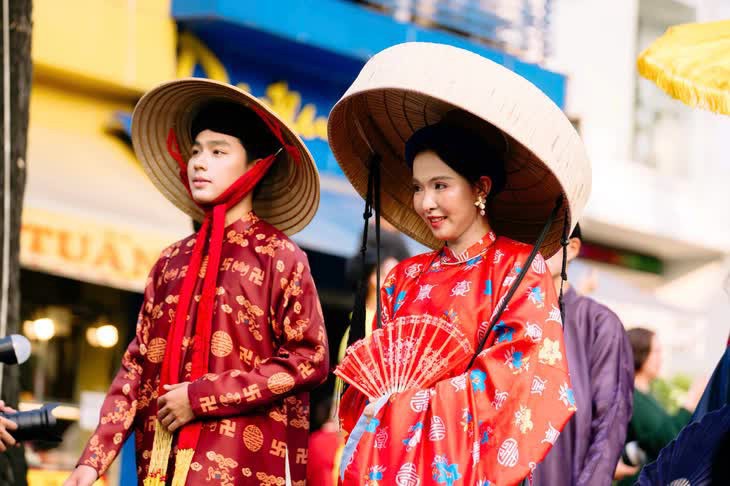
One of the proposals receiving much attention is the choice of November 24 each year as Vietnamese Culture Day, where workers are allowed to take a paid day off.
At the same time, admission fees to some public cultural and sports facilities could be waived or reduced. This is not just a technical regulation on the holiday calendar, but a very beautiful policy message: culture must be placed at the center of national life, present in the daily rhythm of every family and every community.
The most commendable aspect of this proposal is viewing culture not as a “decoration” after development, but as the soul of development.
A country that wants to go far cannot rely solely on economic growth, modern infrastructure, or advanced technology; it also needs days for people to pause, reconnect with history, touch heritage, and live within the values that define Vietnamese identity.
When the state designates a paid holiday for culture, it means we acknowledge that time spent on culture is also time for development, for building character, and for nurturing the national spirit. This is a very concrete way of institutionalizing the spirit of Resolution 80 on development.
But for November 24 to truly have meaning, it should not become just another day off, an additional occasion for casual outings or habitual consumption.
Vietnamese Culture Day must be organized as a festival of memory, learning, creativity, and community bonding. On that day, museums, libraries, theaters, cinemas, historical and cultural relics, pedestrian streets, and creative spaces should truly open wider to the public, especially to children, youth, and families.
The waiver or reduction of admission fees proposed in the draft is a good direction, but it should go hand in hand with specific experiential programs so that people not only “go to see” but also “participate,” “understand,” and “feel proud.”
Each locality can choose a highlight suitable to its own identity: places with heritage can organize journeys back to the roots; places with craft villages can offer experiences with artisans; places with strong cultural institutions can bring art closer to the public through quality performances at reasonable prices, or even free of charge for students and workers.
Families can consider this a day to take their children to museums, read a book, listen to folk songs, and kindle in young souls a bond with their roots.
Enterprises can also participate through activities honoring conduct culture, business culture, and professional culture. Then, the holiday will not “slip by” but become a spiritual rendezvous for society.
A holiday, if organized in that spirit, will not be a cost but an investment in the Vietnamese people, in Vietnam’s cultural resilience, and in the nation’s spiritual strength for the future.
November 24, therefore, should not be just a day off. It should be a day for every Vietnamese, wherever they are and whatever they do, to ask themselves how they have lived with the nation’s culture, what values they have passed on to their children, and how they will contribute so that Vietnamese culture is not only preserved but also continues to
Green Hair, Flowing Ao Dai Festival
The Green Hair, Flowing Ao Dai Festival is a vibrant cultural event held in Vietnam that celebrates the traditional beauty of the *áo dài*, the country’s iconic long dress. It often features parades, performances, and community activities where participants, typically women, don flowing *áo dài* in various colors, with green hair symbolizing youth and vitality. While not an ancient tradition, the festival has grown in recent years as a modern movement to preserve and promote Vietnamese heritage and national pride.
museums
Museums are institutions that collect, preserve, and display objects of historical, cultural, scientific, or artistic significance for public education and enjoyment. Originating from private collections in ancient civilizations, the modern public museum emerged during the Enlightenment, with early examples like the Ashmolean Museum in Oxford (1683) and the British Museum in London (1753). Today, they serve as vital centers for learning, research, and cultural heritage, connecting people with the past and inspiring future generations.
libraries
Libraries are institutions that collect, preserve, and provide access to a wide range of knowledge, from books and manuscripts to digital media. Historically, they date back to ancient civilizations, such as the Library of Alexandria in Egypt, which served as a major center of scholarship. Today, libraries continue to evolve as community hubs that promote literacy, learning, and access to information for all.
theaters
Theaters are cultural venues designed for the performance of plays, musicals, and other live stage productions, with origins tracing back to ancient Greece in the 5th century BCE, where they emerged as open-air spaces for dramatic festivals honoring the god Dionysus. Over centuries, theater architecture evolved from Greek amphitheaters to Roman structures, then to elaborate indoor venues during the Renaissance, such as Shakespeare’s Globe. Today, theaters remain vital centers for storytelling and artistic expression, reflecting the social and historical contexts of their times.
cinemas
Cinemas, or movie theaters, are public venues designed for screening films, originating in the late 19th century with short silent movies. They became a global cultural phenomenon in the 20th century, evolving from simple nickelodeons to lavish “picture palaces” and later multiplexes. Today, while facing competition from streaming services, cinemas remain important for communal viewing experiences and preserving film history.
historical and cultural relics
Historical and cultural relics are physical objects, structures, or sites that hold significant value for understanding a society’s past, including its art, traditions, and achievements. These relics, such as ancient tools, monuments, or manuscripts, are often preserved for their educational and symbolic importance, offering direct insight into previous civilizations. Their history typically involves discovery, conservation efforts, and sometimes restoration, ensuring they remain as tangible links to heritage for future generations.
pedestrian streets
Pedestrian streets are urban areas closed to motorized traffic, designed to prioritize walking, shopping, and social activities. Originating in medieval European marketplaces, they gained modern popularity in the mid-20th century as cities sought to reduce congestion and revitalize downtown centers. Today, they are common worldwide, blending historic architecture with contemporary commerce and public spaces.
creative spaces
“Creative spaces” are physical or digital environments intentionally designed to foster collaboration, innovation, and artistic expression. Originating from early 20th-century artist studios and salons, they evolved into modern hubs like coworking offices, makerspaces, and cultural centers, often repurposing historic buildings to support community-driven projects. Today, they serve as incubators for diverse talents, blending history with contemporary needs to inspire new ideas and cultural exchange.