In 2026, which competency assessment test scores will military schools consider for admission?
This year, military schools are using the results of 3 aptitude tests for admission to the military system, with some schools only using specific test codes.
The Military Admissions Board has issued guidelines for the admission process to regular university and college military training programs at military schools in 2026.
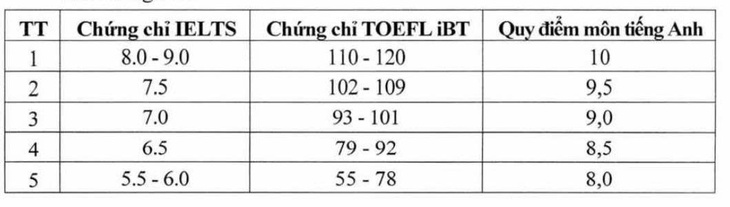
IELTS 8.0 converts to 10 English points
In 2026, military schools will admit students through 4 methods: direct admission and priority admission; using exam scores from Hanoi National University and Ho Chi Minh City National University; using high school graduation exam scores; and using aptitude test scores organized by the Ministry of National Defense.
Schools uniformly use a 30-point scale. Specifically for the Military Science Academy, majors with a designated main subject will multiply that subject by a factor of 2, then convert it to a 30-point scale for admission, and must meet the requirement that the weight of the math or literature score accounts for at least 1/3 of the total admission score.
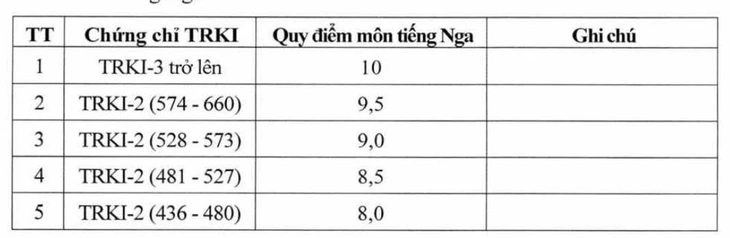
Conversion of foreign language scores from international results applies to IELTS 5.5 or higher or TOEFL iBT 55 points or higher. Specifically, the Military Science Academy converts scores for candidates holding Russian language certificates TRKI-2 or higher applying for admission to the Russian language major.
Foreign language certificates can only be used to convert the foreign language subject score in the admission combination or as an incentive score.
The English subject conversion scale is as follows:
Military – Image 2.
The Russian subject conversion scale is as follows:
Military – Image 3.
Regulations on using aptitude test codes
According to the Military Admissions Board of the Ministry of National Defense, the general regulation is that schools use the aptitude test of Ho Chi Minh City National University and all aptitude test codes of the Ministry of National Defense and Hanoi National University (HSA exam) for admission.
However, some schools have specific regulations regarding the aptitude test codes organized by the Ministry of National Defense and the HSA aptitude exam as follows:
School
Test codes used for admission
– Military Technical Academy
– Military Technical Officer School
– Ministry of National Defense aptitude test: only considers test code QĐ01 (math, literature, physics, chemistry).
– Ministry of National Defense aptitude test: considers 3 test codes: QĐ01 (math, literature, physics, chemistry), QĐ02 (math, literature, chemistry, biology), QĐ03 (math, literature
Hanoi National University
Hanoi National University, officially known as Vietnam National University, Hanoi, was established in 1993 through the merger of several prestigious institutions, though its roots trace back to the University of Indochina founded in 1906. As one of the country’s two leading national universities, it serves as a key center for higher education and research, playing a vital role in training Vietnam’s intellectual and scientific elite. The university’s main campus is located in Hanoi’s Cau Giay District, reflecting a blend of modern academic facilities and the city’s rich historical context.
Ho Chi Minh City National University
Ho Chi Minh City National University (VNU-HCM) is a leading multidisciplinary research university in Vietnam, established in 1995 through the merger of several prestigious institutions. Its roots trace back to the University of Indochina, founded in 1906, and it has since grown into a key hub for higher education and scientific advancement in the country. Today, it comprises multiple member universities and institutes, playing a vital role in training talent and fostering innovation in Vietnam.
Ministry of National Defense
The Ministry of National Defense is a government building typically responsible for overseeing a nation’s armed forces and military policy. In many countries, such as the one in Taipei, Taiwan, the ministry has a complex history tied to national security and political transitions, often housed in historically significant structures that reflect periods of martial law or modernization. Its role has evolved over time, adapting to shifting geopolitical landscapes while maintaining core functions of defense and strategic planning.
Military Science Academy
The Military Science Academy is a prestigious institution dedicated to advanced research and education in military strategy, technology, and defense sciences. Its history often traces back to the Cold War era, when nations sought to centralize and modernize military knowledge, evolving to address contemporary security challenges. Today, it serves as a key think tank and training ground for military leaders and defense experts.
Military Technical Academy
The Military Technical Academy is a prestigious higher education institution in Vietnam, primarily focused on training engineers and technical officers for the country’s defense sector. Established in 1966 during the Vietnam War, it was originally founded as a school to support the military with technical expertise and later evolved into a full-fledged academy. Today, it continues to play a key role in advancing military technology and science in Vietnam.
Military Technical Officer School
The Military Technical Officer School (MTOS) is a prestigious training institution in Vietnam, originally established in the mid-20th century to educate and develop technical officers for the Vietnam People’s Army. It has played a crucial role in supporting the country’s defense capabilities by providing specialized knowledge in military engineering, technology, and logistics. Over the decades, the school has evolved to meet modern defense needs, contributing significantly to Vietnam’s military modernization and technical expertise.
Military Medical Academy
The Military Medical Academy is a prestigious institution dedicated to training military doctors and advancing medical research for armed forces. Its history often dates back to the early 20th century, evolving from military hospitals and medical schools to meet the healthcare needs of soldiers in wartime and peacetime. Today, it serves as a key center for military medicine, combining rigorous education with frontline medical innovation.
Russian language major
“Russian language major” is not a place or cultural site, but an academic field of study. It involves the in-depth learning of the Russian language, literature, and culture, with roots in the historical study of the Russian Empire and the Soviet Union. This major often explores works by authors like Tolstoy and Dostoevsky, as well as the linguistic evolution of Russian from its Old East Slavic origins.