Despite leading the race for the best second-placed team in the 2026 U19 Southeast Asia Championship, Vietnam U19 still faces many concerns ahead of their final Group C match.
On the evening of June 8, Thailand U19 gave Vietnam a meaningful “gift” by defeating Malaysia in the final match of Group B at the 2026 U19 Championship.
Earlier, there were many concerns that Thailand U19 and Malaysia U19 would “collude” to both advance to the semifinals, thereby eliminating Vietnam U19 from the tournament.
The loss to Indonesia in the final match of Group A put Vietnam in a difficult position at the 2026 U19 Southeast Asia Championship. Specifically, the team could only hope to advance as the best second-placed team.
Since Group C (Australia, Cambodia, and Philippines) has only 3 teams, while Groups A and B have 4 teams, the tournament organizers had to discard the results against the bottom team of each group (from Groups A and B) when comparing the performance of second-placed teams.
Thus, Vietnam U19’s second-placed record stands at 3 points with a goal difference of +4. Before the final two matches of Groups B and C, Vietnam temporarily leads the second-placed standings, ahead of Malaysia and Cambodia, who both have 3 points and a goal difference of +3.
If Malaysia U19 had drawn with Thailand in their final match, they would have certainly ranked above Vietnam. But this did not happen, as Thailand U19 won 3-2.
Malaysia U19 finished as the second-placed team in Group B with 6 points and a goal difference of +6. However, because the result against bottom team Brunei was discarded when evaluating second-placed teams, Malaysia only has 3 points and a goal difference of +2 in this race, officially ranking below Vietnam.
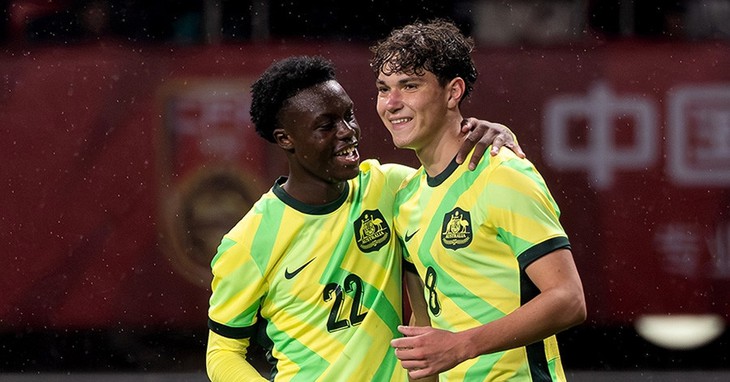
But this is only the first hurdle in the anxious two-day wait for the team. At 8 PM today (June 9), the final match of Group C between Australia and Cambodia will take place.
Australia currently leads Group C with 3 points and a goal difference of +10, while Cambodia follows closely with 3 points and a goal difference of +3.
A similar concern arises for Vietnam U19. If Cambodia draws with Australia, they will overtake Vietnam’s best second-placed position to secure the advancing spot. And even if Cambodia beats Australia, Vietnam will still be eliminated.
Compared to Thailand’s group, Vietnamese fans have an additional worry in this group. That is the situation where “Australia has already secured their advancing spot.”
Even if they lose to Cambodia, Australia will still advance thanks to their 3 points and excellent goal difference (+10) in the second-placed team race. They would only fall behind Vietnam if they lose to Cambodia by 6 goals, a scenario that is unrealistic.
From this, a major concern arises for Vietnam U19 as Australia has “finished early, rested early” in the group stage.
It is possible
Southeast Asia Championship
The Southeast Asia Championship (also known as the AFF Championship) is a biennial international football tournament contested by national teams from the ASEAN region. Established in 1996 by the ASEAN Football Federation (AFF), the competition replaced the earlier Southeast Asian Games football tournament as the premier regional championship. Thailand holds the record for the most titles, while the event has grown to become a major cultural and sporting showcase for Southeast Asia.
Group C
Group C refers to a classification of cultural sites, most notably the ancient rock-hewn churches in Lalibela, Ethiopia. These 11 monolithic churches were carved from solid rock in the 12th and 13th centuries under King Lalibela, who aimed to create a “New Jerusalem” for Christians. The site remains a major pilgrimage destination and a UNESCO World Heritage site, showcasing remarkable medieval engineering and religious devotion.
Group B
“Group B” refers to a category of archaeological sites in the Maya region, specifically the seven Late Classic period (c. 600–900 CE) sites in the Puuc hills of Yucatán, Mexico. These sites share a distinctive architectural style characterized by intricate stone mosaics, columns, and decorative masks of the rain god Chaac, with prominent examples including Uxmal, Kabah, and Labná. The term is often used by scholars to distinguish this cohesive cultural and artistic tradition from other Maya groups in the region.
Group A
Group A refers to an archaeological classification of ancient Egyptian pyramid complexes, primarily associated with the Old Kingdom period. These structures, including the famous pyramids at Giza, were built as elaborate royal tombs between roughly 2600 and 2500 BCE, showcasing advanced engineering and the centralized power of the pharaohs. The term “Group A” is sometimes used by Egyptologists to categorize specific clusters of pyramids based on their design, location, and historical context.
Australia
Australia is a country and continent located in the Southern Hemisphere, known for its diverse landscapes, unique wildlife, and Indigenous Aboriginal history spanning over 65,000 years. British colonization began in 1788 with the arrival of the First Fleet, leading to the establishment of penal colonies and later independent states. Today, Australia is a multicultural nation with a strong economy, famous for landmarks like the Sydney Opera House and the Great Barrier Reef.
Cambodia
Cambodia is a Southeast Asian country known for its rich history and cultural heritage, most famously home to the Angkor Wat temple complex, a vast 12th-century Hindu-Buddhist monument that served as the capital of the Khmer Empire. After a period of decline, Cambodia endured French colonial rule and later the devastating Khmer Rouge regime in the 1970s. Today, it is rebuilding its identity, balancing its ancient traditions with modern development.
Philippines
The Philippines is a Southeast Asian archipelago of over 7,600 islands, known for its rich cultural heritage shaped by Malay, Spanish, American, and Asian influences. Its history includes early trade with neighboring kingdoms, over 300 years of Spanish colonization, a brief period of American rule, and eventual independence in 1946. Today, the country is celebrated for its vibrant festivals, diverse languages, and landmarks like the historic walled city of Intramuros in Manila and the UNESCO-listed Rice Terraces of the Philippine Cordilleras.
Brunei
Brunei is a small, wealthy sultanate located on the island of Borneo in Southeast Asia, known for its vast oil and gas reserves. Its history dates back to the 14th century when it became a powerful thalassocracy, reaching its golden age during the 15th and 16th centuries under the rule of Sultan Bolkiah. Today, the country is a constitutional monarchy that preserves its Malay Islamic heritage, with landmarks like the opulent Sultan Omar Ali Saifuddien Mosque symbolizing its cultural and religious identity.