Serious air leak prompts International Space Station to prepare emergency evacuation plan.
NASA ordered astronauts aboard the International Space Station to take shelter after an air leak in a Russian section showed signs of worsening.
According to Reuters on June 5, the U.S. National Aeronautics and Space Administration (NASA) said five astronauts aboard the International Space Station (ISS) were ordered to take shelter in their spacecraft and prepare for possible evacuation.
This move came as the Russian crew worked to address a growing air leak in the Russian segment of the station.
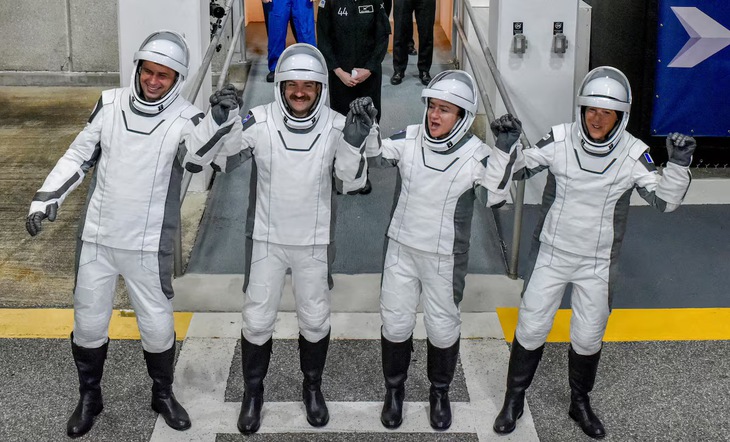
Four astronauts from the Crew-12 mission — two Americans, one French, and one Russian — along with another American astronaut, received an order from the control center at 9:04 a.m. on June 5, requiring them to move into the SpaceX Crew Dragon spacecraft docked at the ISS.
The astronauts were also instructed to put on their spacesuits in case the leak worsened and an immediate evacuation was needed.
However, about two hours later, NASA canceled the order and allowed them to return to the station, while continuing to coordinate with the Russian side to check the air leak rate.
NASA and the Russian space agency Roscosmos — the two main operators of the ISS — have debated for months over the cause and solution for small leaks in the Russian Zvezda service module, a key structure of the station.
According to a senior NASA official, the leak rate was relatively low but doubled on June 5, from about 0.45 kg of air per day to 0.9 kg.
The ISS currently has seven astronauts from two missions. The Crew-12 team, which arrived in February, includes astronauts Jessica Meir, Jack Hathaway (NASA), Sophie Adenot (European Space Agency), and Andrey Fedyaev (Roscosmos).
The remaining group includes American astronaut Christopher Williams and two Russian astronauts, Sergey Kud-Sverchkov and Sergei Mikayev, who arrived in November.
The two Russian astronauts did not follow the evacuation procedure but instead used a saw to open a path to the area suspected of having the crack causing the air leak.
According to informed sources, NASA disagreed with this approach, leading the control center in Houston, Texas, to issue a safe shelter order.
A safe shelter order is rarely issued on the ISS, although in recent years it has been activated due to the risk of collision with space debris or fluctuations in leak rates. In 27 years of operation, astronauts have never had to evacuate the station.
JAXA successfully launched the HTV-X1 spacecraft on an H3 rocket, affirming Japan’s position and ambitions in international space missions.
International Space Station
The International Space Station (ISS) is a multinational space laboratory orbiting Earth, first launched in 1998 through a partnership between NASA, Roscosmos, ESA, JAXA, and CSA. It has been continuously inhabited since November 2000, serving as a hub for scientific research in microgravity, technology development, and international cooperation. The ISS represents one of humanity’s most ambitious engineering achievements, symbolizing peaceful collaboration in space exploration.
Zvezda service module
The Zvezda service module is a critical component of the International Space Station (ISS), providing living quarters, life support, and propulsion. Launched by Russia in July 2000, it serves as the structural and functional centerpiece of the Russian segment, enabling the station to host long-duration crews. Its history traces back to the Soviet-era Mir space station program, as Zvezda was originally designed for the Mir-2 project before being repurposed for the ISS.
Houston, Texas
Houston, Texas, is a major city founded in 1836 and named after General Sam Houston, a key figure in Texas’s independence from Mexico. It grew rapidly as a railroad and shipping hub, with its destiny forever changed by the discovery of oil at Spindletop in 1901, which fueled its rise as the energy capital of the world. Today, it is a diverse, sprawling metropolis known for NASA’s Johnson Space Center and the world-renowned Texas Medical Center.
SpaceX Crew Dragon
The SpaceX Crew Dragon is a reusable spacecraft designed by SpaceX to transport astronauts to and from the International Space Station (ISS) under NASA’s Commercial Crew Program. Its first crewed flight, Demo-2, launched in May 2020, marking the first time a private company sent humans into orbit and restored American crew-launch capability after the Space Shuttle’s retirement. Since then, Crew Dragon has conducted multiple operational missions, including Crew-1, becoming a key vehicle for regular ISS crew rotations.
Crew-12 mission
The Crew-12 mission refers to a specific crewed flight under NASA’s Commercial Crew Program, most likely associated with a SpaceX Dragon spacecraft transporting astronauts to the International Space Station. While the exact details of a “Crew-12” designation may vary, it continues the legacy of NASA’s partnership with private companies to ensure reliable, safe access to low-Earth orbit. This mission represents a step in the ongoing collaboration between government and commercial entities to sustain human presence in space.
European Space Agency
The European Space Agency (ESA) is an intergovernmental organization dedicated to space exploration, established in 1975 with the merger of earlier European space bodies. Its history reflects Europe’s collaborative efforts in science and technology, leading to landmark missions like the Ariane rocket program, the Rosetta comet-chasing mission, and contributions to the International Space Station. Headquartered in Paris, ESA now comprises 22 member states and continues to advance space research and exploration.
Roscosmos
Roscosmos is the state space corporation of Russia, responsible for the country’s space exploration, satellite launches, and human spaceflight programs. Its history traces back to the Soviet space program, which achieved major milestones such as launching the first satellite, Sputnik, and sending the first human, Yuri Gagarin, into orbit. Today, Roscosmos continues to operate the International Space Station and pursue lunar and interplanetary missions.
JAXA
JAXA, the Japan Aerospace Exploration Agency, is Japan’s national aerospace and space agency, formed in 2003 through the merger of three smaller organizations. It is responsible for space research, satellite launches, and planetary exploration, with notable achievements including the Hayabusa asteroid sample-return missions. JAXA has also contributed to the International Space Station and developed advanced technologies for space science and exploration.