
A stress test for businesses amid interest rate fluctuations.
After a period when deposit rates at some banks rose above 9% per year, a wave of downward adjustments has begun. Alongside injecting about 110,000 billion VND through the open market channel to stabilize system liquidity and control interbank rates, the new Governor of the State Bank of Vietnam also held a direct meeting with banks to guide reductions in deposit and lending rates.
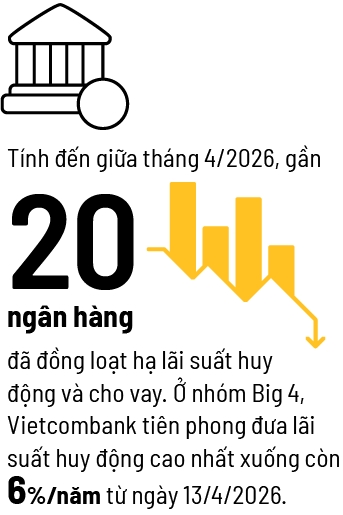
As of mid-April 2026, nearly 20 banks have simultaneously lowered deposit and lending rates. Among the Big 4 group, Vietcombank took the lead in reducing its highest deposit rate to 6% per year from April 13; Agribank cut deposit rates by 0.5% per year for terms of 24 months and above. In the joint-stock bank sector, Nam A Bank reduced personal lending rates by up to 3% per year compared to before; Sacombank cut rates by 0.5% across many terms for both deposits and loans.
 |
A co-founder of the MoneyGain financial platform noted that a key indicator is the State Bank maintaining the OMO rate unchanged, suggesting the root cause of interest rate pressure has not been fully resolved. Since the OMO tool only provides short-term liquidity support, underlying pressure on the system remains, forcing banks to maintain deposit growth to ensure capital safety ratios.
“For interest rates to adjust more gently and stabilize, a combination of domestic policy and international factors is needed. Growth targets, public investment disbursement, deposit growth, geopolitical tensions, and the monetary policy of the US Federal Reserve… the cycle of tension could be resolved around late Q3 or early Q4 this year,” the co-founder expressed hope.
According to FPTS Securities Company statistics, during 2015-2025, the VN-Index showed clear sensitivity. Average annual returns reached 25.34% per year during periods of falling interest rates, but recorded a decline of 6.72% per year when rates rose. This indicates that low interest rates always serve as a “launchpad” for the market, while high rates create significant pressure on market sentiment and valuation. FPTS statistics also show uneven performance among stock groups, as some companies with specific financial structures or business models benefiting from high rates still achieved superior returns compared to the market.
“Regarding the impact on investment channels, changes in interest rates will certainly reshape cash flows across the entire market. In the new context, investors need to accept more realistic profit levels. Cash flows may shift to companies with healthy balance sheets, innovative business models, and good ability to pass on capital costs to selling prices,” a Deputy Director of Institutional Client Analysis at Maybank Investment Bank shared.
 |
In a high-interest-rate environment, the residential real estate group is the most sensitive, being the sector hardest hit when home loan rates peaked at 14-15% per year, exceeding most people’s ability to pay. Rising capital costs not only shrink profit margins and extend payback periods but also pressure maturing bond debts.
However, a positive note is that most of these disadvantages have already been reflected in stock prices after a deep decline, so the negative impact may lessen as risks become clearer.
Additionally, the freeze in the real estate market directly affects construction and building materials groups, as contract numbers drop and working capital costs rise, eroding profit margins. In this bleak picture, only companies closely tied to public investment or key infrastructure/transport projects may maintain positive business results. Even the consumer and retail sectors are not immune, as domestic demand weakens. Instead of spending, people tend to tighten their wallets and shift cash to savings to enjoy high interest rates.
“Insurance is a less noticed group but benefits most clearly in a high-interest-rate environment. Insurance companies invest most of their collected premiums in bonds and deposits; when rates rise, their investment portfolios yield higher returns, directly boosting financial income,” the co-founder said.
<div class="my-4 p-4 rounded-lg