Challenges of Development
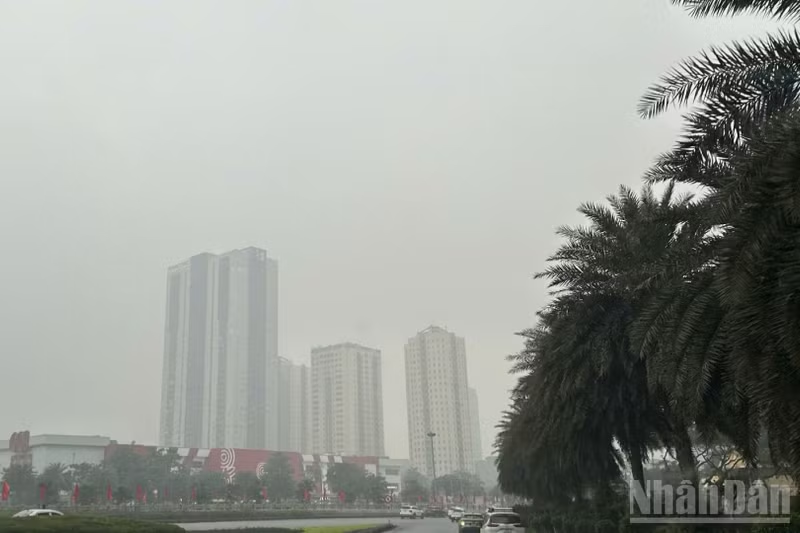
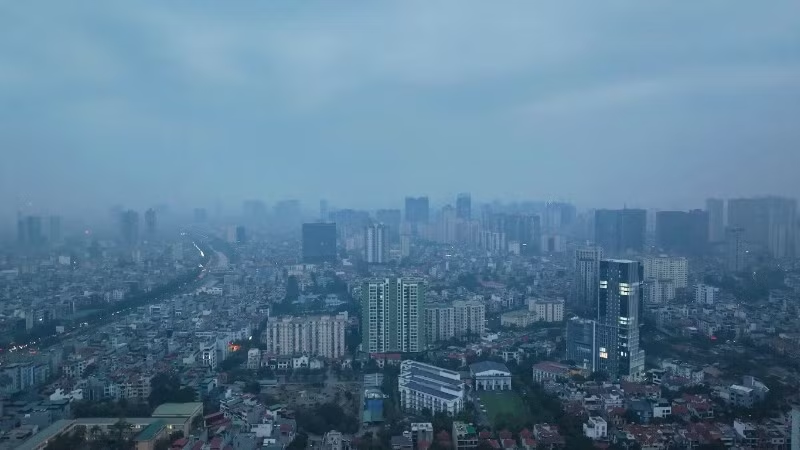
The national environmental status overview report for the period 2021-2025 shows that pressure on air quality continues to increase alongside urbanization, industrialization, and rising vehicle numbers. This indicates that air pollution is not a problem arising from a single source but is a combined consequence of socio-economic development. Therefore, air quality is not just an environmental indicator but is increasingly becoming a measure reflecting the quality of urban and economic development.
Notably, the main sources of air pollution emissions have been quite clearly identified through monitoring systems, specialized studies, and environmental assessment reports.
First is road traffic. The national environmental status report identifies road traffic activities in Hanoi and Ho Chi Minh City as one of the main causes of declining air quality. By 2025, the country has about 77 million motorcycles and nearly 7 million cars in circulation; vehicles over 10 years old account for about 30% of the total. Along with the rapid increase in motor vehicles, especially older ones, the amount of exhaust emissions continues to put great pressure on the urban environment.
In addition, there are construction activities, production of building materials, industrial parks, industrial clusters, and scattered production facilities. Rapid urbanization and infrastructure development needs have significantly increased dust from construction sites and material transport.
Another emission source often overlooked but having a significant impact in many localities is the burning of straw after harvest. This activity still produces smoke, fine dust, and various polluting gases, directly affecting air quality and public health.
In the energy sector, although the energy transition is being promoted, coal-fired thermal power still holds a large share in the power structure. In 2024, at many peak load times, coal-fired thermal power accounted for about 59-70% of the total system electricity output.
It can be said that what is lacking today is not understanding of the causes, but sufficiently strong solutions to effectively control the main emission sources.
The Gap Between Policy and Implementation
It cannot be said that Vietnam lacks mechanisms and policies for air quality management. In recent years, the legal system on environmental protection has been continuously improved; many air quality management programs and plans have been issued; the environmental monitoring network has been expanded; and emission standards have become increasingly stricter.
In particular, emission standards for road vehicles have been gradually improved; the roadmap for controlling emissions from motorcycles and mopeds in major cities is also being implemented.
However, it can be said that the biggest gap today is not in awareness or policy, but in the speed and effectiveness of implementing solutions in practice.
In many localities, controlling the burning of agricultural by-products has not been truly effective. The public transport system is not attractive enough to significantly reduce private vehicles. The transition to green vehicles is still in its early stages. Emission inventory and regional load management are only being gradually implemented.
Meanwhile, the urbanization rate continues to increase. Vietnam’s urbanization rate currently reaches about 43%, driving growing demand for infrastructure, transport, construction, and energy consumption.
That is why, despite many efforts, air quality in some major cities has not yet shown clear improvements as expected.
One of the major current limitations is that air pollution management is still mainly carried out by sector, field, or locality.
Meanwhile, air has no administrative boundaries. Fine dust from one area can affect another; emissions from transport, industry, construction, or biomass burning all exist in a common atmospheric space.
Draft regulations and policies being developed also require a shift from environmental management by administrative boundaries to governance by region, watershed, and ecosystem; strengthening total emission load control; and applying data in environmental management. This approach is suitable for the characteristics of air pollution—a type of pollution not limited by administrative boundaries.
This requires building a synchronized emission database; conducting periodic emission inventories; controlling emission loads by area; enhancing inter-provincial and inter-regional coordination; and promoting the application of science, technology, digital transformation, and artificial intelligence in environmental monitoring, forecasting, and warning.
This is also the direction of transitioning from traditional environmental management to modern environmental governance based on data, technology, and economic tools.
Clean Air – A Criterion for Development
Air