Accordingly, An Giang will temporarily suspend appointments and nominations from local personnel for leadership and management positions at the provincial and commune levels under the management of the Provincial Party Standing Committee. For cases that are truly necessary, the decision will be made by the competent authority.
Continue to strictly implement the policy that commune-level party secretaries are not local people.
The Provincial Party Organization Committee is tasked with coordinating with the Provincial People’s Committee Party Committee and relevant agencies and units to thoroughly review the number of deputy heads, department heads, deputy department heads, and specialists in provincial departments, boards, and sectors that are currently redundant.
Based on each person’s professional qualifications, expertise, and work experience, they will advise the Provincial Party Standing Committee and the Provincial Party Committee on a plan to assign and deploy personnel to communes where there is a shortage of staff; prioritize arranging officials with integrity, competence, strong political will, the ability to withstand pressure, and experience in handling situations in complex areas with heavy workloads.
At the same time, advise on reviewing, arranging, and deploying appropriately for cases of officials with limited capacity, who are unsuitable for their job positions or strengths, in places showing signs of internal disunity, or where operational effectiveness is low.
After deploying officials from the provincial level to the grassroots, if there is still a shortage of personnel, then selection will be made to supplement the staffing for each commune. Absolutely do not select personnel to fill quotas just to meet numbers, if they do not have the correct expertise or skills, or if there is no room to transfer and arrange officials with professional expertise from provincial departments and sectors to the commune level.
Complete the review and advisory on the implementation plan for arranging officials by June 2026. Party committees, party organizations, agencies, and units are requested to seriously implement this; during implementation, if difficulties or issues arise, promptly report to the Provincial Party Standing Committee for consideration and direction.
Rach Gia ward
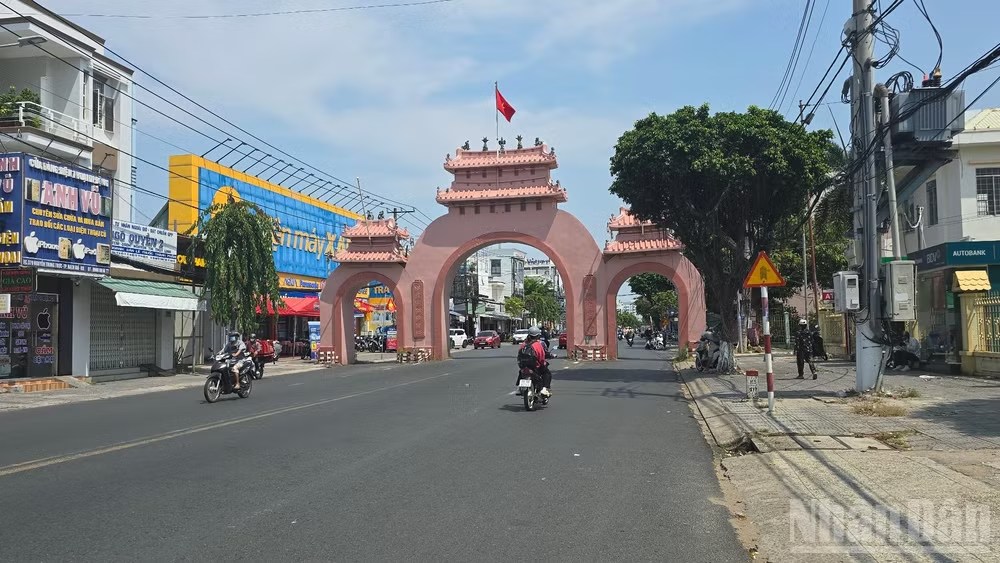
Rach Gia is a coastal ward and the capital of Kien Giang Province in southern Vietnam. Historically, it developed as a small fishing village before becoming an important port city under the Nguyen Dynasty, later serving as a base for the French colonial administration. Today, it is known for its bustling harbor, seafood markets, and as a gateway to the islands of Phu Quoc and the Mekong Delta.
An Giang province
An Giang province, located in the Mekong Delta region of southern Vietnam, is known for its rich cultural diversity, including significant Khmer and Cham communities. Historically, it was part of the ancient kingdom of Funan and later the Khmer Empire before being incorporated into Vietnam in the 18th century. The province is famous for its floating markets, lush rice fields, and sacred sites like Sam Mountain and the Ba Chua Xu Temple.
Rach Gia ward
Rach Gia is a coastal ward in the city of Rach Gia, located in Kien Giang Province, southern Vietnam. Historically, it developed as a fishing port and trading hub during the Nguyen Dynasty, later becoming a key economic center in the Mekong Delta. Today, it is known for its bustling harbor, seafood markets, and proximity to the famous Phu Quoc Island.
An Giang province
An Giang province, located in the Mekong Delta region of southern Vietnam, is known for its rich cultural diversity and stunning landscapes, including the Tra Su Melaleuca Forest and floating markets. Historically, the area was part of the Khmer Empire before becoming a key settlement for Vietnamese migrants in the 17th and 18th centuries, and it later played a role in the resistance against French colonial rule. Today, it is a major agricultural hub, famous for its rice production, and a center for the Khmer, Cham, and Vietnamese ethnic communities.
Phu Quoc
Phu Quoc is a Vietnamese island in the Gulf of Thailand, known for its white-sand beaches, tropical forests, and fish sauce production. Historically, it was sparsely inhabited until the French colonial period, when it became a site for rubber plantations and later a prison camp during the Vietnam War. Today, it is a popular tourist destination, with a growing economy centered on resorts, pearl farming, and national park conservation.
Mekong Delta
The Mekong Delta, often called the “Rice Bowl of Vietnam,” is a vast network of rivers, swamps, and islands in southern Vietnam, formed by the Mekong River’s nine main tributaries. Its history is deeply tied to the Khmer Empire and later Vietnamese expansion in the 17th and 18th centuries, with the region becoming a crucial agricultural hub during French colonial rule. Today, it is known for its floating markets, lush orchards, and vital role in Vietnam’s rice and seafood production.
Kien Giang Province
Kien Giang Province, located in the Mekong Delta region of southern Vietnam, is known for its diverse landscapes of coastal plains, islands, and the UNESCO-listed Phu Quoc archipelago. Historically, the area was part of the Khmer Empire before being settled by Vietnamese migrants in the 17th and 18th centuries, and it played a role in the resistance wars against French colonial rule and the United States. Today, it is a major hub for tourism, fishing, and agriculture, particularly famed for its fish sauce and pepper production.
Sam Mountain
Sam Mountain, located near Chau Doc in southern Vietnam, is a prominent hill known for its spiritual significance and scenic views. It is home to several pagodas and temples, including the famous Ba Chua Xu Temple, and has a history tied to the region’s Khmer and Vietnamese communities. The site also played a role during the Vietnam War as a strategic lookout point.
Ba Chua Xu Temple
Ba Chua Xu Temple, located at the foot of Sam Mountain in Chau Doc, Vietnam, is a prominent religious site dedicated to the goddess Ba Chua Xu (the Lady of the Realm). According to local legend, the statue of the goddess was discovered on the mountain in the early 19th century and was brought to the temple, where she is believed to grant blessings for prosperity and protection. The temple hosts a grand annual festival in the fourth lunar month, attracting thousands of pilgrims who come to pray and offer tributes.
Nguyen Dynasty
The Nguyễn Dynasty was the last ruling family of Vietnam, reigning from 1802 to 1945. Founded by Emperor Gia Long, the dynasty established its imperial capital at Huế, where it constructed the famous Citadel and royal tombs. The dynasty ended with Emperor Bảo Đại’s abdication in 1945, marking the conclusion of Vietnam’s monarchy.