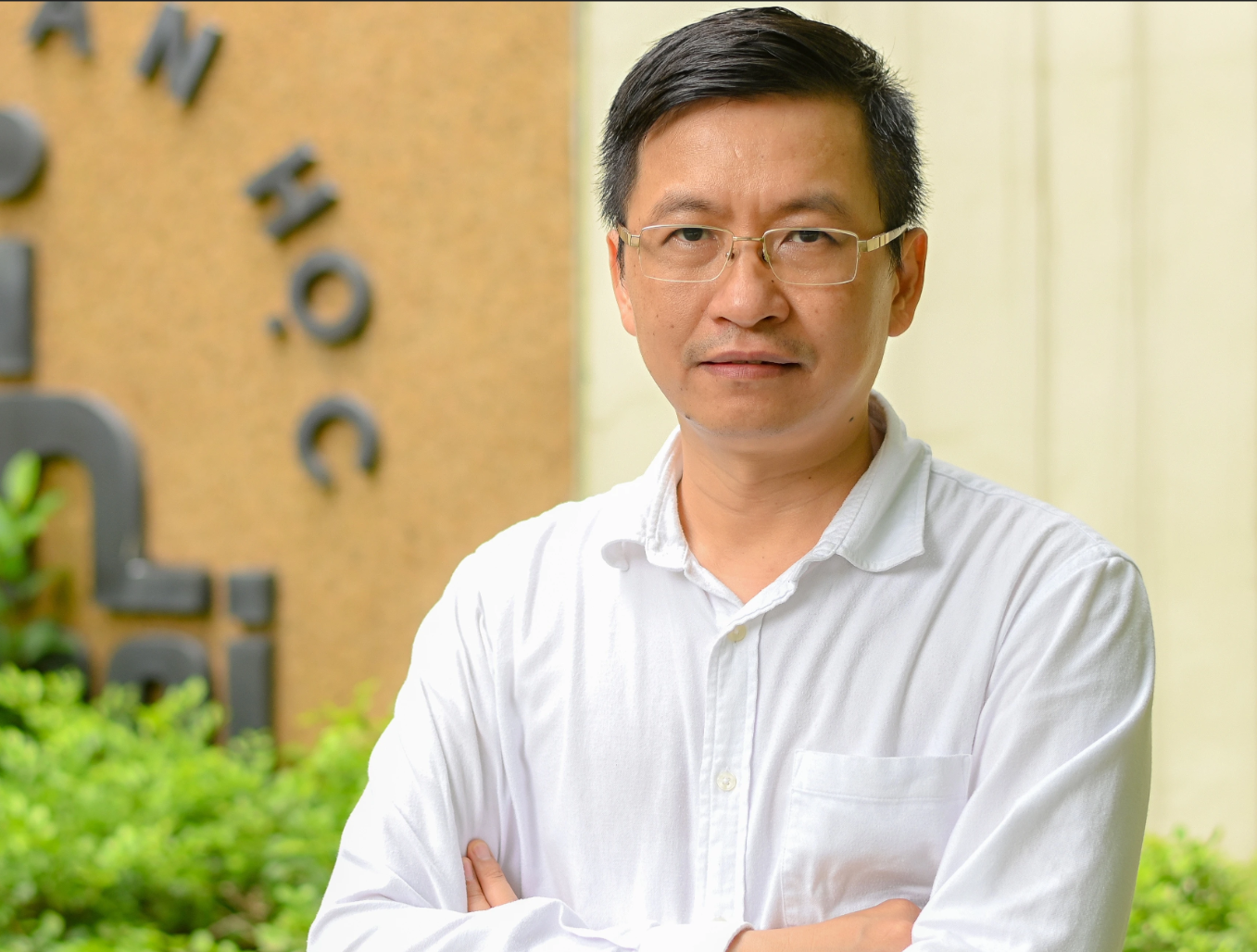
The Alexander von Humboldt Foundation (Federal Republic of Germany) has officially announced the awarding of the Humboldt Research Award to Professor, Doctor of Science Phung Ho Hai, former Director of the Institute of Mathematics at the Vietnam Academy of Science and Technology, in recognition of his outstanding and sustained contributions to the field of Mathematics.
The award was granted based on the nomination of a prominent German mathematician, acknowledging the entire body of scientific achievements built throughout his research career.
The Humboldt Research Award is one of the world’s most prestigious honors, awarded to scientists with international influence. Each award is valued at 80,000 euros and opens opportunities for research collaboration in Germany with leading scientific partners.
Since its establishment in 1972, this award has honored many scientists who later received the Nobel Prize, confirming its prestige and global reach.
Born in 1970, Professor Phung Ho Hai is a leading expert in the fields of algebra, algebraic geometry, quantum groups, Hopf algebras, and category theory. He served as Director of the Institute of Mathematics from 2017 to 2022 and is currently the Secretary General of the Vietnam Mathematical Society.
Previously, he received the Von Kaven Award from the German Research Foundation in 2006 and is the principal author of numerous valuable scientific works, including a notable study published in 2023 in the journal Algebraic Geometry.
He is also the first Vietnamese person to be elected as a Young Fellow of The World Academy of Sciences (TWAS) and was exceptionally recognized with the title of Professor in 2012.
Trained at Lomonosov University (Russia), he earned his PhD at the University of Munich (Germany) and his Doctor of Science degree at the University of Duisburg-Essen (Germany). He spent many years working and teaching at prestigious international research centers before returning to Vietnam to make long-term contributions to the country’s mathematics.
Not only leaving a mark in research, Professor Phung Ho Hai has also played an important role in training the younger generation of mathematicians and promoting international scientific cooperation.
His receipt of the Humboldt Research Award is not only a well-deserved recognition for an outstanding individual but also helps affirm the increasingly solid position of Vietnamese fundamental science on the international stage, opening up broader opportunities for cooperation between Vietnam and Germany in the coming time.
Alexander von Humboldt Foundation
The Alexander von Humboldt Foundation is a German non-profit organization established in 1860 to promote international academic cooperation. Named after the renowned naturalist and explorer, it primarily provides research fellowships and awards to outstanding scholars from around the world, facilitating scientific exchange and fostering a global network of researchers.
Institute of Mathematics
The Institute of Mathematics is a research institution dedicated to the advancement of mathematical sciences, often founded by national academies or universities. Historically, such institutes emerged prominently in the 20th century, like the Institute for Advanced Study in Princeton (1930), to provide a collaborative environment for fundamental research. They serve as hubs where mathematicians pursue pure and applied research, shaping modern mathematical thought.
Vietnam
Alexander von Humboldt Foundation
The Alexander von Humboldt Foundation is a German non-profit organization established in 1860, named after the renowned naturalist and explorer. Its primary mission is to promote international academic cooperation by providing research fellowships and awards to outstanding scholars from around the world, facilitating scientific exchange and collaboration.
Institute of Mathematics
The Institute of Mathematics is a major research center for mathematical sciences, often part of a national academy or university. Historically, such institutes were established in the 20th century to advance pure and applied mathematics, fostering collaboration among leading scholars. A prominent example is the Institute for Advanced Study’s School of Mathematics in Princeton, founded in 1930, which became a refuge for European mathematicians fleeing WWII and a cradle for groundbreaking work.
Vietnam Academy of Science and Technology
The Vietnam Academy of Science and Technology (VAST) is the leading national center for scientific research and technological development in Vietnam. It was established in 1975, following the reunification of the country, to consolidate and advance the nation’s scientific capabilities. Today, it oversees a vast network of research institutes, driving progress in fields from natural sciences to high technology.
Vietnam Mathematical Society
The Vietnam Mathematical Society (VMS) is a professional organization founded in 1965 to promote the development and application of mathematics in Vietnam. It plays a key role in fostering research, organizing national and international conferences, and supporting mathematical education throughout the country.
The World Academy of Sciences (TWAS)
The World Academy of Sciences (TWAS), founded in 1983 by Pakistani physicist Abdus Salam, is a global science academy based in Trieste, Italy, dedicated to promoting scientific capacity and excellence in the developing world. It provides research grants, fellowships, and awards to scientists from the Global South, with a focus on addressing critical challenges through sustainable science. Its history is rooted in a vision of using science as a unifying force for progress and reducing the North-South divide in scientific resources.
Lomonosov University
Lomonosov Moscow State University (MSU) is Russia’s oldest and most prestigious university, founded in 1755 by the decree of Empress Elizabeth and named after the influential scientist Mikhail Lomonosov. Its iconic main building, a Stalinist skyscraper on Sparrow Hills, was completed in 1953 and remains a dominant symbol of Moscow. Today, it continues to be a leading center for Russian science and education.
University of Munich
The University of Munich, officially known as Ludwig Maximilian University of Munich (LMU), was founded in 1472 in Ingolstadt before being relocated to Munich in 1826 by King Ludwig I of Bavaria. It is one of Germany’s oldest and most prestigious universities, renowned for its contributions to the humanities, sciences, and medicine. Notable figures like Max Planck, Werner Heisenberg, and Pope Benedict XVI have been associated with the institution, cementing its legacy as a leading center of European research and learning.
University of Duisburg-Essen
The University of Duisburg-Essen (UDE) is a public university in Germany’s Ruhr region, formed in 2003 through the merger of the University of Duisburg and the University of Essen. Its historical roots, however, trace back much further, as the University of Duisburg was originally founded in 1654 before being closed in 1818 and later re-established. Today, it is known as a major, modern university with a strong focus on interdisciplinary research, particularly in urban systems, nanotechnology, and biomedical sciences.