
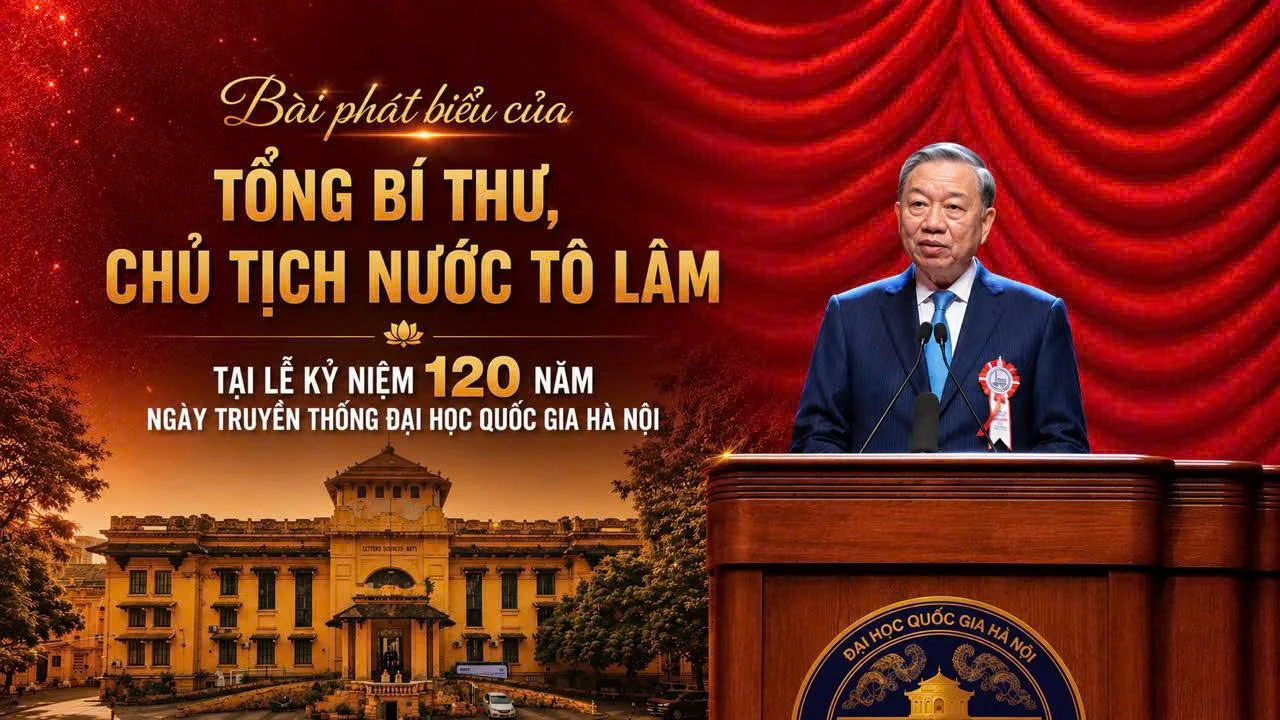
Today, in the great joy of celebrating the 120th anniversary of the tradition of VNU Hanoi, I am deeply moved to recall the university with an extremely special mark. Over 80 years ago, President Ho Chi Minh directly presided over the first opening ceremony of independent Vietnam’s higher education. From that sacred milestone, VNU Hanoi has become a brilliant symbol of Vietnamese intellect, a convergence of academic aspirations, a forge of talent, making important contributions to the cause of national construction and development.
In the solemn, proud, and uplifting atmosphere of the ceremony, on behalf of the Party and State leadership, I cordially send to the leaders, distinguished delegates, generations of professors, researchers, teachers, staff, students, trainees, alumni, and workers of VNU Hanoi our warmest feelings, sincere regards, and best wishes.
Congratulations to VNU Hanoi for receiving the noble award from the Party and State: the First-Class Labor Medal.
Dear comrades and delegates,
Our country has a thousand-year tradition of culture, always considering talents as “the vital energy of the nation,” the decisive foundation for the country’s prosperity or decline. This thought is engraved on the stone steles of the Temple of Literature – Imperial Academy, the first university of Vietnam, and is continued in the development space of VNU Hanoi.
Looking back at the history of the University of Indochina from its inception in 1906, we understand more deeply the significance of today’s traditional day of VNU Hanoi. This is the milestone marking the birth of modern higher education in Vietnam, and also one of the earliest multi-disciplinary, multi-field university models in Southeast Asia. From this school, many generations of Vietnamese intellectuals have matured, choosing the path of dedication and service to the nation, bringing glory to the country. Commemorating the 120th anniversary of VNU Hanoi’s tradition is an occasion for us to be grateful for a persistent flow of knowledge, from the thousand-year tradition of studiousness of the nation, through the milestone of opening modern higher education, to today’s mission of nurturing talents to serve the Fatherland, serve the People, and elevate Vietnamese intellect.
From this school, many generations of Vietnamese intellectuals have matured, choosing the path of dedication and service to the nation, bringing glory to the country.
Dear comrades and distinguished delegates,
After the August Revolution, at the first session of the Provisional Government on September 3, 1945, President Ho Chi Minh affirmed: “An ignorant nation is a weak nation,” and launched a campaign against the “enemy of ignorance” along with the “enemy of hunger” and foreign invaders. That was his profound strategic vision: To maintain independence and build a prosperous country, it is necessary to enlighten the people’s intellect, revitalize the national spirit, and value talents.
In his letter to students on the first opening day of independent Vietnam, he ignited the aspiration for the nation to “step onto the throne of glory to stand shoulder to shoulder with the great powers of the five continents.” That aspiration was quickly realized. In late September 1945, President Ho Chi Minh ordered the “early reopening of the university” and decided to establish the Vietnam National University, building upon and developing from the University of Indochina.
Then, right at this school, on November 15, 1945, Uncle Ho attended and presided over the first opening ceremony of the Vietnam National University, personally awarding diplomas to medical students, and together with comrades Pham Van Dong, Vo Nguyen Giap, Vu Dinh Hoe, etc., participated in teaching some important subjects such as Constitution, Law, and Economics. That image demonstrates the special attention of the young revolutionary state to higher education and sends a strong message about the role of knowledge and talents in the cause of nation-building and defense. The birth of the Vietnam National University marked the beginning of modern Vietnamese higher education in the Independence era. From its first opening day, the school voluntarily undertook the mission of becoming “a strong force among the fighting forces of the Vietnamese nation,” “a fortress for the protracted resistance to fully restore territory and liberate the spirit of the nation.”

![[Infographic] Ý kiến chuyên môn hỗ trợ thực thi quyền sở hữu trí tuệ](https://asiacity.news/wp-content/uploads/2026/05/so-huu-tri-tue-2-3641-150x150.jpg)