Sacrificial animals are stable in price and widely available in Riyadh markets.
The branch of the Ministry of Environment, Water and Agriculture in the Riyadh region confirmed the abundance of sacrificial animals in the region’s markets and the stability of supplies as Eid al-Adha approaches, to enhance the readiness of markets, slaughterhouses, and temporary sales points in Riyadh city and the governorates.
Necessity of purchasing from official sales points and markets
The ministry has authorized over 2.01 million head of live livestock as part of preparations for the Hajj season of 1447 AH, including approximately 2.014 million sheep, 3,673 camels, and 1,031 cows, during the period from 1 Dhu al-Qa’dah to 6 Dhu al-Hijjah.
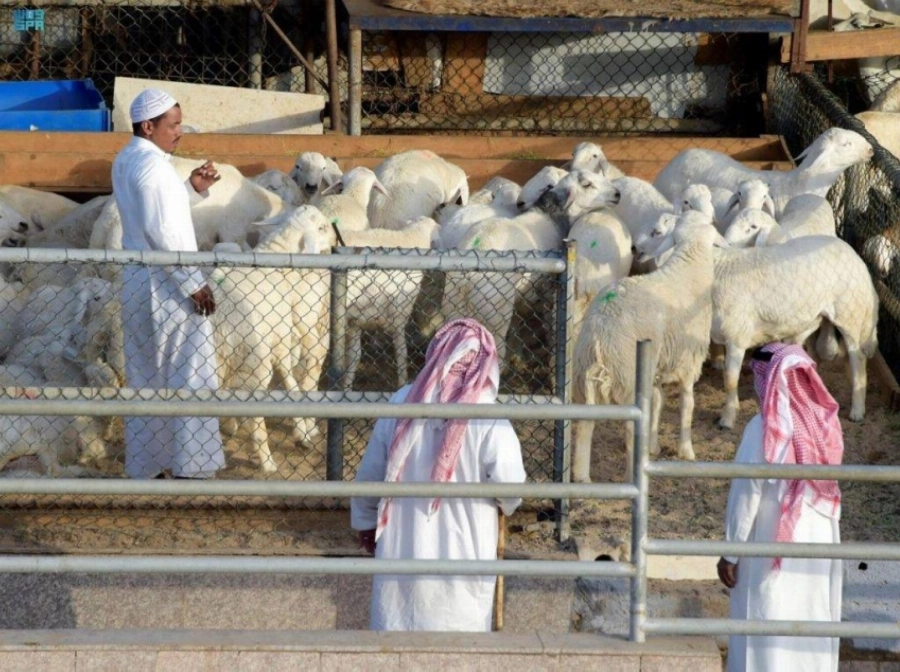
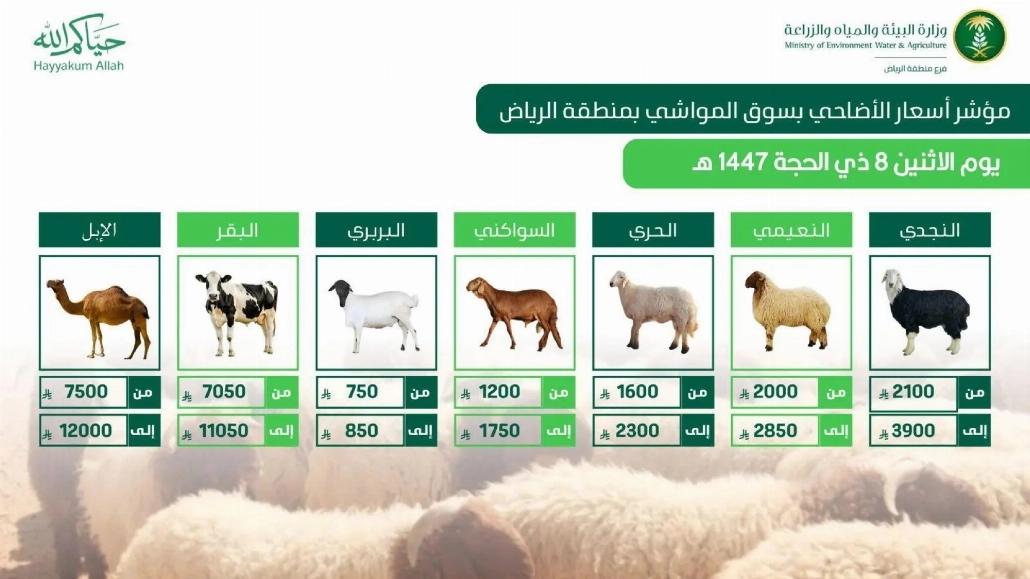
The region’s livestock markets are witnessing high daily inflows of various types of sacrificial animals, with a wide diversity in supply meeting the needs of beneficiaries, along with adequate quantities of Najdi, Naimi, Sawakni sheep, goats, and camels. Daily monitoring of prices and market movement continues.
The branch indicated that field indicators confirm price stability and the availability of suitable options for all segments, noting that some prices circulated on social media do not accurately reflect market reality, especially since there is natural variation in prices depending on type, size, age, sales locations, and services provided.
It explained that temporary sales points in Riyadh city represent an additional supportive option for permanent markets, to enhance accessibility for consumers and reduce operational pressure. Several of these points have been equipped with temporary slaughterhouses and supporting operational services to facilitate official slaughter procedures and improve service efficiency for beneficiaries during the season.
Veterinary and supervisory teams continue their intensive work within markets, sales points, and slaughterhouses to verify the health of sacrificial animals, enforce health and regulatory requirements, monitor animal welfare, and address violations according to approved regulations and instructions.
The branch called on citizens and residents to purchase sacrificial animals from official markets and approved sales points, and to utilize official and temporary slaughterhouse services during Eid days, contributing to public health, environmental safety, and the quality of services provided.
Riyadh
Riyadh is the capital and largest city of Saudi Arabia, located in the heart of the Arabian Peninsula. Originally a small walled settlement known for its date palm oases, it rose to prominence in the 18th century as the stronghold of the Al Saud family and later became the center of the modern Saudi state. Today, Riyadh is a rapidly growing metropolis, blending its rich historical heritage with futuristic skyscrapers and ambitious development projects.
Makkah
Makkah, also spelled Mecca, is the holiest city in Islam, located in western Saudi Arabia. It is the birthplace of the Prophet Muhammad and the site of the Kaaba, the sacred structure within the Masjid al-Haram mosque that Muslims face during prayer. Historically, it has been a major center for pilgrimage and trade for centuries, and today it hosts the annual Hajj pilgrimage, which draws millions of Muslims from around the world.
<h3 class="text-lg font-semib
Riyadh
Riyadh, the capital of Saudi Arabia, evolved from a small, walled desert settlement into a sprawling modern metropolis over the 20th century. It was historically a key stronghold for the House of Saud, and in 1902, King Abdulaziz Al Saud recaptured the city, which became the launchpad for the unification of the kingdom. Today, Riyadh is a hub of commerce, culture, and government, blending its historic mud-brick architecture, like the Masmak Fortress, with futuristic skyscrapers.
Makkah
Makkah, also spelled Mecca, is the holiest city in Islam, located in western Saudi Arabia. It is the birthplace of the Prophet Muhammad and the site of the Kaaba, the sacred structure within the Masjid al-Haram mosque towards which Muslims pray. Historically, Makkah has been a major center for pilgrimage and trade since pre-Islamic times, and today it is the destination of the Hajj, an annual pilgrimage that millions of Muslims undertake.
Masjid al-Haram
Masjid al-Haram, located in Mecca, Saudi Arabia, is the holiest site in Islam and the largest mosque in the world. It surrounds the Kaaba, the structure toward which Muslims pray, and has been a center of pilgrimage since the time of the Prophet Abraham. The mosque has undergone numerous expansions over centuries, most recently in the 21st century, to accommodate the millions of pilgrims who visit annually for Hajj and Umrah.
Kaaba
The Kaaba is a sacred cube-shaped building located in the center of the Grand Mosque in Mecca, Saudi Arabia, and is the holiest site in Islam. According to Islamic tradition, it was originally built by the prophet Abraham and his son Ishmael as a house of monotheistic worship, though it was later used for polytheistic practices before being rededicated by the Prophet Muhammad in 630 CE. Muslims around the world face the Kaaba during their daily prayers, and it is the focal point of the Hajj pilgrimage.