The King Salman Humanitarian Aid and Relief Center continues to implement a series of relief initiatives in various Arab countries, targeting affected and vulnerable groups, as part of the Kingdom’s ongoing efforts to alleviate humanitarian crises and enhance rapid response.
Syria: Date Distribution to Mitigate Flood Impact
In the Deir ez-Zor region of Syria, the center delivered 720 cartons of dates to families affected by the rising waters of the Euphrates River. The operation included 720 families who benefited from this assistance as part of the Saudi aid project for the Syrian people, aiming to alleviate the effects of disasters and crises they are experiencing.
Gaza Strip: Hot Meals for the Most Needy
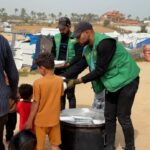
In central and southern Gaza Strip, the center’s central kitchen distributed a total of 25,000 hot meals to the most needy groups, as part of the Saudi popular campaign to relieve the Palestinian people. These meals benefited 25,000 people, helping to ease the suffering of affected families due to difficult humanitarian conditions.
Sudan: Food Baskets for Returnees from Displacement
In the city of Wad Rawah in Sudan’s Al Jazirah state, the center distributed 800 food baskets to returnees and those affected by the humanitarian crisis. This action was implemented as part of the “Maddad” project for the current year, reaching 4,185 beneficiaries, contributing to providing basic needs for families suffering from deteriorating conditions.
Yemen: Operation of the Prosthetics Center in Seiyun
The project to operate the Prosthetics and Rehabilitation Center in Seiyun city in Hadhramaut continued to provide medical services to patients and amputees. During the past month of May, 578 patients benefited from the center’s activities, with 1,552 services provided, including manufacturing and fitting prosthetics, as well as physical therapy sessions and specialized consultations. Male beneficiaries accounted for 54% compared to 46% for females, while displaced persons made up 15% of total beneficiaries, and residents 85%.
These diverse activities reflect the renewed humanitarian role of the Kingdom through the King Salman Humanitarian Aid and Relief Center, seeking to provide food, medical, and relief support to affected peoples, thereby contributing to alleviating the suffering of the most needy groups and improving their living conditions.
Deir ez-Zor
Deir ez-Zor is a city in eastern Syria on the Euphrates River, historically significant as a key trading and transport hub. It was the site of a major Armenian Genocide memorial, destroyed by ISIS in 2014, and saw heavy fighting during the Syrian Civil War. The city has a rich history dating back to ancient times, with Ottoman-era bridges and a famous suspension bridge.
Euphrates River
The Euphrates River is one of the longest and most historically significant rivers in Western Asia, flowing through Turkey, Syria, and Iraq. It was a vital water source for ancient Mesopotamian civilizations, including the Sumerians, Babylonians, and Assyrians, and is often cited as one of the rivers of the biblical Garden of Eden. Today, the river remains crucial for agriculture, hydroelectric power, and regional geopolitics, though its flow has been impacted by dams and political tensions.
Gaza Strip
The Gaza Strip is a narrow coastal territory along the Mediterranean Sea, bordered by Israel and Egypt, with a history of control by various empires including the Egyptians, Philistines, Romans, and Ottomans. In modern times, it was administered by Egypt after the 1948 Arab-Israeli war, then occupied by Israel from 1967 until 2005,
Deir ez-Zor
Deir ez-Zor is a city in eastern Syria on the Euphrates River, historically significant as a key trade and transport hub. It was part of the Ottoman Empire until World War I, and later became a site of notable archaeological discoveries, including the ancient city of Dura-Europos nearby. In the 21st century, the city suffered extensive damage during the Syrian Civil War, particularly during the siege by ISIS from 2014 to 2017.
Euphrates River
The Euphrates River is one of the longest and most historically significant rivers in Western Asia, flowing through Turkey, Syria, and Iraq. It was a cradle of ancient civilizations, including the Sumerians, Akkadians, Babylonians, and Assyrians, who relied on its waters for agriculture and trade. The river is also mentioned in religious texts such as the Bible and Quran, and its basins contain archaeological sites like the ancient city of Mari.
Gaza Strip
The Gaza Strip is a densely populated Palestinian territory on the eastern coast of the Mediterranean Sea, bordered by Israel and Egypt. Its history includes ancient Philistine and Canaanite roots, control by various empires, and a significant modern period under Egyptian administration (1948-1967) followed by Israeli occupation after the 1967 Six-Day War. Since 2007, the area has been governed by Hamas and has faced recurring conflict, a blockade, and severe humanitarian crises.
Wad Rawah
Wad Rawah is an archaeological site in Sudan, located along the Nile River, known for its ancient rock art and inscriptions dating back to the Kingdom of Kush. The site features engravings of animals, boats, and human figures, offering insight into the region’s prehistoric and early historical cultures. Its carvings reflect the area’s significance as a crossroads for trade and cultural exchange in the Nile Valley.
Al Jazirah state
Al Jazirah State is a region in central Sudan, named after the fertile land between the Blue and White Niles. Its history is deeply tied to the Gezira Scheme, one of the world’s largest irrigation projects, which began in the early 20th century under British colonial rule and transformed the area into a major producer of cotton and other crops. Today, the state remains a vital agricultural hub, with its capital at Wad Madani serving as a key economic and cultural center.
Seiyun
Seiyun is a historic city in the Hadhramaut region of Yemen, renowned for its striking mud-brick architecture, including the iconic Seiyun Palace, which served as the residence of the local sultan. The city was once a key stop along ancient incense trade routes and later became a cultural and administrative center under the Qu’aiti Sultanate in the 19th and early 20th centuries. Today, it remains a symbol of Hadhrami heritage, with its traditional buildings and lively souks attracting visitors interested in Yemeni history.
Hadhramaut
Hadhramaut is a historical region in southern Yemen, known for its ancient cities, distinctive mud-brick architecture, and deep-rooted cultural heritage. It was a key center along the frankincense trade route and has been inhabited for millennia, with the famous Wadi Hadhramaut valley hosting the UNESCO-listed city of Shibam, often called the “Manhattan of the Desert.” The region also played a significant role in Islamic history and the spread of Sufism, with many of its inhabitants migrating across the Indian Ocean as traders and scholars.
Syria
Syria is a country in the Middle East with a rich and ancient history, home to some of the world’s oldest continuously inhabited cities, such as Damascus and Aleppo. It was a major center of early civilization, including the Eblaite and Aramean kingdoms, and later became part of the Roman, Byzantine, and Ottoman empires. In modern times, Syria gained independence in 1946, but has faced devastating civil war since 2011, which has heavily damaged its cultural heritage sites.