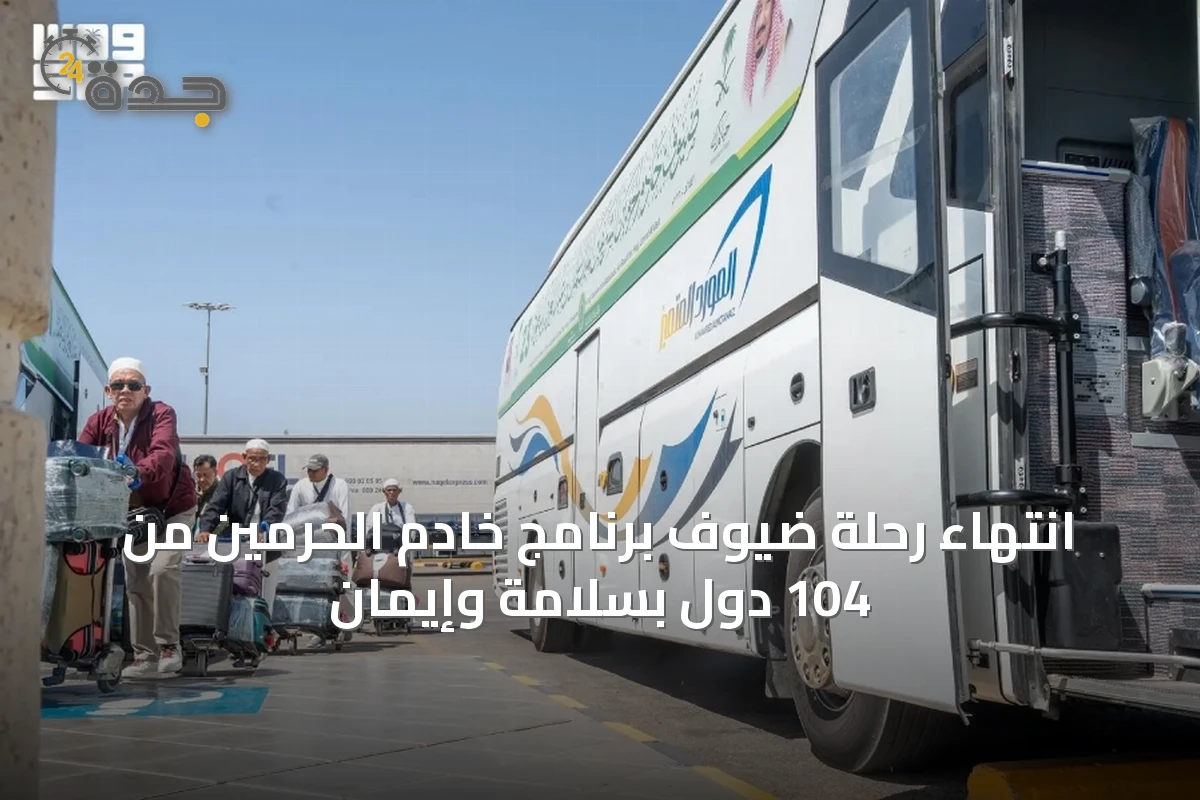
The Ministry of Islamic Affairs, Dawah and Guidance announced that all guests of the Custodian of the Two Holy Mosques Program for Hajj, Umrah, and Visit have left the country after completing their rituals, representing one hundred and four countries from various continents.
End of Stay and Departure Procedures
The guests were transported to Prince Mohammed bin Abdulaziz International Airport in Medina, where departure operations proceeded smoothly thanks to a coordinated and integrated service system, reflecting the Ministry’s commitment to providing a comfortable and hassle-free experience.
Comprehensive Cultural and Spiritual Program
The stay included a variety of activities, featuring cultural and educational programs, as well as field visits to Islamic and historical landmarks in Mecca and Medina, within a comprehensive framework of services and care provided by the relevant authority in implementation of leadership directives.
Guests’ Appreciation for Leadership and Organizational Efforts
The participants expressed their deep gratitude to King Salman bin Abdulaziz, the Custodian of the Two Holy Mosques, and to Crown Prince Mohammed bin Salman, noting the care and attention they received, which facilitated their performance of the rituals with ease and safety.
They affirmed that the meticulous organization and integrated services they witnessed demonstrate the great efforts made by the Kingdom in serving Islam and Muslims, praising the role of the Ministry of Islamic Affairs, Dawah and Guidance in providing the highest levels of hospitality and care throughout their stay.
Prayers for Goodness and Continuity
The guests concluded their prayers for the Kingdom and its leadership to remain steadfast on the path of security and stability, asking the Almighty to protect the country and bestow upon it the blessing of prosperity.
Two Holy Mosques
The “Two Holy Mosques” refers to the Masjid al-Haram in Mecca and the Al-Masjid an-Nabawi in Medina, the two holiest sites in Islam. Masjid al-Haram surrounds the Kaaba, the direction of prayer for Muslims worldwide, and has been expanded over centuries since the time of Prophet Abraham. Al-Masjid an-Nabawi, built by the Prophet Muhammad himself in 622 CE, houses his tomb and has undergone numerous expansions, most notably by the Saudi government to accommodate millions of pilgrims.
Prince Mohammed bin Abdulaziz International Airport
Prince Mohammed bin Abdulaziz International Airport, located in Medina, Saudi Arabia, serves as a key gateway for pilgrims visiting the Prophet’s Mosque. Originally opened in 1974 as a smaller domestic facility, it was significantly expanded and renamed in 2015 to accommodate increasing international traffic, particularly during the Hajj and Umrah seasons. The airport now features a modern terminal and plays a vital role in connecting the holy city to destinations across the Middle East, Asia, and Europe.
Mecca
Mecca is the holiest city in Islam, located in western Saudi Arabia. It is the birthplace of the Prophet Muhammad and the site of the Kaaba, the sacred structure within the Masjid al-Haram mosque that Muslims face during prayer. Every year, millions of pilgrims visit Mecca to perform the Hajj, a mandatory religious duty, with its history as a spiritual center dating back to pre-Islamic times.
Medina
Medina, known as the “City of the Prophet,” is the second holiest city in Islam, located in western Saudi Arabia. It is most famous as the site where the Prophet Muhammad migrated in 622 CE (the Hijra) and established the first Muslim community, and it houses his final resting place within the Al-Masjid an-Nabawi (the Prophet’s Mosque). The city served as the early political and spiritual capital of the Islamic world and remains a major pilgrimage destination for Muslims visiting the mosque.