
8-new-daily-records-for-the-e-delivery-sector

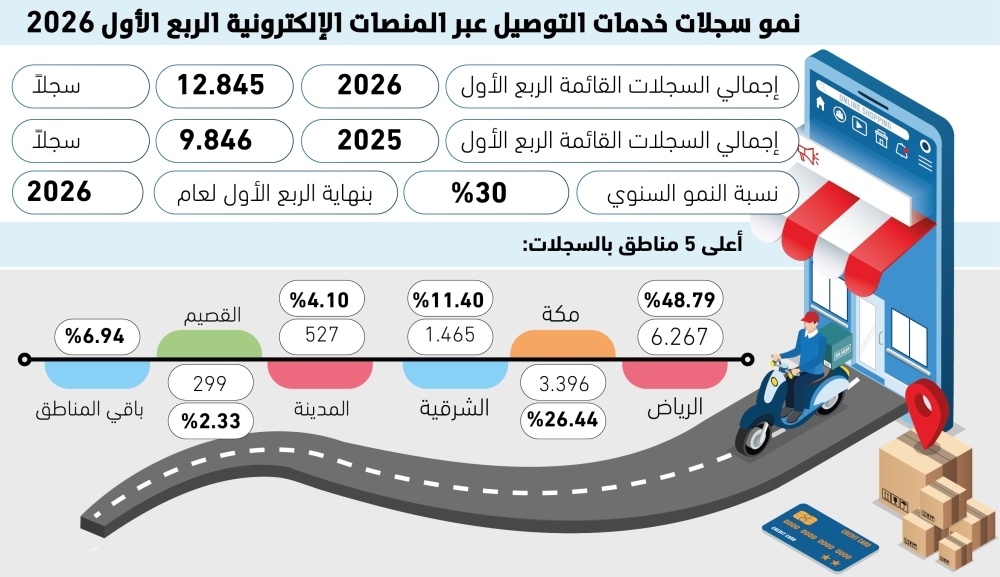
The platform-based delivery services sector recorded an annual growth of 30% by the end of the first quarter of 2026, with the total number of active commercial records in this activity jumping to 12,845, compared to approximately 9,846 records in the same period last year, an increase of 2,999 records, equivalent to 8 new records per day.

This notable rise in commercial records for this activity coincides with the significant and accelerating growth of e-commerce and the increasing role of technological solutions in meeting consumer needs. This has transformed the sector from a mere supplementary service into a logistical infrastructure that the growth of the private sector heavily relies upon, effectively contributing to solidifying the Kingdom’s position as a global logistics hub.

Key Regions

According to the periodic report from the Ministry of Commerce for the first quarter of 2026, the Riyadh region accounted for the largest share of records in the electronic delivery sector, with 48.79% of the Kingdom’s total records, amounting to 6,267 records. The Makkah region came in second with a share of 26.44%, achieving 3,396 records, followed by the Eastern Region, which recorded a presence of 1,465 records at 11.40%. Other regions were not isolated from this growth, with Al-Madinah recording 527 records at 4.10%, and Al-Qassim 299 records at 2.33%. The remaining regions of the Kingdom shared the remaining percentage of 6.94%, demonstrating the spread of technological investment growth to encompass all regions of the Kingdom, driven by increased consumer awareness and the development of digital payment services.

Global Growth

On the international level, this local scene is inseparable from a major global boom. Economic estimates for 2026 indicate that the size of the global electronic delivery platform market is heading to surpass the $350 billion barrier, with a compound annual growth rate approaching 12%. These global gains are the fruit of structural shifts in global consumer behavior, where digital platforms now dominate over 58% of channels reaching the end consumer. This boom has enhanced global economic gains by creating new value chains and improving supply chain efficiency through artificial intelligence technologies, contributing to lower operational costs and opening billion-dollar investment horizons in ‘last-mile’ technologies and logistics automation.

Employment Growth

In terms of the labor market and sector localization, electronic delivery activity in the Kingdom has transformed into one of the largest job incubators for Saudi youth. The number of citizens working in this sector, whether under full-time employment or ‘freelance’ work, exceeded the barrier of 100,000 active practitioners by the end of last year. Government support programs, led by the Human Resources Development Fund in cooperation with the General Transport Authority, played


Riyadh region

The Riyadh region is the historic heart of Saudi Arabia, centered on the capital city of Riyadh. It was the seat of the First and Second Saudi States before becoming the permanent capital in 1932 following the kingdom’s unification by King Abdulaziz Al Saud. Today, it is a major political, financial, and administrative hub, where modern skyscrapers stand alongside historic sites like Diriyah, the original home of the Saudi royal family.

Makkah region

The Makkah region, located in western Saudi Arabia, is the spiritual heart of Islam and home to the holy city of **Makkah (Mecca)**. Its history is defined by the birth of the Prophet Muhammad in 570 CE and the subsequent revelation of the Quran, which established the Kaaba in the Grand Mosque (Masjid al-Haram) as the holiest site and focal point for Muslim prayer and pilgrimage (Hajj). For over 1,400 years, it has been the eternal and exclusive destination for millions of Muslims worldwide, with its religious significance strictly prohibiting entry for non-Muslims.

Eastern Region

The Eastern Region is a large administrative area of Saudi Arabia, historically significant as the heart of the nation’s oil discovery and industry. It is home to the UNESCO World Heritage Site of Al-Ahsa Oasis, one of the world’s largest oases with a history of continuous human settlement for thousands of years. The region’s major urban center, Dammam, along with Dhahran and Al Khobar, forms a key commercial hub on the Persian Gulf coast.

Al-Madinah

Al-Madinah, officially known as Medina, is a city in western Saudi Arabia revered as the second holiest city in Islam. It is historically significant as the site where the Prophet Muhammad migrated to in 622 CE (the Hijrah), establishing it as the first capital of the Islamic community and the location of his tomb within the Prophet’s Mosque (Al-Masjid an-Nabawi). The city remains a major pilgrimage destination and a central spiritual and scholarly center for Muslims worldwide.

Al-Qassim

Al-Qassim is a central region of Saudi Arabia, historically known as a major agricultural heartland and a crossroads for ancient trade routes. It is famous for its vast date palm groves and its historical significance as a cultural and commercial hub in the Najd plateau. The region’s history is deeply tied to the early Saudi states and it remains a symbol of traditional Najdi heritage.

Kingdom

“Kingdom” is too broad a term for a specific place or cultural site, as it could refer to many historical or modern nations (e.g., the Kingdom of Saudi Arabia), fictional realms, or even entertainment venues. If referring to a historical kingdom, such as the ancient Kingdom of Kush in Nubia, it was a major African power along the Nile from around 1070 BCE to 350 CE, known for its wealth, ironworking, and pyramids. For a more accurate summary, please specify a particular kingdom or site.