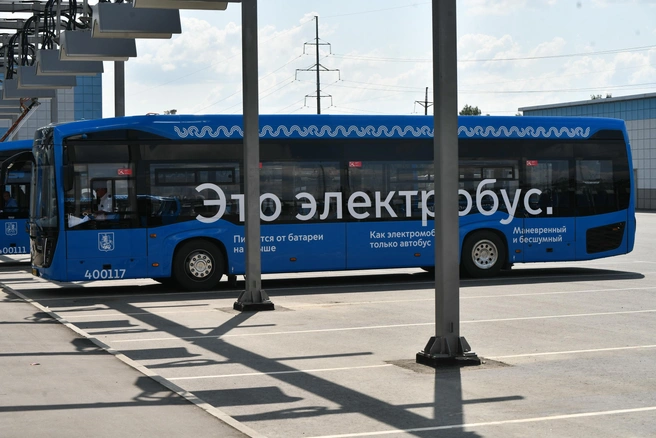
Moscow has expanded its fleet of electric buses. Under a contract with PJSC “KAMAZ” from 2025, 400 new-generation vehicles were delivered to the capital. Russian-made electric buses are already operating at 9 Mosgortrans operational sites.
Since the start of operation, the new-generation electric buses have already traveled more than 4.2 million kilometers and have proven their reliability in use. The network of eco-friendly ground transport routes will continue to be developed.
It was also noted that electric buses, as modern and eco-friendly transport, make travel around the city more comfortable and safer. These vehicles have a smooth ride, without noise and vibrations, and are equipped with a folding ramp and call buttons for the driver for passengers with limited mobility, a storage area for strollers and bicycles. The interiors are equipped with charging ports for gadgets and information media screens.
The capital is developing infrastructure for eco-friendly ground transport. Modern electric buses have been transporting residents and guests of Moscow since 2018.
Moscow was the first in the country to begin building modern electric bus depots. In 2022, the first in Russia and the largest in Europe electric bus depot, “Krasnaya Pakhra,” opened in TiNAO. Eco-friendly vehicles began operating on routes in the Novomoskovsky and Troitsky administrative districts. A year later, the “Mitino” depot was built in the northwest. With its appearance, electric buses began running on routes in 20 districts of the capital and two nearby cities in the Moscow region. At the end of 2023, a third innovative electric bus depot, “Saltykovka,” began operation. It serves routes in the eastern part of the city. In total, electric buses are serviced at 12 Mosgortrans sites.
In electric buses supplied since 2022, the range has increased from 40–50 km to 80–90 km, while the vehicle’s weight has remained unchanged. However, changes have been made to the interior lighting—it has become adaptive—and the route indicator has been enlarged to be visible from a distance.
Since 2025, new-generation KAMAZ-52222 electric buses have been entering service. They feature a redesigned interior layout and a 15% larger storage area, a space for hand luggage, and a modified door design. The climate control system has also been updated, and light strips indicating door opening and closing have been added. All electric buses meet safety and service level standards.
Increasing the number of urban transport routes and renewing the rolling stock are part of the modernization of social and utility infrastructure. They align with the goals of the national project “Infrastructure for Life.” Furthermore, under the national project, Moscow has begun developing the Central Transport Hub. It will become a unified circuit with predictable suburban rail transport for more than 30 million residents of 11 regions of Russia.
Moscow
Moscow is the capital and largest city of Russia, founded in 1147. Historically the heart of the Russian state, it is famed for the Kremlin, a historic fortress complex that has been the seat of power for centuries, and Red Square, a UNESCO World Heritage site. The city showcases a blend of architectural styles, from medieval churches like St. Basil’s Cathedral to Soviet-era monuments and modern skyscrapers.
Mosgortrans
“Mosgortrans” is the common name for the Moscow Municipal Transport Company, the primary operator of public ground transportation in Moscow, Russia. It was established in 1958 to consolidate and manage the city’s extensive network of buses, trolleybuses, and trams. Today, it is a key part of Moscow’s infrastructure, historically known for its iconic vehicles and for evolving into a modern system integrated with the metro.
Krasnaya Pakhra
Krasnaya Pakhra is a rural settlement and former estate area located southwest of Moscow, Russia. Historically, it was part of a network of noble country estates, with the most notable being the 18th-century **Valuevo Estate**, which was owned by several prominent Russian families and features a preserved classical palace and park. Today, it is primarily a residential area within the Moscow region, known for its historical architecture and surrounding forested landscapes.
TiNAO
“TiNAO” refers to the **Templo Mayor Museum** (Museo del Templo Mayor) in Mexico City, built adjacent to the excavated ruins of the main Aztec temple. The site was the sacred center of Tenochtitlan, the capital of the Aztec Empire, and was largely destroyed by the Spanish in the 16th century. The modern museum, opened in 1987, houses thousands of artifacts discovered at the site, showcasing the history, religion, and daily life of the Aztec civilization.
Novomoskovsky
Novomoskovsky is a city in Tula Oblast, Russia, founded in 1930 as a settlement for workers building a nearby chemical plant. It was originally named Stalinogorsk and was developed as a key industrial center in the Soviet era, later being renamed to its current form in 1961. Today, it remains an important industrial city, known for its chemical production and as a significant railway junction.
Troitsky
“Troitsky” most commonly refers to the Trinity Lavra of St. Sergius (Sergiyev Posad), a historic Russian Orthodox monastery near Moscow. Founded in 1337 by St. Sergius of Radonezh, it became the spiritual center of Russia and played a key role in its history, including during the Time of Troubles. Today, it is a UNESCO World Heritage Site, functioning as both a major pilgrimage destination and the residence of the Patriarch of the Russian Orthodox Church.
Mitino
Mitino is a residential district in northwestern Moscow, Russia, known for its large, modern apartment complexes built primarily in the late 1980s and 1990s. Historically, the area was a village dating back to at least the 16th century, but its most significant ancient feature is the nearby Mitino Cemetery, which contains archaeological remains of a medieval Slavic settlement and burial mounds from the 12th-13th centuries. Today, it is a populous suburb with extensive green spaces, including the Mitino Landscape Park.
Saltykovka
Saltykovka is a historic dacha settlement (summer cottage community) located in the Balashikha urban district of Moscow Oblast, Russia. It was founded in the late 19th century and became a popular retreat for Moscow’s artistic and intellectual elite, including famous writers and painters. Today, it is known for its preserved wooden architecture from that period and its status as part of the greater Moscow metropolitan area.