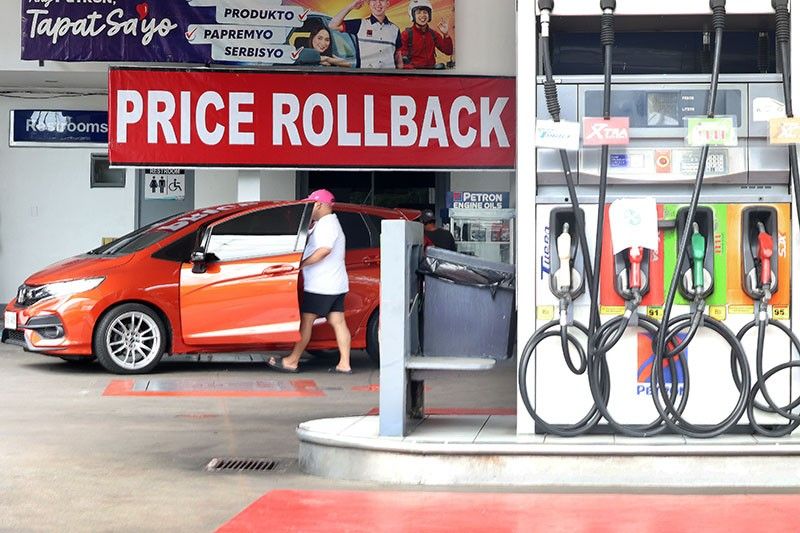
Motorists pass by a “price rollback” banner at a gasoline station along Katipunan Avenue in Quezon City following weeks of relentless price hikes. Fuel companies implemented price rollbacks with diesel by ₱20.89 per liter, gasoline by ₱4.43 per liter and kerosene by ₱8.50 per liter.
MANILA, Philippines — There is reportedly no certainty if the rollback in the prices of petroleum products in the country will continue, following the significant price reductions implemented by oil companies this week.
The Energy Secretary explained that the latest rollback was due to a temporary decrease in oil prices in the global market, following the announcement of a ceasefire between the United States and Iran.
However, this is not a guarantee that the rollback will continue as tensions in the Middle East persist.
It will be recalled that effective April 14, oil companies reduced prices by a minimum of ₱20.89 per liter for diesel, ₱4.43 for gasoline, and ₱8.50 for kerosene.
“So, will it continue to go down? There’s no assurance for that, if they still continue the war. Then, if they stop the war today, I think the prices will still be on the high side for a few months still,” the Secretary added.
The Secretary also explained that unfortunately, the statements of US President Donald Trump also affect trading prices.
“So, we are really at the mercy of these countries. We are not even part of it,” they said.
In relation to this, the Secretary assured that the Department of Energy (DOE) is taking action to secure additional supply of petroleum products, through the Philippine National Oil Company (PNOC).
Katipunan Avenue
Katipunan Avenue is a major thoroughfare in Quezon City, Philippines, named after the Katipunan, the secret revolutionary society that fought for independence from Spanish rule in the late 19th century. It runs through a prominent academic district, passing by several major universities, and serves as a key transport artery in eastern Metro Manila.
Quezon City
Quezon City was founded in 1939 and served as the capital of the Philippines from 1948 to 1976, named after the country’s second president, Manuel L. Quezon. Today, it is the most populous city in the Philippines and a major hub for government, education, and commerce, housing landmarks like the Quezon Memorial Circle.
Manila
Manila is the capital city of the Philippines, founded in 1571 by Spanish conquistadors on the site of a pre-existing Muslim settlement. It served as a vital colonial port for the Spanish Empire’s trade across the Pacific for over three centuries. Today, the historic walled city of Intramuros stands as a prominent reminder of this colonial past amidst the modern metropolis.
Philippines
The Philippines is an archipelagic nation in Southeast Asia with a rich cultural history shaped by centuries of colonization, most notably by Spain for over 300 years and later by the United States. This complex past is reflected in its unique blend of Asian, Hispanic, and American influences, visible in its languages, religions, festivals, and historic sites like the Baroque churches and the ancient rice terraces of the Cordilleras.
United States
The United States is a federal republic founded in 1776 after declaring independence from Great Britain, with its modern government established by the Constitution in 1787. Culturally, it is a vast and diverse nation built on immigration, known globally for its influential contributions in areas like technology, cinema, music, and democratic ideals. Key historical sites span from Native American heritage and colonial settlements to landmarks of the Civil Rights Movement and symbols of innovation.
Iran
Iran, historically known as Persia, is a country in Western Asia with one of the world’s oldest continuous major civilizations, dating back to the Elamite kingdoms of the 4th millennium BCE. It is home to numerous UNESCO World Heritage Sites, including the magnificent ruins of Persepolis, the ceremonial capital of the Achaemenid Empire founded in the 6th century BCE. Today, Iran’s rich cultural heritage is reflected in its intricate architecture, poetry, and traditions, shaped by a history of powerful empires and its 1979 Islamic Revolution.
Middle East
The Middle East is a transcontinental region centered on Western Asia and Egypt, historically known as the “Cradle of Civilization” for the emergence of ancient cultures like Mesopotamia and the birthplace of major world religions. Its history is defined by successive empires, from the Persians and Ottomans to the influence of 20th-century colonial powers, which shaped its modern political borders. Today, it remains a globally significant area due to its vast energy resources, profound cultural heritage, and complex geopolitical dynamics.
Philippine National Oil Company (PNOC)
The Philippine National Oil Company (PNOC) is a state-owned corporation established in 1973 to ensure the country’s energy security and reduce dependence on imported oil. It has historically been involved in upstream and downstream oil activities, exploration, and the development of alternative energy resources. Today, it functions as a holding company for government energy-related investments and projects.