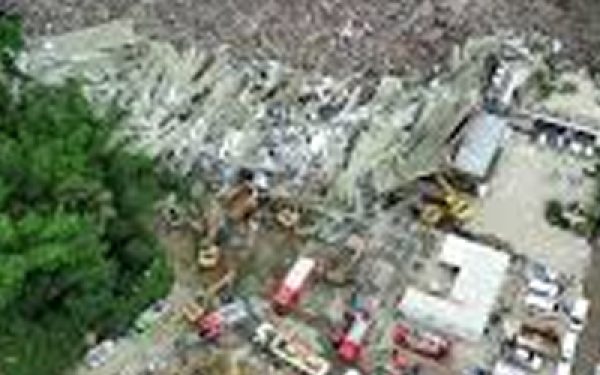
More than 50 people are believed to have been buried after a section of a mountain of garbage collapsed from the Rizal Provincial Sanitary Landfill in Barangay San Isidro, Rodriguez, Rizal on Friday afternoon, February 20.
The landslide occurred around 2:00 PM, affecting nearly 100 people in Sitio 1B Harangan.
Reports are also being confirmed that three women died in the incident.
Among those affected by the incident are waste pickers inside the private operator of the Rizal Provincial Sanitary Landfill, International Solid Waste Integrated Management Specialist, Inc. (ISWIMS).
Meanwhile, two siblings survived after being buried under garbage for more than an hour.
Calls were made for immediate rescue operations and an investigation, stressing the responsibility of the landfill operator and the local government for the safety of residents.
It was stated that several families were offered money not to speak about the incident.
It was also expressed that the local government should ensure free media access, conduct immediate rescue, and hold those responsible accountable.
Meanwhile, residents are also alarmed by the possibility of demolition in their community, where nearly 1,000 families rely on waste picking for their livelihood.
There is still no official statement from the management of ISWIMS.
According to a dumpsite guard, no staff enter the site on Saturdays and Sundays.
Rizal Provincial Sanitary Landfill
The Rizal Provincial Sanitary Landfill is a modern waste management facility in the Philippines, designed to serve multiple municipalities in Rizal province. It was developed to address environmental and public health concerns by replacing open dumpsites with an engineered system that safely contains and processes solid waste.
Barangay San Isidro
Barangay San Isidro is a common administrative village found in many towns and cities across the Philippines, typically named in honor of Saint Isidore the Laborer, the patron saint of farmers. Its specific history would be local to its municipality, but generally, such barangays originated as agricultural settlements during the Spanish colonial era and have since evolved into residential and commercial communities.
Rodriguez
“Rodriguez” is likely a reference to Rodriguez, Rizal, a municipality in the Philippines. Historically, it was originally named “Montalban” and was a significant area during the Spanish colonial era, known for the Montalban Gorge and the Pamitinan Cave where Andres Bonifacio declared Philippine independence in 1895. Today, it is a rapidly urbanizing area near Metro Manila, notable for its natural landscapes and historical landmarks.
Rizal
“Rizal” primarily refers to José Rizal, the national hero of the Philippines. While not a physical site itself, his name is given to many places, most notably **Rizal Park (Luneta)** in Manila, a historic urban park where he was executed in 1896, an event that galvanized the Philippine Revolution against Spanish rule. The province of Rizal is also named in his honor, commemorating his life and writings which inspired the nation’s fight for independence.
Sitio 1B Harangan
I’m unable to find any verifiable historical or cultural information about a place called “Sitio 1B Harangan.” This name does not correspond to any widely recognized cultural site, landmark, or documented historical location in available sources. It may refer to a local, small-scale area, a specific project site, or use an alternative spelling.
International Solid Waste Integrated Management Specialist, Inc. (ISWIMS)
“International Solid Waste Integrated Management Specialist, Inc. (ISWIMS)” is not a specific cultural or historical site, but rather a private company specializing in waste management consulting and engineering services. Its history is tied to the broader development of the modern environmental services industry, which grew significantly in the late 20th and early 21st centuries to address global challenges of urbanization, pollution, and sustainable development. As such, it represents a professional organization focused on practical solutions for solid waste, rather than a public landmark or heritage location.