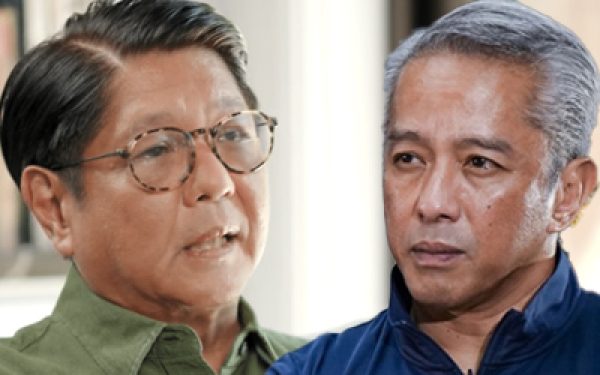
Jonvic Remulla nominated by President Bongbong Marcos.
President Ferdinand “Bongbong” Marcos Jr. is reportedly disappointed with Interior and Local Government Secretary Jonvic Remulla over the failure to capture high-profile fugitives, including Senator Ronald “Bato” dela Rosa.
According to a report, an informant said the President was disappointed with Remulla’s approach, which focused more on grandstanding rather than immediate action.
This reportedly came to light during a press briefing at Malacañang on May 19 regarding Dela Rosa’s escape, where Remulla suddenly disappeared before the briefing ended, along with Philippine National Police (PNP) Chief P/Gen. Jose Melencio Nartatez Jr. and Acting Justice Secretary Fredderick Vida.
“Marcos allegedly ordered Jonvic to be pulled out because his statements were no longer aligned with Nartatez’s messaging,” according to the informant.
The President has long been considering bringing back former DILG Secretary Benhur Abalos, but Remulla remained in his position reportedly due to his brother, Ombudsman Jesus Crispin “Boying” Remulla.
Remulla received criticism for his allegedly slow action in executing the International Criminal Court (ICC) arrest warrant for Dela Rosa, who stayed in the Senate for three days until leaving on May 14 after a shooting incident.
According to the informant, Remulla should have acted immediately after the Supreme Court denied the senator’s request for a temporary restraining order.
“Instead of moving decisively once the TRO was denied, he went to the Senate during the height of the May 13 shooting incident, faced the media while limping, and publicly announced that he was not there to arrest Dela Rosa,” the informant added.
Aside from Dela Rosa, other unarrested individuals include former Presidential Spokesperson Harry Roque, who faces a qualified human trafficking case due to his involvement in Pampanga POGO operations; businessman Charlie “Atong” Ang, linked to the case of missing cockfighting enthusiasts; and former Ako Bicol Party-list Rep. Zaldy Co, implicated in the flood control scam.
Malacañang
Malacañang is the official residence and principal workplace of the President of the Philippines, located in Manila. Originally built in 1750 as a summer house for a Spanish aristocrat, it became the Spanish governor-general’s residence in 1825 and later the seat of power for American and Philippine leaders. The complex has witnessed significant historical events, including the declaration of martial law in 1972 and the People Power Revolution in 1986.
Senate
The Senate is a key legislative body in many governments, most notably the United States Senate, which was established in 1789 as part of the bicameral Congress. It was designed to provide equal representation for each state, with two senators per state, and has played a central role in shaping national laws, treaties, and confirmations. The U.S. Senate meets in the Capitol building in Washington, D.C., and its history includes debates over major issues such as civil rights and federal power.
Supreme Court
<div
Malacañang
Malacañang is the official residence and principal workplace of the President of the Philippines, located in Manila. Originally built in the 18th century as a summer house for a Spanish aristocrat, it was later acquired by the Spanish colonial government and eventually became the seat of executive power. The palace has witnessed numerous historical events, including the American colonial period, the Japanese occupation, and the People Power Revolution that ousted President Ferdinand Marcos in 1986.
Senate
The Senate is a key legislative body in many countries, most famously the United States Senate, which was established in 1789 as part of the bicameral Congress. It was created to represent states equally, with two senators per state, and has played a central role in American history by debating laws, confirming presidential appointments, and ratifying treaties. The term “Senate” originates from the ancient Roman Senate, a governing council that advised leaders and influenced early democratic systems.
Supreme Court
The Supreme Court of the United States is the highest federal court in the country, established by Article III of the Constitution in 1789. It holds the power of judicial review, allowing it to declare laws unconstitutional, a power solidified in the landmark 1803 case Marbury v. Madison. Located in Washington, D.C., its iconic neoclassical building was completed in 1935, symbolizing the judiciary’s role as a co-equal branch of government.
International Criminal Court
The International Criminal Court (ICC) is a permanent international tribunal located in The Hague, Netherlands, established to prosecute individuals for genocide, war crimes, crimes against humanity, and the crime of aggression. It was created by the Rome Statute, which entered into force on July 1, 2002, after being ratified by 60 countries, marking a historic step toward ending impunity for the world’s most serious crimes. As a court of last resort, it complements national judicial systems and has since investigated cases in regions such as Africa, Asia, and Eastern Europe.
Philippine National Police
The Philippine National Police (PNP) is the primary law enforcement agency in the Philippines, established on January 29, 1991, through Republic Act 6975, which merged the Philippine Constabulary and the Integrated National Police. Its history traces back to the Spanish colonial era, evolving through American rule and the Marcos dictatorship, where it was often criticized for human rights abuses. Today, the PNP is tasked with maintaining peace, order, and public safety across the country.
Pampanga
Pampanga is a province in the Philippines known for its rich culinary heritage and historical significance. It was one of the first provinces to rebel against Spanish colonial rule in 1896, and it later became a key site during the Philippine-American War. Today, Pampanga is celebrated for its Kapampangan cuisine, such as sisig and tocino, and landmarks like the Mount Pinatubo volcano and the historic city of Angeles.
Ako Bicol Party-list
The Ako Bicol Party-list is a political organization in the Philippines that represents the interests of the Bicolano people and region. It was established to advocate for the rights, development, and welfare of Bicolanos in the national government, focusing on issues such as agriculture, education, and disaster resilience. The party-list has consistently participated in Philippine elections since the early 2000s, aiming to amplify the voice of the Bicol region in Congress.
People Power Revolution
The People Power Revolution was a series of nonviolent protests in the Philippines in February 1986 that successfully ousted the authoritarian regime of President Ferdinand Marcos. The movement, fueled by widespread public outrage over election fraud and human rights abuses, culminated in millions of Filipinos gathering on Epifanio de los Santos Avenue (EDSA) to demand change. This historic uprising restored democracy to the country and inspired similar peaceful movements worldwide.