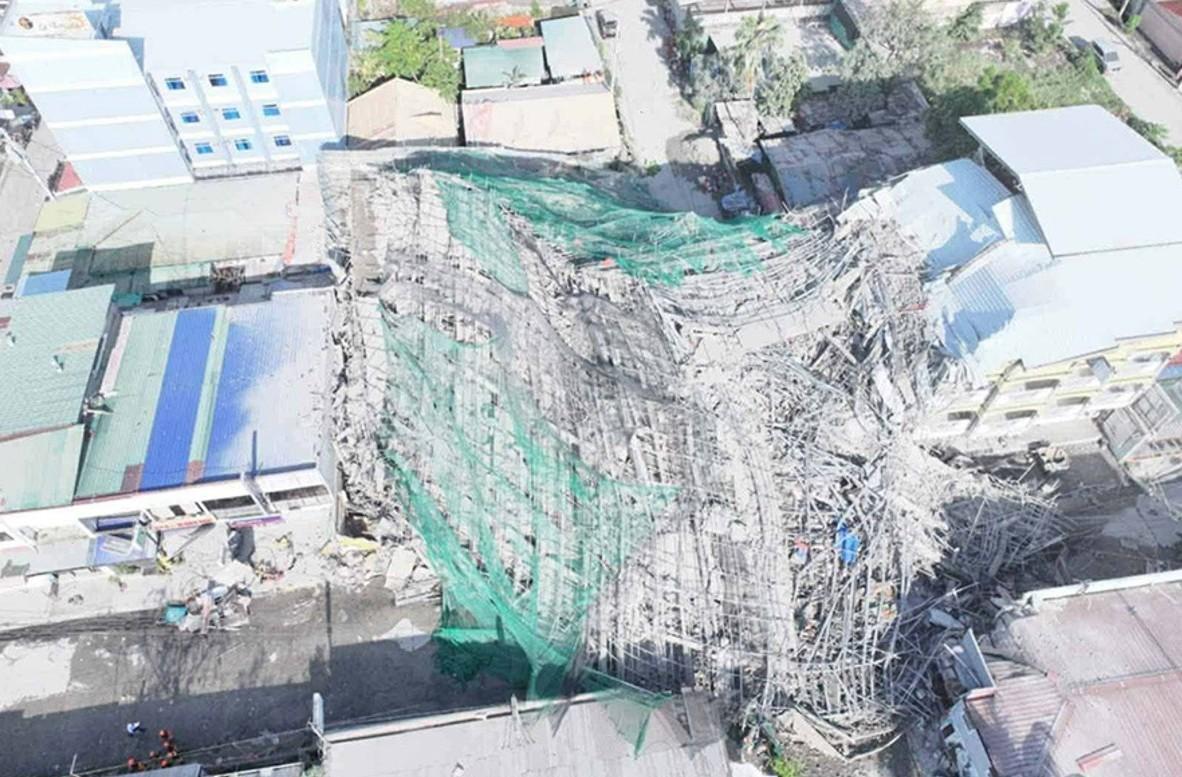
The Philippine National Police (PNP) on Monday said it is helping in the investigation of the collapsed building in Angeles City, Pampanga to determine the cause of the incident and possible violations of building regulations.
“The PNP is likewise supporting the ongoing investigation to determine the cause of the incident and possible violations of safety and building regulations,” the PNP chief said in a statement.
“Rescue operations remain ongoing amid hazardous conditions caused by unstable debris and live power lines,” he said.
The Police Regional Office 3 immediately deployed 175 police personnel to work with the Bureau of Fire Protection (BFP), Armed Forces of the Philippines (AFP), and the Angeles City Disaster Risk Reduction and Management Office in search and retrieval operations, traffic management, and area security.
The PNP advised the public to avoid the area to allow unhampered emergency operations.
Angeles City public information officer on Sunday said they will conduct operations for 20 individuals believed to be trapped beneath the rubble of the collapsed building.
Most of the trapped victims are believed to be construction workers.
As of posting time, some have died in the collapse while 26 out of the 47 victims have been rescued. Eighteen others remain missing.
Barangay Balibago
Barangay Balibago is a densely populated urban community in Angeles City, Philippines, best known as the primary entertainment and commercial hub of the area. Its history is closely tied to the former Clark Air Base, as the barangay grew rapidly during the American military presence, catering to service members with businesses, nightlife, and housing. Today, it remains a vibrant center for tourism, dining, and shopping, reflecting a blend of local culture and international influence.
Angeles City
Angeles City, located in the Philippines’ Pampanga province, has a rich history rooted in its founding as a settlement by Augustinian friars in the late 18th century. It became a key hub during the American colonial period and later the site of Clark Air Base, which heavily influenced its development and culture. Today, Angeles City is known for its vibrant dining and entertainment scene, as well as its proximity to historical landmarks like the Holy Rosary Parish Church.
Pampanga
Pampanga, a province in the Philippines, is known for its rich culinary heritage, earning the nickname “Culinary Capital of the Philippines.” Historically, it was one of the earliest Spanish settlements in the country, established in the 16th century, and played a significant role in the Philippine Revolution against Spanish colonial rule. Today, it is also famous for its vibrant festivals, such as the Giant Lantern Festival, and its resilience in rebuilding after the 1991 eruption of Mount Pinatubo.
Philippine National Police
The Philippine National Police (PNP) is the primary law enforcement agency in the Philippines, formed in 1991 through the merger of the Philippine Constabulary and the Integrated National Police under Republic Act 6975. Its history traces back to the early 20th century, evolving from colonial-era police forces to its modern role in maintaining public safety and order. Today, the PNP operates under the Department of the Interior and Local Government, focusing on crime prevention, counter-terrorism, and community policing.
Bureau of Fire Protection
The Bureau of Fire Protection (BFP) is the government agency in the Philippines responsible for fire prevention, suppression, and emergency response. Established under the Department of the Interior and Local Government, its modern form was created in 1991 through the Fire Code of the Philippines, evolving from earlier fire services dating back to the American colonial period. The BFP plays a crucial role in public safety, enforcing fire safety standards and responding to fires and other hazardous incidents nationwide.
Armed Forces of the Philippines
The Armed Forces of the Philippines (AFP) is the unified military organization responsible for defending the country’s sovereignty and territorial integrity. Its roots trace back to the Philippine Revolutionary Army established in 1897 during the fight for independence from Spain, later evolving through the Philippine Commonwealth and post-World War II eras. Today, the AFP comprises three major branches—the Army, Navy, and Air Force—and plays a key role in national security, disaster response, and peacekeeping efforts.
Angeles City Disaster Risk Reduction and Management Office
The Angeles City Disaster Risk Reduction and Management Office (DRRMO) is a local government agency in the Philippines responsible for coordinating disaster preparedness, response, and mitigation efforts within Angeles City. Established to enhance community resilience, it manages early warning systems, emergency operations, and recovery programs, often collaborating with national agencies and local volunteers. The office plays a key role in protecting residents from natural hazards such as typhoons, earthquakes, and volcanic eruptions, reflecting the city’s proactive approach to disaster management.
Police Regional Office 3
The Police Regional Office 3 (PRO3) is the regional command of the Philippine National Police (PNP) responsible for Central Luzon. Established to maintain peace and order, its history is tied to the evolution of the national police force, which was reorganized from the earlier Philippine Constabulary and Integrated National Police in 1991. As a key law enforcement hub, PRO3 oversees operations across seven provinces, including Pampanga and Bulacan, and plays a vital role in regional security and crime prevention.