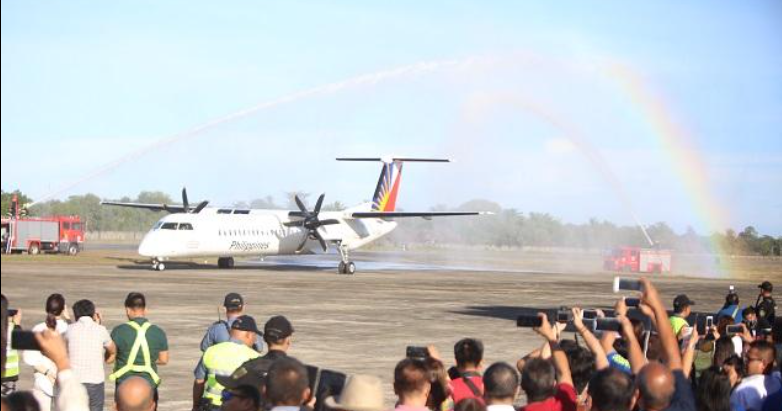
Flag carrier Philippine Airlines (PAL) announced it will reroute its turboprop operations from Manila to Clark, following the mandated transition of such services out of Ninoy Aquino International Airport (NAIA).
In an advisory, PAL said flights to and from Busanga, Siargao, Antique, and Catarman will be rerouted to Clark starting March 29, 2026, in line with the timeline set by the Manila Slot Coordination Committee (MSCC).
Passengers booked on affected flights will receive updated itineraries, with options for rebooking, rerouting, or refund as needed.
“With the mandated transition of turboprop services out of NAIA, PAL will introduce domestic jet frequencies beginning March 2026, expanding capacity on high-demand routes and providing passengers with more travel options,” the advisory read.
Expanded weekly services will include trips from Manila to Clark with up to 76 flights, Dumaguete up to 21, Iloilo up to 42, Roxas up to 14, and Tacloban up to 28 flights.
Ninoy Aquino International Airport (NAIA)
Ninoy Aquino International Airport (NAIA) is the primary international gateway serving Metro Manila, Philippines. Originally named Manila International Airport, it was renamed in 1987 in honor of Senator Benigno “Ninoy” Aquino Jr., whose assassination at the airport in 1983 was a pivotal event leading to the People Power Revolution. Today, it is one of Southeast Asia’s busiest aviation hubs.
Clark
“Clark” most commonly refers to **Clark Air Base**, a major United States Air Force installation in the Philippines. It was established in 1903 after the Spanish-American War and served as a crucial strategic hub in the Pacific until the 1991 eruption of Mount Pinatubo and the subsequent withdrawal of U.S. forces. Today, the area has been redeveloped into **Clark Freeport Zone**, a bustling economic and tourism center with the former airfield now operating as Clark International Airport.
Manila
Manila is the capital city of the Philippines, founded in 1571 by Spanish conquistadors on the site of a pre-existing Muslim settlement. It served as a vital colonial port for the Spanish Empire’s trade between Asia and the Americas for over three centuries. Today, it is a densely populated metropolis and the country’s political, economic, and cultural center, known for its historic walled city of Intramuros and its blend of diverse cultural influences.
Busanga
Busanga refers to the Busanga Plains, a vast seasonal floodplain located in the northern part of Zambia’s Kafue National Park. Historically used by the indigenous Lozi people for seasonal cattle grazing, the area is now a protected wildlife haven, renowned for its large herds of lechwe and exceptional predator sightings. Its ecosystem is sustained by the annual flooding of the Lufupa and Kafue rivers.
Siargao
Siargao is a teardrop-shaped island in the Philippines, renowned globally as a premier surfing destination, particularly for the famous “Cloud 9” wave. Historically a quiet fishing and agricultural island, its modern identity was shaped in the late 1980s and 1990s when international surfers discovered its consistent reef breaks. Today, it is a major tourism hub that blends world-class surf culture with pristine lagoons, mangrove forests, and laid-back island life.
Antique
Antique is a province located on the western coast of Panay Island in the Philippines. Historically, it was settled by the Ati people and later by migrants from Borneo, becoming a significant trade and cultural hub before Spanish colonization in the 16th century. Today, it is known for its rich cultural heritage, pristine beaches, and the vibrant **Binirayan Festival**, which commemorates the legendary arrival of the Bornean settlers.
Catarman
Catarman is a municipality located in the province of Northern Samar, Philippines. Historically, it served as a significant settlement during the Spanish colonial era and was the site of a major volcanic eruption from Mount Hibok-Hibok on the nearby island of Camiguin in 1871, which led to widespread destruction and changes in the local landscape. Today, it is a commercial and administrative center for the region.
Dumaguete
Dumaguete is a coastal city on Negros Island in the Philippines, often called the “City of Gentle People.” It is historically known as a university town, being home to Silliman University, the country’s first Protestant university founded by American missionaries in 1901. The city’s name is derived from the Cebuano word *daggit*, meaning “to snatch,” a reference to its past vulnerability to raids by Moro pirates.