Filtered by: Money
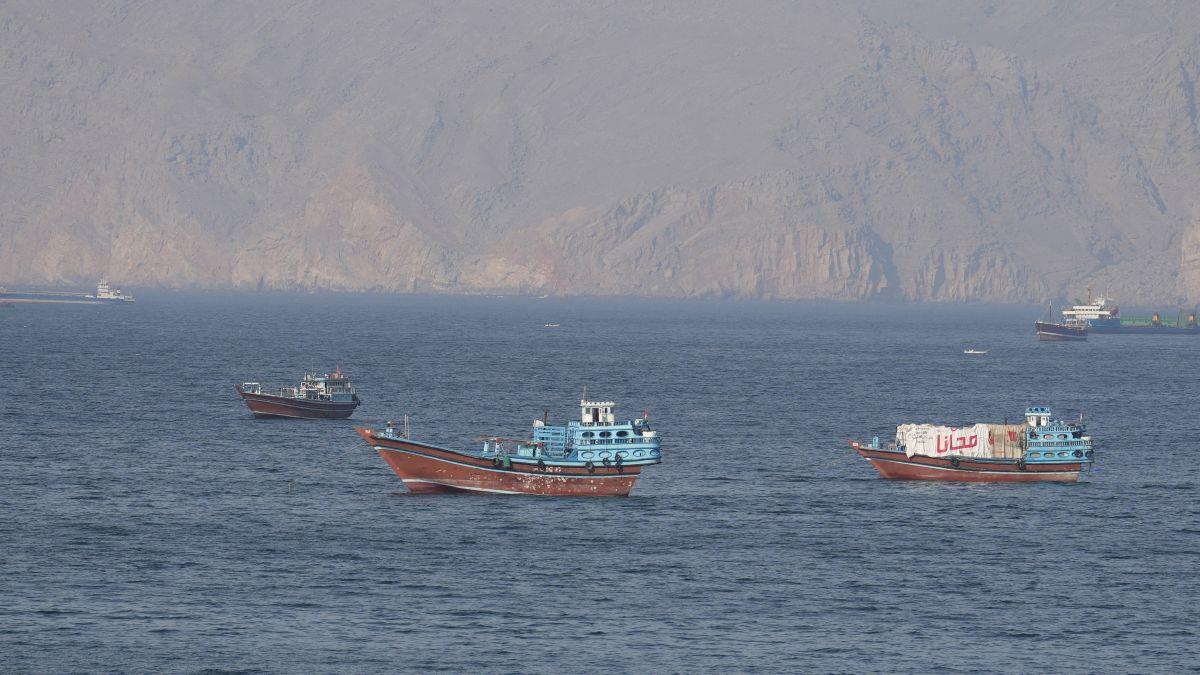
NEW YORK – US and European stocks reversed Monday as oil prices surged over fears hostilities could resume in the weeks-long Middle East war after Iran closed the Strait of Hormuz following its brief reopening.
Investors were on edge approaching the end of the US-Iran ceasefire, with Washington saying it will send a delegation to Pakistan for a new round of talks “soon” and Iran saying it had yet to decide whether to attend.
“The market mood is very different at the start of the week compared to Friday,” said a research director at a trading group.
Crude had plunged Friday after the Islamic republic said it would again allow ships to pass through the Strait of Hormuz, through which a fifth of global oil and liquefied natural gas usually passes.
But world oil prices bounced on Monday as Iran closed the waterway and said the US blockade and seizure of an Iranian cargo ship breached the two-week ceasefire.
“Renewed attacks on commercial vessels in the Strait of Hormuz increased fears of supply disruptions and raised the risk of a broader escalation in hostilities between the US and Iran,” said an analyst.
“Uncertainty also remains over whether negotiations in Islamabad will proceed after Iran said it would not attend talks while the blockade remains in place,” they added.
Wall Street’s main stock indices dipped, with the S&P 500 and Nasdaq Composite edging down from record closes.
While US investors are wary over what happens next, “they are afraid to step away from the market because we know that if a deal is announced, the market’s going to go up very quickly,” said a capital management representative.
The losses were sharper in Europe. Frankfurt dropped 1.2 percent, Paris shed 1.1 percent and London gave up 0.6 percent.
That came after gains for Tokyo, Hong Kong and Shanghai.
“Asian shares rebounded as they were in catch-up mode, having missed the rally seen in the US and Europe on Friday,” said an investment director.
“European indices presented a truer picture of the market mood, with investor wariness and weariness amid the continuing tensions in the Middle East,” they added before trading began in New York.
The blockade of Iranian ports has been a significant sticking point in negotiations between the two countries, with both accusing the other of ceasefire violations.
There has so far been only one negotiating session, held in Islamabad on April 11 that ended inconclusively, although groundwork for fresh talks continued afterwards.
A trader noted that market participants were assessing “whether the ceasefire can be salvaged through this week’s diplomatic talks, with recalibration on the probability of military escalation.”
“Without a comprehensive agreement on Iran’s nuclear program, the ceasefire remained fragile.”
Strait of Hormuz
The Strait of Hormuz is a narrow, strategically vital waterway connecting the Persian Gulf to the Gulf of Oman and the Arabian Sea. Historically, it has been a crucial trade route for centuries, controlling the flow of oil and gas from the Middle East to the rest of the world. Today, it remains a focal point of geopolitical tension, as roughly 20% of the world’s petroleum passes through its waters.
Musandam, Oman
Musandam, Oman, is a stunningly rugged peninsula known as the “Norway of Arabia” for its dramatic fjords and mountainous coastline along the Strait of Hormuz. Historically, it was a key strategic point for maritime trade and pearl fishing, and its remote villages have long maintained a distinct culture shaped by the sea. Today, it is a popular destination for dhow cruises, diving, and exploring its secluded inlets and traditional fishing communities.
S&P 500
The S&P 500 is a stock market index that tracks the performance of 500 of the largest publicly traded companies in the United States, serving as a key benchmark for the overall health of the U.S. economy. It was introduced in 1957 by Standard & Poor’s, evolving from a smaller index first created in 1923, and has since become one of the most widely followed equity indices in the world. Unlike a cultural site, it represents a financial metric rather than a physical location.
Nasdaq Composite
The Nasdaq Composite is a stock market index that tracks the performance of over 3,000 companies listed on the Nasdaq stock exchange, with a strong emphasis on technology and growth-oriented firms. Established in 1971, it was the world’s first electronic stock market, revolutionizing trading by moving away from physical trading floors. The index is widely followed as a barometer for the tech sector and the broader U.S. economy, known for its volatility and inclusion of major companies like Apple, Amazon, and Microsoft.
Frankfurt
Frankfurt is a major German city known as a global financial hub, home to the European Central Bank and the Frankfurt Stock Exchange. Historically, it was a free imperial city of the Holy Roman Empire and the site of imperial elections, as well as the birthplace of the famous writer Johann Wolfgang von Goethe. Much of its historic Altstadt (Old Town) was rebuilt after heavy bombing in World War II, blending modern skyscrapers with reconstructed medieval buildings like the Römer.
Paris
Paris, the capital of France, is a global center for art, fashion, and culture, known for its iconic landmarks like the Eiffel Tower and the Louvre Museum. Founded over 2,000 years ago as a Roman settlement called Lutetia, it evolved into a medieval city and later became the epicenter of the French Revolution and the Age of Enlightenment. Today, Paris remains a symbol of romance and innovation, drawing millions of visitors to its historic streets, cafés, and world-renowned institutions.
London
London is the capital city of the United Kingdom, with a history spanning nearly two millennia, having been founded by the Romans as Londinium around 43 AD. It is a global hub for finance, culture, and politics, home to iconic landmarks like the Tower of London, Buckingham Palace, and the Houses of Parliament. The city has survived major events such as the Great Fire of 1666 and the Blitz of World War II, continuously evolving into the diverse, vibrant metropolis it is today.
Islamabad
Islamabad, the capital of Pakistan, was built in the 1960s to replace Karachi as the country’s capital, with its design masterplanned by Greek architect Constantinos Apostolou Doxiadis. The city is known for its modern, planned layout, lush greenery, and iconic landmarks like the Faisal Mosque and the Pakistan Monument. Its history reflects a deliberate shift toward a centrally located, serene administrative hub, contrasting with the bustling commercial port of Karachi.