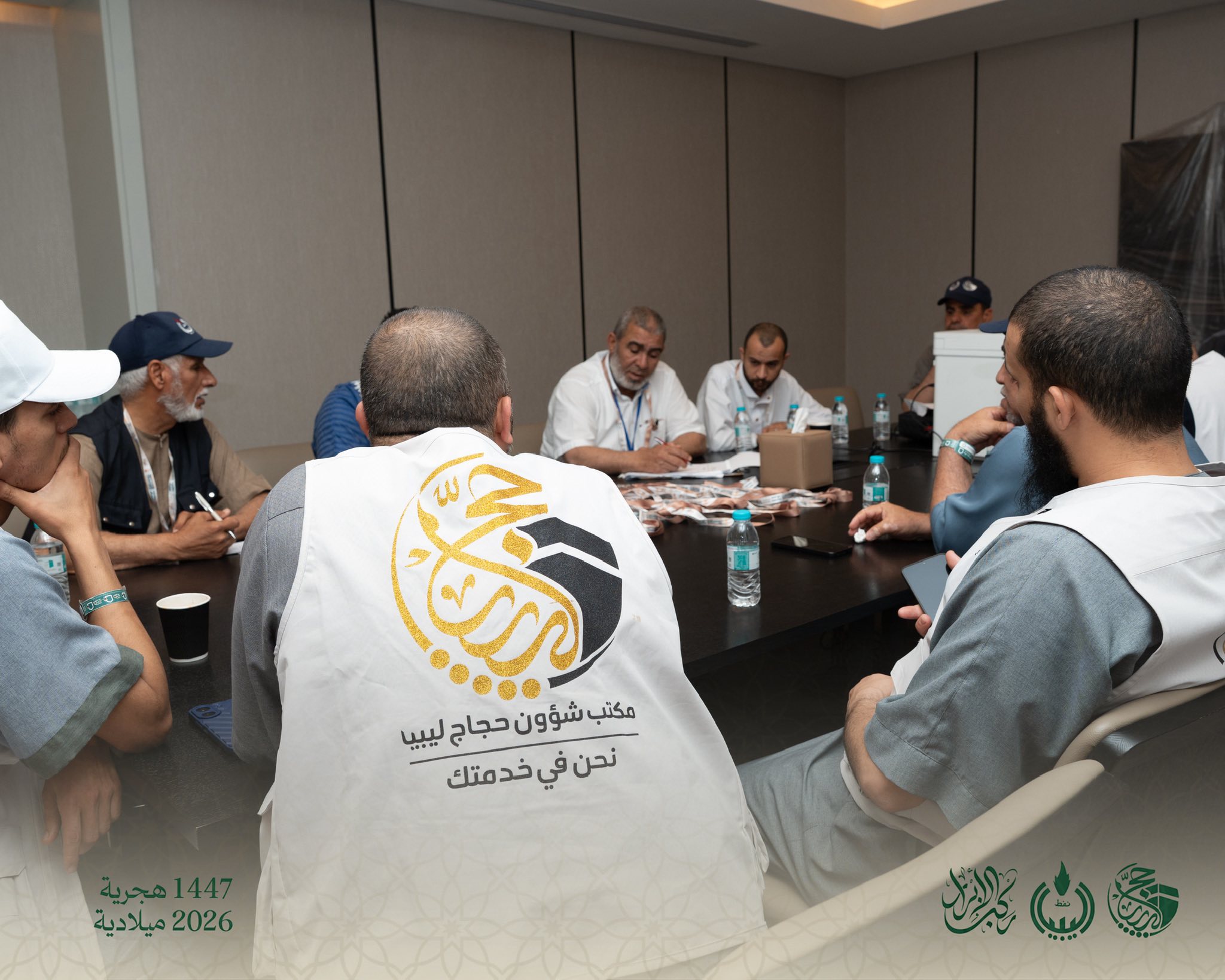
The Libyan Hajj mission confirms its field teams are ready for the holy sites days.
Tripoli, May 21, 2026 – The Libyan Hajj mission has completed its preparations for the days of the holy sites, confirming the readiness of field teams and approved operational plans to serve Libyan pilgrims, ensuring smooth services and the best care and organization during the Hajj season.
The General Authority for Hajj and Umrah stated on its official page that the Deputy Head of the Libyan Pilgrims Affairs Office and Head of the Central Committee chaired a coordination meeting with coordinators to follow up on work progress and the level of coordination between coordinators and supervisors, and to review key field challenges and mechanisms for addressing them.
The meeting discussed the plan for ascending to Arafat, the mechanism for moving to Muzdalifah, and the flow to Mina, in addition to organizational and logistical aspects related to the days of the holy sites, contributing to the efficient implementation of approved plans.
In the same context, the Services Committee of the Hajj mission held a coordination meeting to develop the operational plan for the holy sites, emphasizing continuous readiness to immediately handle any issues or emergencies, ensuring services are provided to pilgrims according to approved arrangements.
Tripoli
Tripoli, the capital of Libya, is a historic port city on the Mediterranean coast with roots dating back to the 7th century BCE, when it was founded by the Phoenicians. It later flourished under Roman, Byzantine, and Islamic rule, and was known as “Oea” in ancient times. Today, it blends rich cultural heritage, including landmarks like the Arch of Marcus Aurelius and the Medina, with modern urban life.
Arafat
Arafat is a plain located about 20 kilometers east of Mecca, Saudi Arabia, and holds immense significance in Islam as the site where the Prophet Muhammad delivered his final sermon. It is the central location for the Hajj pilgrimage, where pilgrims gather on the ninth day of Dhul Hijjah for the standing vigil, or Wuquf, which is considered the most essential rite of the pilgrimage. The site is also historically associated with the meeting of Adam and Eve after their expulsion from paradise, according to Islamic tradition.
Muzdalifah
Muzdalifah is a significant open plain located between Mina and Mount Arafat in Saudi Arabia, playing a crucial role in the annual Hajj pilgrimage. It is historically known as the place where pilgrims pause after sunset on the 9th day of Dhul Hijjah to pray and collect pebbles for the symbolic stoning of the devil at Mina. This practice commemorates the Prophet Ibrahim’s (Abraham’s) trial of faith, as he was commanded by Allah to sacrifice his son.
Mina
Mina is a valley located near Mecca in Saudi Arabia, best known for its role in the annual Hajj pilgrimage. It is where pilgrims spend several days performing rituals, including the symbolic stoning of the devil at the Jamarat. Historically, Mina is significant as the site where the Prophet Abraham was tested by God’s command to sacrifice his son, a story central to Islamic tradition.
Tripoli
Tripoli, the capital of Libya, is a historic port city on the Mediterranean coast with roots dating back to the Phoenician era, when it was known as Oea. It later flourished under Roman, Byzantine, and Islamic rule, and its old city, or Medina, features landmarks like the Arch of Marcus Aurelius and the Karamanli Mosque. Today, Tripoli blends ancient heritage with modern urban life, though it has faced challenges from political instability in recent decades.
Arch of Marcus Aurelius
The Arch of Marcus Aurelius is a Roman triumphal arch located in Oea, modern-day Tripoli, Libya, built to honor the Roman emperor Marcus Aurelius. Constructed around 165 AD, it celebrates his military victories, particularly over the Parthian Empire. The arch is notable for its intricate reliefs and inscriptions, serving as a key example of Roman architectural influence in North Africa.
Medina
Medina, known as the “City of the Prophet,” is the second holiest city in Islam, located in western Saudi Arabia. It is revered as the place where the Prophet Muhammad migrated in 622 CE (the Hijra) and established the first Muslim community, and it houses his final resting place within the Al-Masjid an-Nabawi (the Prophet’s Mosque). Historically, Medina served as the capital of the early Islamic caliphate and remains a major pilgrimage destination for Muslims visiting the mosque.
Arafat
Arafat is a plain located about 20 kilometers east of Mecca, Saudi Arabia, and holds immense religious significance in Islam. It is the site where the Prophet Muhammad delivered his final sermon during his farewell pilgrimage, and it serves as the central location for the Hajj pilgrimage, where pilgrims gather on the Day of Arafat for prayer and reflection. The area is considered a place of mercy and forgiveness, and standing at Arafat is an essential rite of the Hajj.
Muzdalifah
Muzdalifah is a significant site in Islam located between the holy cities of Mecca and Mina in Saudi Arabia. It is historically known as the place where pilgrims stop after sunset on the 9th day of Dhul Hijjah during the Hajj pilgrimage, collecting pebbles for the symbolic stoning of the devil at Mina. The site is also associated with the Prophet Muhammad’s farewell pilgrimage and holds deep spiritual importance as a place for prayer and reflection.
Mina
Mina is a valley located near Mecca in Saudi Arabia, best known for its role in the annual Hajj pilgrimage. Historically, it is the site where the Prophet Abraham is believed to have been commanded to sacrifice his son, and where pilgrims today perform the ritual of “stoning the devil” by throwing pebbles at three pillars. During Hajj, the valley becomes a massive tent city, accommodating millions of pilgrims for several days of prayer and reflection.
Mount Arafat
Mount Arafat, also known as Jabal al-Rahmah (Mountain of Mercy), is a granite hill located about 20 kilometers east of Mecca, Saudi Arabia. It holds profound religious significance in Islam as the site where the Prophet Muhammad delivered his Farewell Sermon, and it is the central location of the Hajj pilgrimage, where pilgrims gather on the ninth day of Dhu al-Hijjah for the most essential ritual of the journey. According to Islamic tradition, it is also believed to be where Adam and Eve were reunited on Earth after their expulsion from the Garden of Eden.
Jamarat
Jamarat refers to the three stone pillars located in Mina, near Mecca, Saudi Arabia, which are central to the Hajj pilgrimage ritual of “stoning the devil.” During the pilgrimage, Muslims throw pebbles at these pillars to symbolically reject evil and commemorate the actions of the Prophet Ibrahim (Abraham), who is believed to have driven away Satan by throwing stones at him. The site has been modernized with a multi-level bridge structure to safely accommodate the millions of pilgrims who perform this ritual annually.