Italy, Poland, and Denmark advance to the playoff finals, while Kosovo delivers the biggest surprise.
Europe held its breath last night, with the kick-off of the semi-final matches for qualification to the 2026 World Cup finals (United States, Canada, Mexico). It was no ordinary night in the UEFA calendar, but a night where farewell tears mixed with qualification shouts, as stadiums witnessed unexpected results that shattered the ambitions of historic national teams and opened the door for rising powers to write a new chapter in the history of the beautiful game.
Italy heals past wounds… and a shock in Cardiff
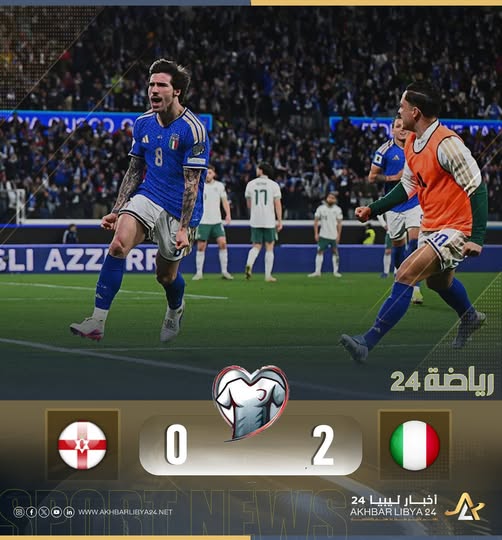
In Path A, the Italian national team entered its match against Northern Ireland fully aware that any stumble would mean another catastrophic absence from the world stage. The Azzurri delivered a tactical masterclass, controlling the midfield thanks to the movement of Nicolò Barella and the decisive passing of Sandro Tonali, emerging victorious with a (2-0) scoreline amid wild celebrations in the stands of the San Siro.
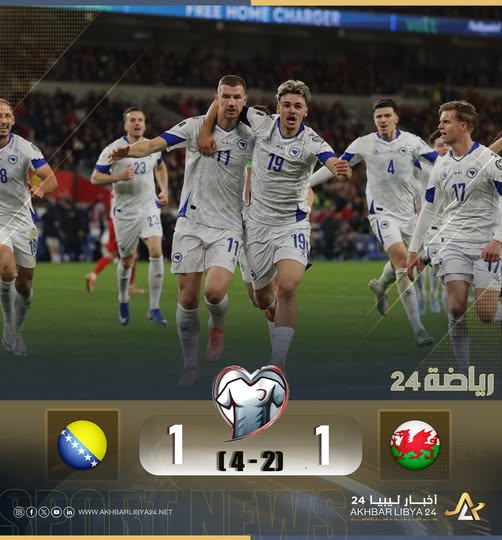
On the other side of the same path, Bosnia and Herzegovina delivered the biggest upset by eliminating the Welsh national team in the heart of Cardiff. The match, which went to extra time after a dramatic (1-1) draw, was decided by a (4-2) penalty shootout in favor of the Bosnians, shattering the dreams of the Welsh Dragons to return to the World Cup and setting up a fiery final date between Bosnia and Italy.
Shock in Cardiff
Lewandowski leads Poland… and a surprising Ukrainian collapse
In Path B, veteran Robert Lewandowski proved he is still the key figure in Polish football, leading the Polish national team past the tough obstacle of Albania with a (2-1) score. <b data-index-in-node="159"
2026 World Cup
The 2026 FIFA World Cup is not a single place or cultural site, but a major international sporting event. It will be the first World Cup hosted jointly by three nations—the United States, Canada, and Mexico—and will feature an expanded format of 48 teams. Historically, it marks the first World Cup hosted across three countries and Mexico will become the first nation to host men’s World Cup matches in three different editions (1970, 1986, 2026).
San Siro
San Siro is the iconic football stadium in Milan, Italy, officially named Stadio Giuseppe Meazza. Opened in 1926, it is the shared home of the city’s two major football clubs, AC Milan and Inter Milan, and has hosted numerous historic matches, including World Cup and Champions League finals. The stadium is renowned for its distinctive cylindrical towers and intense, electrifying atmosphere during derby matches.
Cardiff
Cardiff is the capital and largest city of Wales, with a history dating back to Roman times. It grew into a major global port during the 19th century due to the coal industry, which funded its impressive civic buildings. Today, it is a vibrant cultural and political centre, home to landmarks like Cardiff Castle and the Welsh Parliament.
UEFA
UEFA, the Union of European Football Associations, is the administrative and governing body for association football in Europe, founded in 1954 in Basel, Switzerland. It organizes prestigious continental competitions, most notably the UEFA European Championship (started in 1960) and the UEFA Champions League (evolved from the European Cup in 1955), which have become central to European sporting culture.
Italian national team
The Italian national football team, known as the “Azzurri,” is one of the world’s most successful national teams, having won four FIFA World Cup titles (1934, 1938, 1982, 2006). Operated by the Italian Football Federation (FIGC), it was founded in 1898 and is renowned for its tactical prowess, defensive tradition, and passionate fanbase.
Welsh national team
The Welsh national football team represents Wales in international competitions and is governed by the Football Association of Wales (FAW), the third-oldest national football association in the world, founded in 1876. Historically, the team experienced long periods without major tournament qualification but achieved a modern resurgence, notably reaching the semi-finals of UEFA Euro 2016 and qualifying for the 2022 FIFA World Cup, their first since 1958.
Polish national team
The Polish national football team, known as “Biało-Czerwoni” (The White and Reds), is the representative side of Poland in international men’s football, governed by the Polish Football Association (PZPN). Founded in 1919 following the country’s regained independence, its most storied achievements include winning gold at the 1972 Munich Olympics and securing third-place finishes in the 1974 and 1982 FIFA World Cups, led by legendary players like Grzegorz Lato and Zbigniew Boniek.
Bosnia and Herzegovina
Bosnia and Herzegovina is a country in Southeastern Europe on the Balkan Peninsula, with a rich and complex history shaped by Slavic, Ottoman, and Austro-Hungarian influences. It is renowned for its cultural and religious diversity, as well as historic sites like the medieval Stari Most (Old Bridge) in Mostar and the ancient stećci (medieval tombstones) scattered across the region. The country endured a devastating war in the 1990s following the breakup of Yugoslavia but has since worked to rebuild and preserve its unique multicultural heritage.