The “Porch Market” is being held on December 17 at the community space “Taisei Porch Front” (2 Aioicho, Naka-ku, Yokohama) on Kannai Sakura-dori.
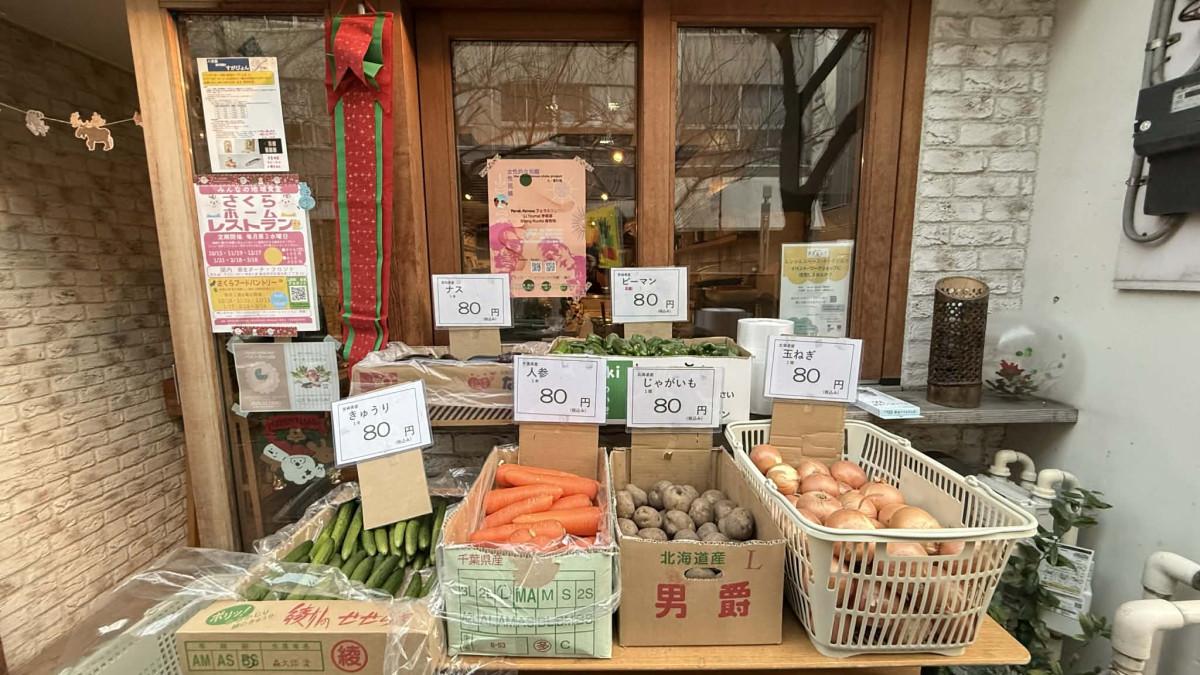
“Yaoiya Goyokiki Sugapyon,” which opened at the end of November opposite “Sotetsu Rosen Mutsuogawa Store” in Minami-ku, displays cucumbers, carrots, onions, and other items on shelves facing the street. The shop provides fresh vegetables sourced from markets within Kanagawa Prefecture, operating under the motto “good products at a better price.”
The market is organized by the “Sakura-dori o Tanoshiku Suru Kai” (Association to Make Sakura-dori Enjoyable). The association applied this year for the “Yokohama Citizen Machibushin Project,” which supports and subsidizes facility improvements aimed at “wanting to solve local problems and further enhance the area’s appeal.” They are considering the development of a “‘Library’ & ‘Community Center'” for Kannai Sakura-dori utilizing “Taisei Porch Front” and are using the market to test the process of opening a facility to the community during their planning.
On December 10, the association also provided a gathering place for local parents with young children under the name “Baby Stroller Cafe.” They plan to hold a “NEW YEAR MARKET” on January 17, 2026, which will also utilize the public road in front of the facility.
The market hours are from 3:00 PM to 6:00 PM. The “NEW YEAR MARKET” on January 17 will be held from 11:00 AM to 4:00 PM. Admission is free.
Taisei Porch Front
“Taisei Porch Front” is a modern commercial and community space located in the Taisei area of Yokohama, Japan. Developed as part of a larger urban revitalization project, it was designed to create a welcoming public “porch” or gateway to the neighborhood, featuring shops, cafes, and event areas to foster local interaction. Its history is tied to the early 21st-century redevelopment efforts aimed at enhancing the city’s waterfront districts and community hubs.
Kannai Sakura-dori
Kannai Sakura-dori is a popular, tree-lined street in Yokohama, Japan, known for its beautiful cherry blossoms in spring. Historically, the area was part of the foreign settlement in the late 19th century, and the street itself was developed to create a scenic promenade connecting Kannai, the old administrative center, with the Yamate Bluff residential area. Today, it is a beloved spot for hanami (cherry blossom viewing) and a pleasant walkway near landmarks like Yokohama Stadium.
Sotetsu Rosen Mutsuogawa Store
The Sotetsu Rosen Mutsuogawa Store is a historic commercial building located in Yokohama, Japan, originally constructed in 1928 as part of the Sotetsu railway company’s development of the Mutsuogawa area. It served as a key community retail hub for decades and is noted for its distinctive Taisho-era Western-influenced architecture. Today, it has been preserved and revitalized as a charming complex housing cafes, shops, and cultural spaces, reflecting Yokohama’s early 20th-century urban history.
Sakura-dori o Tanoshiku Suru Kai
“Sakura-dori o Tanoshiku Suru Kai” (literally “Association for Enjoying Sakura-dori”) is a community group in Nagoya, Japan, dedicated to the appreciation and beautification of Sakura-dori, one of the city’s main boulevards. Historically, the group formed to enhance the public experience along this important street, which was originally developed in the early 20th century as part of Nagoya’s modern urban planning. Their activities often include organizing events, maintaining greenery, and promoting the cultural and historical significance of the avenue lined with cherry trees (*sakura*).
Yokohama Citizen Machibushin Project
The Yokohama Citizen Machibushin Project is a community-driven urban revitalization initiative in Yokohama, Japan, focused on repurposing vacant commercial spaces (“machibushin”) in the city’s historic Kannai district. It began in the early 2000s as a response to economic decline, with citizens, businesses, and the government collaborating to transform empty shops into galleries, cafes, and workshops. The project aims to preserve local heritage while fostering new creative and economic activity in the city’s older neighborhoods.
Library
A library is a curated collection of books, media, and digital resources, traditionally serving as a public or institutional center for knowledge, learning, and research. Its history dates back to ancient archives like those in Mesopotamia and the famed Library of Alexandria, evolving from exclusive scholarly collections to the accessible public libraries first championed in the 19th century. Today, modern libraries function as vital community hubs, preserving information while providing free access to technology and educational programs.
Community Center
A community center is a public facility designed to serve local residents by offering social, recreational, and educational activities. Historically, such centers emerged in the late 19th and early 20th centuries, often through settlement houses or municipal projects, to foster social cohesion and support urban and immigrant communities. Today, they remain vital hubs for programs, events, and services that strengthen neighborhood bonds.
Baby Stroller Cafe
The Baby Stroller Cafe is a modern, family-friendly concept, typically a café designed to accommodate parents with infants and young children by providing ample space for strollers, changing facilities, and play areas. While not a single historic site, this type of establishment emerged in the late 20th and early 21st centuries, primarily in urban centers, as a social and commercial response to the growing demand for accessible public spaces for families. It reflects a contemporary cultural shift towards more inclusive urban leisure and community environments.