The immersive museum “THE MOVEUM YOKOHAMA by TOYOTA GROUP” will be held from December 20 at the No. 4 Shed at Yamashita Pier (Yamashita-cho, Naka-ku, Yokohama).
The first phase is “Vienna Fin-de-Siècle Art ‘The Golden Age of Beauty’ Gustav Klimt and Egon Schiele ~ Artists of Light and Shadow~”. It will feature “The Golden Age of Beauty”, expressing late 19th-century Viennese art through the works of Gustav Klimt (1862-1918) and Egon Schiele (1890-1918), and will screen a new series “ONE MOMENT” from the video and sound work “LISTEN.”
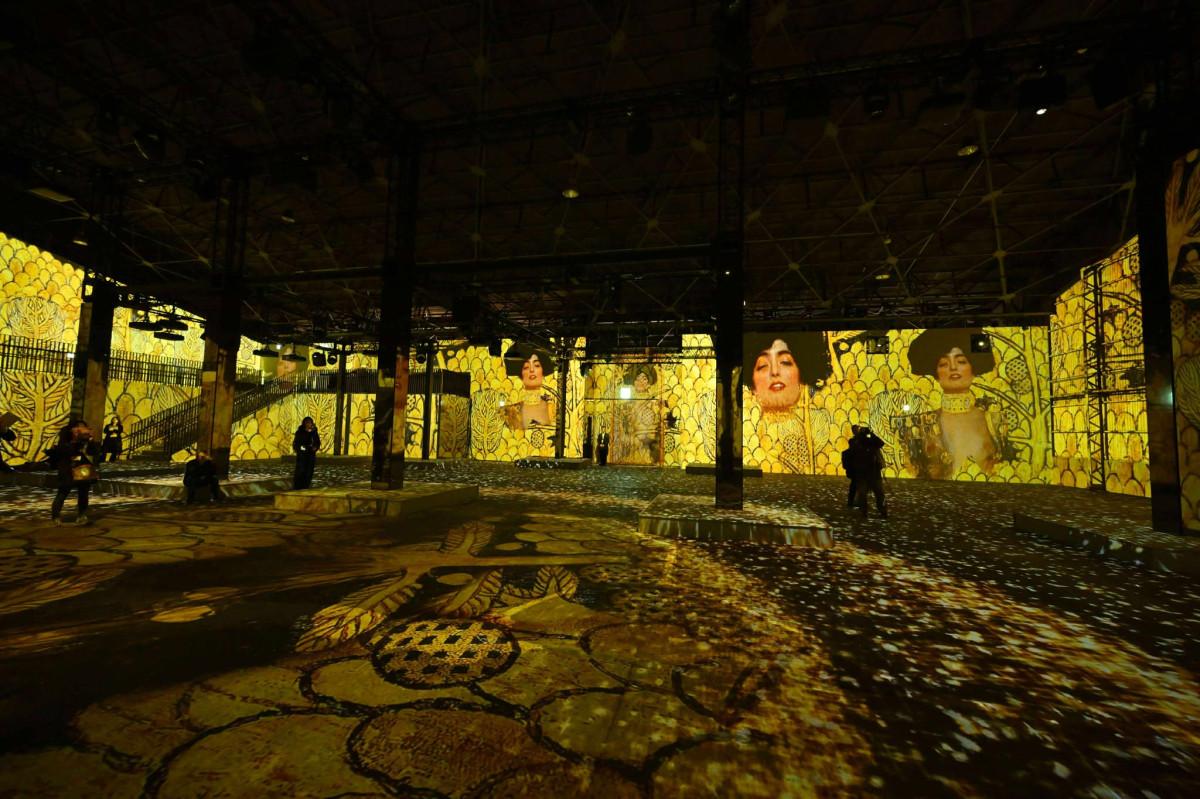
The venue, Yamashita Pier No. 4 Shed, is a vast warehouse of approximately 6,000 square meters that has supported Japan’s logistics since the post-war reconstruction period. It realizes a column-free theater space of about 1,800 square meters using the Showa-era “truss structure” architectural technique. Inside the theater, besides the main stage, there is a second-floor area and a mirror room.
In the theater, Klimt’s works, which led the Vienna Secession with decorative elegance, are presented as “The Golden Age” with approximately 170 pieces in a 40-minute program. Egon Schiele’s “In the Golden Shadow”, visualizing the inner anxiety of the fin-de-siècle, is compiled into a 12-minute program with about 110 pieces. Using 75 Epson projectors and 27 speakers, sound resonates throughout the entire warehouse, enabling an “immersive experience” from any location within the venue.
In a separate studio room, the new series “ONE MOMENT” will be screened, which fuses immersive art with the project “LISTEN.”, a long-term personal project for which she serves as producer. This project spent 10 years from 2010 traveling the world’s music cultures, archiving them into a video library, and producing short films and movies. “ONE MOMENT” delivers sounds born from various lands—such as the rhythms of nomadic horse riders, the melodies of wandering peoples, and song feasts—based on footage collected from visits to about 20 countries including Hungary and Serbia.
At a reception held on the 18th, alongside the representative of the organizing “TOYOTA GROUP”, the Commissioner of the Agency for Cultural Affairs, and the Mayor of Yokohama gave speeches.
One speaker said, “It’s a time capsule packed with the ‘present’ of Earth that we want to be proud of for the future. I think this place is where the layered air of ancient history and the present and future connect and fuse.” Another speaker revealed that while thinking about the connection with Yokohama, they realized, “The Crown car departed for America from Yokohama. It was from Yokohama that the path to the world opened up.”
A guest in attendance praised the experience, stating, “I have seen the original works in museums many times, but this is the first time I have experienced an immersion into the works of Klimt and Schiele in this way.”
“THE MOVEUM YOKOHAMA” operating hours are 10:30 AM to 7:30 PM (until 8:30 PM on Fridays, Saturdays, and days before holidays). Screenings start every hour on the hour and last approximately one hour. Tickets are: General Online Sales = 3,000 yen, Same-Day Sales = 3,800 yen, among others. The first phase runs until March 31.
THE MOVEUM YOKOHAMA
THE MOVEUM YOKOHAMA is a contemporary art museum that opened in 2020 in Yokohama, Japan, as part of the city’s Minato Mirai 21 district redevelopment. It is designed by the renowned Japanese architect Sou Fujimoto and focuses on interactive, experiential exhibitions that encourage visitors to physically engage with the artworks. The museum represents a modern cultural initiative, contrasting with the city’s older historical sites like the Yokohama Port opening memorials.
Yamashita Pier
Yamashita Pier is a historic waterfront pier in Yokohama, Japan, originally constructed in the 1890s to serve as a major international shipping terminal. It was significantly damaged during the Great Kantō Earthquake of 1923 and later rebuilt, becoming a popular public promenade with views of Yokohama Bay. Today, it is a scenic landmark adjacent to Yamashita Park, symbolizing the city’s maritime history and recovery.
No. 4 Shed
No. 4 Shed is a historic wool store located on the waterfront of Wellington, New Zealand. Built in 1907, it was a key part of the city’s bustling wool export trade in the early 20th century. Today, it has been repurposed as a popular venue for offices, restaurants, and events, retaining its original industrial character.
Vienna
Vienna is the capital of Austria, historically the seat of the powerful Habsburg monarchy and the heart of the Holy Roman Empire. Renowned as a global center for classical music, it was home to composers like Mozart, Beethoven, and Strauss, and its historic center is a UNESCO World Heritage Site filled with grand imperial architecture, such as the Hofburg Palace and Schönbrunn.
Gustav Klimt
Gustav Klimt was a prominent Austrian symbolist painter and a founding member of the Vienna Secession art movement in the late 19th and early 20th centuries. He is best known for his opulent, gold-leaf-adorned works like “The Kiss” and his striking portraits, which often explored themes of love, human desire, and the human condition. His distinctive style bridged traditional academic art and modernism, leaving a lasting legacy on European art.
Egon Schiele
Egon Schiele was a prominent Austrian Expressionist painter of the early 20th century, known for his raw, intense, and often provocative figurative works. While not a physical place, his legacy is preserved at institutions like the Leopold Museum in Vienna, which holds the world’s largest collection of his art, showcasing his brief but prolific career before his untimely death in the 1918 influenza pandemic.
Vienna Secession
The Vienna Secession was an influential art movement founded in 1897 by a group of Austrian artists, including Gustav Klimt, who broke away from the traditional artistic establishment. Its most iconic landmark is the Secession Building, designed by Joseph Maria Olbrich, which famously bears the motto “To every age its art, to art its freedom.” The movement championed Jugendstil (the Austrian variant of Art Nouveau) and sought to create a new, modern style that integrated all art forms.
Agency for Cultural Affairs
The Agency for Cultural Affairs is a special body of the Japanese government, established in 1968, responsible for promoting and preserving Japan’s arts, culture, and national heritage. It oversees cultural policies, protects important cultural properties, and supports activities ranging from traditional arts to contemporary media.