TOKYO — Japanese idol group Arashi’s farewell concert tour generated an estimated 137.5 billion yen (about $858 million) in economic impact across 15 performances, according to a website specializing in economic impact analysis.
Analysis concluded that the rarity of the performances before the group ended its activities boosted demand nationwide. Arashi ended its 26 1/2-year career at the end of May after holding concerts in five cities across Japan, with fans flocking to see the group perform one last time.
The estimated economic impact of all the tour’s performances was calculated by measuring direct spending such as ticket and merchandise purchases, as well as secondary effects including venue operations and related business activity in host cities. For data that was not publicly available, estimates were produced based on analyses of past music events and similar activities.
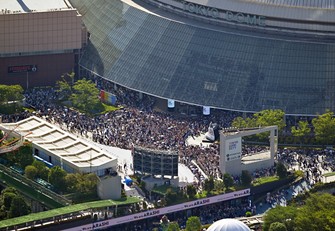
The tour ran from March through May this year, with 15 performances held in Hokkaido, Tokyo, Aichi, Fukuoka and Osaka. Total attendance reached about 800,000.
Tickets cost 12,000 yen (about $75), including tax, with additional service fees charged, bringing estimated ticket revenue to 10.9 billion yen (about $68 million). The final concert was livestreamed, with viewing tickets starting at 3,900 yen (about $24). Estimating fan club membership at 2 million and assuming all watched the stream, livestream revenue was calculated at 7.6 billion yen (about $47 million).
Sales of official merchandise sold at concert venues also accounted for a significant share of spending. Demand for tour-exclusive and commemorative goods was particularly strong. Merchandise sales were estimated at 10.5 billion yen (about $65 million), assuming individual spending ranged from several thousand yen to tens of thousands of yen.
Many fans also traveled long distances to attend the concerts. Related spending included an estimated 5.8 billion yen (about $36 million) for transportation, 6.7 billion yen (about $41 million) for accommodation and 4 billion yen (about $25 million) for food and beverages. The concerts also boosted so-called “live tourism,” in which fans travel to host cities and stay before or after events while enjoying sightseeing and other local activities.
Ripple effects in host cities accounted for 75 billion yen (about $468 million), or more than half of the total estimated economic impact. The increased demand extended to businesses related to venue operations, security and transportation. The estimate also factored in consumer spending generated by income earned through those activities.
Average spending per concertgoer, excluding livestream viewing, came to 61,371 yen (about $383). A chief researcher at the analysis website and a part-time lecturer specializing in economics and urban development at Tokyo City University said the scale of spending was exceptional.
“Even compared with past large-scale music concerts, no other three-and-a-half-hour concert has generated this level of consumer spending,” the researcher said. “The tour provided a major boost to economic activity in and around the host cities.”
Tokyo Dome
Bunkyo Ward
<div class="my-4 p-4 rounded-lg shadow-md bg-blue-50 border