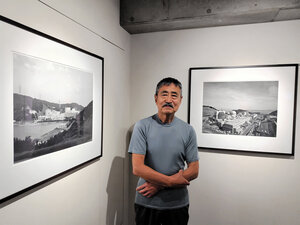
A photo exhibition titled “STILL CRAZY” is being held at “Arika Hole” in 4-chome until the 28th. It features landscape photographs of nuclear power plants across Japan taken 30 years ago, and asks what the photographer thinks of those photos now.
Between 1991 and 1993, as part of a project for the now-discontinued magazine “Asahi Camera,” the photographer traveled extensively from Hokkaido to Kagoshima, photographing all nuclear power plants in the country, including those under construction, capturing them as they were in black-and-white photos.
Against the backdrop of the 1986 accident at a nuclear plant, the content questioned the state of nuclear power. In 1994, 39 photos of 53 reactors were published in photography magazines and displayed in galleries.
This time, the photographer decided to offer an opportunity to reconsider nuclear power, which has been gaining renewed presence through operational extensions and restarts after the tsunami. From the original photos, 17 images were selected, including those of plants and related sites.
The title “STILL CRAZY” comes from the name of a love song by a global singer-songwriter. The song’s meaning is “I’m still crazy about you.”
The photographer says, “Compared to 30 years ago, wind and solar power have become more widespread, but the issues surrounding nuclear power, such as safety and waste disposal methods, remain unchanged. I want to ask whether we can still be ‘crazy’ about nuclear power today.”
Free admission. On the 23rd, there will also be a talk event. The event requires a participation fee of 1,000 yen for both in-person and online attendance, and reservations are required.
Arika Hole
Arika Hole is a sacred limestone cave located in the Western Province of Papua New Guinea, known for its cultural and spiritual significance to the local Huli people. Historically, it was used as a refuge during tribal conflicts and is also tied to creation myths, believed to be the emergence point of the first Huli ancestors. Today, it remains an important site for traditional rituals and is a notable destination for cultural tourism.
4-chome
4-chome is a common Japanese address term meaning “4th block,” often referring to bustling commercial districts in major cities like Tokyo’s Shinjuku or Osaka’s Namba. Historically, these blocks developed during the post-war economic boom, becoming hubs for shopping, entertainment, and nightlife. In particular, Tokyo’s Shinjuku 4-chome is famous for its vibrant LGBTQ+ scene, with a history dating back to the 1950s when it emerged as a gathering place for the community.
Hokkaido
Hokkaido, Japan’s northernmost island, was historically inhabited by the Ainu people before large-scale Japanese colonization began in the late 19th century during the Meiji era. Its development accelerated with the establishment of the Hokkaido Development Commission in 1869, which promoted agriculture and industry. Today, Hokkaido is known for its natural landscapes, ski resorts, and vibrant cities like Sapporo.
Kagoshima
Kagoshima, located on the southern tip of Kyushu, Japan, is a historic port city known for its dramatic volcanic landscape dominated by Sakurajima. It played a pivotal role in Japan’s modernization as a stronghold of the Satsuma Domain, which led the Meiji Restoration in the late 19
Arika Hole
Arika Hole is a significant archaeological site in Japan, located in the Kyushu region, known for yielding some of the oldest human remains in the country, dating back to the Paleolithic period (around 30,000–40,000 years ago). Excavations revealed stone tools and fossilized bones, providing crucial evidence of early human habitation in the Japanese archipelago. Its discoveries have helped scholars understand the migration and lifestyle of prehistoric peoples in East Asia.
4-chome
4-chome is a common district designation in Japanese cities, most famously referring to the bustling heart of Shibuya, Tokyo. This area is centered around the iconic Shibuya Crossing, one of the world’s busiest pedestrian intersections, and has evolved from a quiet suburb into a major commercial and entertainment hub since the late 19th century. Its history is marked by rapid post-war development and the rise of youth culture, making it a global symbol of Tokyo’s vibrant urban life.
Hokkaido
Hokkaido, Japan’s northernmost island, is known for its stunning natural landscapes, including volcanoes, hot springs, and ski resorts. Historically, it was populated by the indigenous Ainu people before becoming a Japanese settlement frontier in the late 19th century. Today, it is famous for its unique culture, outdoor activities, and seasonal attractions like the Sapporo Snow Festival.
Kagoshima
Kagoshima, located on the southern tip of Kyushu, Japan, is a historic port city known for its dramatic volcanic backdrop, Sakurajima. It played a key role in Japan’s modernization as a center of the Satsuma Domain, where influential samurai helped end the shogunate and launch the Meiji Restoration. Today, it offers visitors hot springs, volcanic landscapes, and cultural sites like the reconstructed Sengan-en garden.