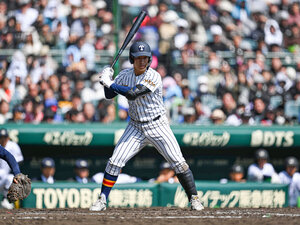
On the team, the best hitter is placed in the leadoff spot. Manager Yuya Kaneda entrusted this important role to Joji Ando (3rd year), who had often batted in the heart of the lineup. In official games last autumn, he hit four home runs. As a powerful long-distance hitter in clutch situations, he was a notable batter in this tournament as well.
In the first game, he had no hits, but Manager Kaneda said, “He was swinging well and seeing the ball.” He started again as the leadoff hitter in today’s game.
In his first at-bat, he struck out swinging, but he accurately relayed information about the opposing pitcher to the team, saying, “The high fastball has some rise.” In the next two at-bats, he drew walks, creating scoring opportunities. He even scored the tying fourth run.
Born in Shinjuku and raised in Shibuya, he is a city boy. Following in his older brother’s footsteps, he started playing baseball before entering elementary school.
When he first entered Teikyo, he was impressed by the behavior of captain Kippei Nishizaki (at the time). Nishizaki never let his guard down, not only during practice but also in school life. When younger players were scolded by Manager Kaneda, Nishizaki advised them, “We are a team. We can’t win without you guys.” Ando thought, “If there were 20 people like him, we could become number one in Japan.” He became a role model to aspire to.
In the second round game against Chukyo, Ando, who was the designated hitter, ran to the mound multiple times as a messenger during critical moments. He encouraged the pitcher, who seemed overwhelmed by the Koshien atmosphere, saying, “Just swing your arm as usual, with all your might.” Reflecting on Ando’s dedication to the team, which reminded him of his admired senior, Manager Kaneda said, “It was reassuring.”
The game went into extra innings, but they fell just short. Ando himself finished hitless and bit his lip, saying, “I lacked clutch hitting.”
However, in the invitational tournament, which they entered for the first time in 16 years, Teikyo defeated last summer’s champion and earned a valuable win. Next month, the spring Tokyo metropolitan tournament will begin. “I want to use today’s loss and become Japan’s number one in the summer.”