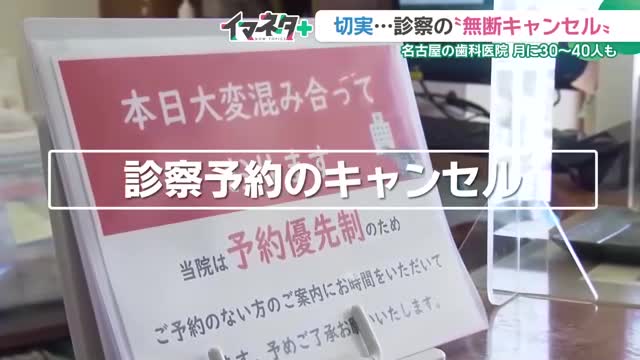
Starting in June, new formal rules will allow medical facilities to charge cancellation fees for missed appointments. But will they actually enforce them?
Medical institutions are troubled by the problem of patients not showing up for appointments. With rules changing from June, more medical institutions may start charging cancellation fees.
Shiroyama Dental Clinic & Orthodontics in Kita Ward, Nagoya City, treats about 50 patients a day.
What troubles them is the significant number of appointment cancellations.
“Three spots marked in red with an X are where appointments were made but no contact was given and patients did not actually come. In the afternoon, there were two no-show cancellations.”
At Shiroyama Dental Clinic & Orthodontics, about 30 to 40 people cancel without notice each month.
Including cases where notice was given at the last minute, the number can sometimes reach about 50 people.
“We need to prepare materials and various equipment for procedures, as well as staff. I think this results in losses in labor and material costs.”
Dental treatment often takes 30 minutes to an hour per person and requires preparation tailored to the patient, so appointments are generally required.
“I feel that the greater damage is when other patients lose opportunities. If we know an appointment slot is open, we can give that slot to someone who needs treatment.”
In this context, the rules regarding cancellation fees for medical appointments will change from June.
Previously, there was no clear rule, and the cancellation fee was ambiguous. The Ministry of Health, Labour and Welfare has now codified a rule stating that fees can be charged under certain conditions.
It states that fees can be charged if the medical institution explains to the patient in advance that a fee will be incurred upon cancellation and obtains their consent.
However, whether to actually introduce such fees, and the amount, is left to the discretion of each medical institution.
At Shiroyama Dental Clinic & Orthodontics, although challenges exist, after consideration, they decided not to introduce the system from June.
“If we start charging cancellation fees, the patient might feel awkward when they come back next time. If a sense of guilt arises, they might stop coming and treatment may not progress. We have to proceed based on a relationship of trust.”
Will the introduction of cancellation fees effectively eliminate treatment losses?
Medical institutions continue to explore solutions.
Shiroyama Dental Clinic & Orthodontics
Shiroyama Dental Clinic & Orthodontics is a modern dental practice located in Japan, likely named after the nearby Shiroyama area, which often holds historical significance related to feudal castles or battle sites. While the clinic itself focuses on contemporary dental and orthodontic care, its name reflects the local heritage of regions like Kagoshima, where Shiroyama is known for the 1877 Battle of Shiroyama during the Satsuma Rebellion. Today, it serves as a community healthcare provider, blending traditional place-name history with advanced medical services.
Kita Ward, Nagoya City
Kita Ward is one of the 16 wards of Nagoya City in Aichi Prefecture, Japan. Historically, it developed as a suburban area after the late 19th century, with its growth accelerating in the post-war period due to residential expansion and industrial development. Today, it is known for its residential neighborhoods, local parks, and landmarks such as the Nagoya Dome, a major sports and entertainment venue.
Shiroyama
Shiroyama, meaning Castle Mountain, is a historic hill in Kagoshima, Japan, best known as the site of Saigō Takamori’s final stand during the 1877 Satsuma Rebellion. Once the location of Kagoshima Castle, the mountain now features a park with statues and monuments commemorating the samurai and the battle. It offers panoramic views of the city and Sakura
Shiroyama Dental Clinic & Orthodontics
Shiroyama Dental Clinic & Orthodontics is a modern dental practice located in Japan, likely named after the common Japanese place name “Shiroyama” (meaning “castle mountain”), which often refers to historic castle sites. While the clinic itself does not have a long history, its name may evoke regional heritage tied to local castles or hilltop landmarks. The clinic provides general dentistry and orthodontic care, blending contemporary medical services with a culturally resonant location.
Kita Ward, Nagoya City
Kita Ward (Kita-ku) is one of the 16 wards of Nagoya City, Japan, located in the northern part of the city. Historically, the area developed around the Nagoya Castle and along key transportation routes, and it is known for landmarks such as the Nagoya Dome and the historic Shirotori Garden. Today, Kita Ward is a mix of residential neighborhoods and commercial districts, reflecting both its historical roots and modern urban development.
Shiroyama
Shiroyama, meaning “Castle Mountain,” is a historic hill in Kagoshima, Japan, best known as the site of the final battle of the Satsuma Rebellion in 1877. During this conflict, the samurai leader Saigō Takamori and his remaining forces made their last stand against the Imperial Japanese Army on the mountain’s slopes. Today, Shiroyama is a peaceful park offering panoramic views of Kagoshima Bay and Sakurajima, with monuments commemorating the fallen samurai.
Nagoya Dome
Nagoya Dome is a large baseball stadium located in Nagoya, Japan, and serves as the home field of the Chunichi Dragons professional baseball team. Opened in 1997, it was the first dome stadium in Japan to feature a natural grass field, which can be retracted to allow for various events. The venue has hosted numerous sports competitions and concerts, becoming a key cultural and entertainment landmark in the region.
Kagoshima Castle
Kagoshima Castle, also known as Tsurumaru Castle, was built in the early 17th century by the powerful Shimazu clan, who ruled the Satsuma domain. Unlike many Japanese castles, it was not built on a hill, but rather on flat land, and was largely destroyed during the 1877 Satsuma Rebellion. Today, its restored stone walls and moats remain, with a modern reconstruction of the main keep housing a museum about the castle and the region’s history.
Satsuma Rebellion
The Satsuma Rebellion was a major but ultimately unsuccessful samurai uprising in Japan led by Saigō Takamori in 1877, against the Meiji government’s rapid modernization and abolition of the samurai class. The rebellion began in Kagoshima and ended with the Battle of Shiroyama, where Saigō was killed. This event marked the end of the samurai era and solidified the Meiji government’s control.
Kagoshima
Kagoshima is a city located on the southwestern tip of Japan’s Kyushu island, known for its striking volcanic backdrop, Sakurajima. Historically, it served as a key domain for the powerful Shimazu clan during the feudal era and played a pivotal role in Japan’s modernization, as it was a birthplace of the Meiji Restoration. The city also witnessed fierce battles during the Satsuma Rebellion, the last major samurai conflict in Japan.
Sakura
Sakura, or cherry blossoms, are a cherished cultural symbol in Japan, representing the fleeting beauty of life due to their brief blooming period. The tradition of hanami, or flower viewing, dates back over a thousand years to the Nara period, when it was initially practiced by the elite before spreading to all levels of society. Today, sakura season attracts millions of visitors who gather to appreciate the blossoms, a practice deeply tied to Japanese art, poetry, and seasonal festivals.