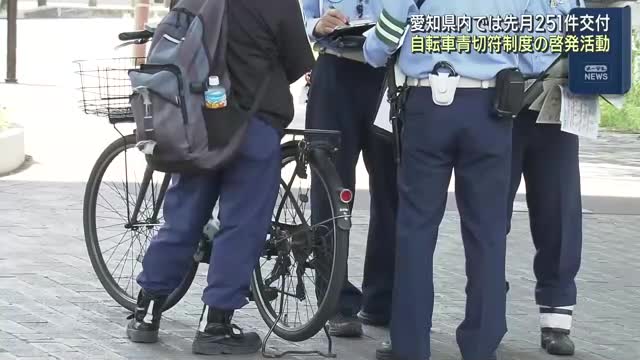
In May, designated as “Bicycle Month,” awareness activities for the blue ticket system were held in Nagoya’s Sakae district, following 251 blue tickets issued in Aichi Prefecture in April.
In an effort to promote awareness of the bicycle “blue ticket system” that started in April, an awareness campaign was held in Nagoya’s Sakae district.
The campaign was conducted by the Aichi Prefectural Police, with about 20 police officers from the Traffic General Affairs Division distributing flyers at the Sakae intersection and carrying out enforcement activities.
The bicycle “blue ticket system” applies to those aged 16 and older, imposing fines for distracted riding using smartphones or running red lights.
In Aichi Prefecture, 251 blue tickets were issued in April.
“There were also violators, so we want to continue strengthening traffic safety education, including the dissemination of traffic rules.”
May is “Bicycle Month,” and the Aichi Prefectural Police plan to conduct large-scale awareness campaigns and enforcement at each police station.
Sakae district
Sakae is a major commercial and entertainment district in Nagoya, Japan. Historically, it developed as a modern urban center after the city’s reconstruction following World War II, and today it is known for its skyscrapers, shopping centers like the Nagoya Parco, and cultural landmarks such as the Nagoya City Art Museum and the iconic Oasis 21 complex.
Sakae intersection
Sakae intersection is a major urban hub located in the heart of Nagoya, Japan, known for its vibrant shopping, entertainment, and dining districts. Historically, the area developed rapidly after World War II, transforming from a war-damaged zone into a modern commercial center, symbolized by the iconic Nagoya TV Tower and the nearby Oasis 21 complex. Today, it remains a bustling crossroads where tradition and modernity meet, hosting cultural events and serving as a key transportation node.
Sakae district
Sakae is the bustling downtown and entertainment hub of Nagoya, Japan, known for its shopping, dining, and nightlife. Historically, the area developed in the early 20th century as part of Nagoya’s modernization, and it was largely rebuilt after World War II. Today, it features landmarks like Nagoya TV Tower and Oasis 21, blending modern urban life with the city’s resilient post-war history.
Nagoya Parco
Nagoya Parco is a major shopping and entertainment complex located in the Sakae district of Nagoya, Japan. Originally opened in 1989, it is part of the Parco chain and has become a cultural hub, hosting events, fashion boutiques, and pop culture attractions. The site reflects Nagoya’s modern urban development, blending retail with youth-oriented entertainment in the heart of the city.
Nagoya City Art Museum
The Nagoya City Art Museum, located in Nagoya, Japan, opened in 1988 and is known for its striking modern architecture designed by Kisho Kurokawa. The museum’s collection focuses on 20th-century art, with a strong emphasis on works from the School of Paris and contemporary Japanese artists. It serves as a cultural hub, hosting rotating exhibitions and educational programs that highlight both local and international artistic movements.
Oasis 21 complex
Oasis 21 is a modern multi-purpose complex located in Nagoya, Japan, known for its distinctive spaceship-like glass roof and a large water basin that collects rainwater for reuse. Opened in 2002, it serves as a transportation hub, shopping center, and event space, symbolizing Nagoya’s blend of futuristic design and environmental consciousness. The complex sits near the historic Nagoya TV Tower and Sakae district, connecting the city’s past with its forward-looking urban development.
Sakae intersection
Sakae intersection is a bustling hub located in Nagoya, Japan, known for its vibrant shopping, dining, and entertainment districts. Historically, the area developed rapidly after World War II, transforming from a wartime landscape into a modern commercial center. Today, it is famous for landmarks like the Nagoya TV Tower and Oasis 21, symbolizing the city’s postwar revival and contemporary culture.
Nagoya TV Tower
The Nagoya TV Tower, completed in 1954, is a historic broadcasting and observation tower located in Hisaya-ōdōri Park in Nagoya, Japan. Standing at 180 meters tall, it was the first wave-resistant steel tower built in the country and served as a symbol of post-war reconstruction. Today, it remains a popular tourist attraction, offering panoramic views of the city and hosting various events throughout the year.