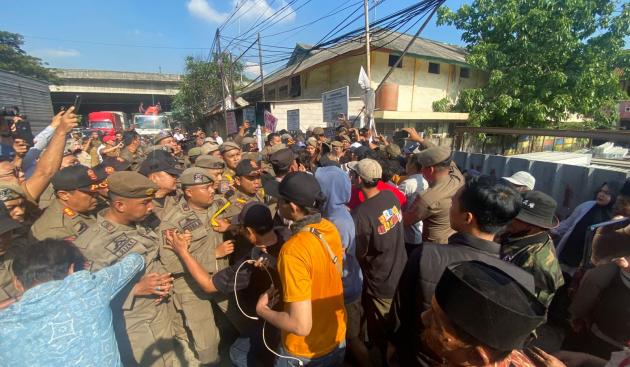
Satpol PP officers were confronted by residents claiming to be heirs during the execution of regional assets at the former SDN Rawa Bokor, on Jalan Husein Sastranegara, Benda Village, Benda District, Tangerang City, Friday, April 24, 2026.
The Tangerang City Government secured an asset consisting of land and buildings of the former Rawa Bokor State Elementary School on Jalan Husein Sastranegara, Benda Village, Benda District, Tangerang City, on Friday, April 4, 2026.
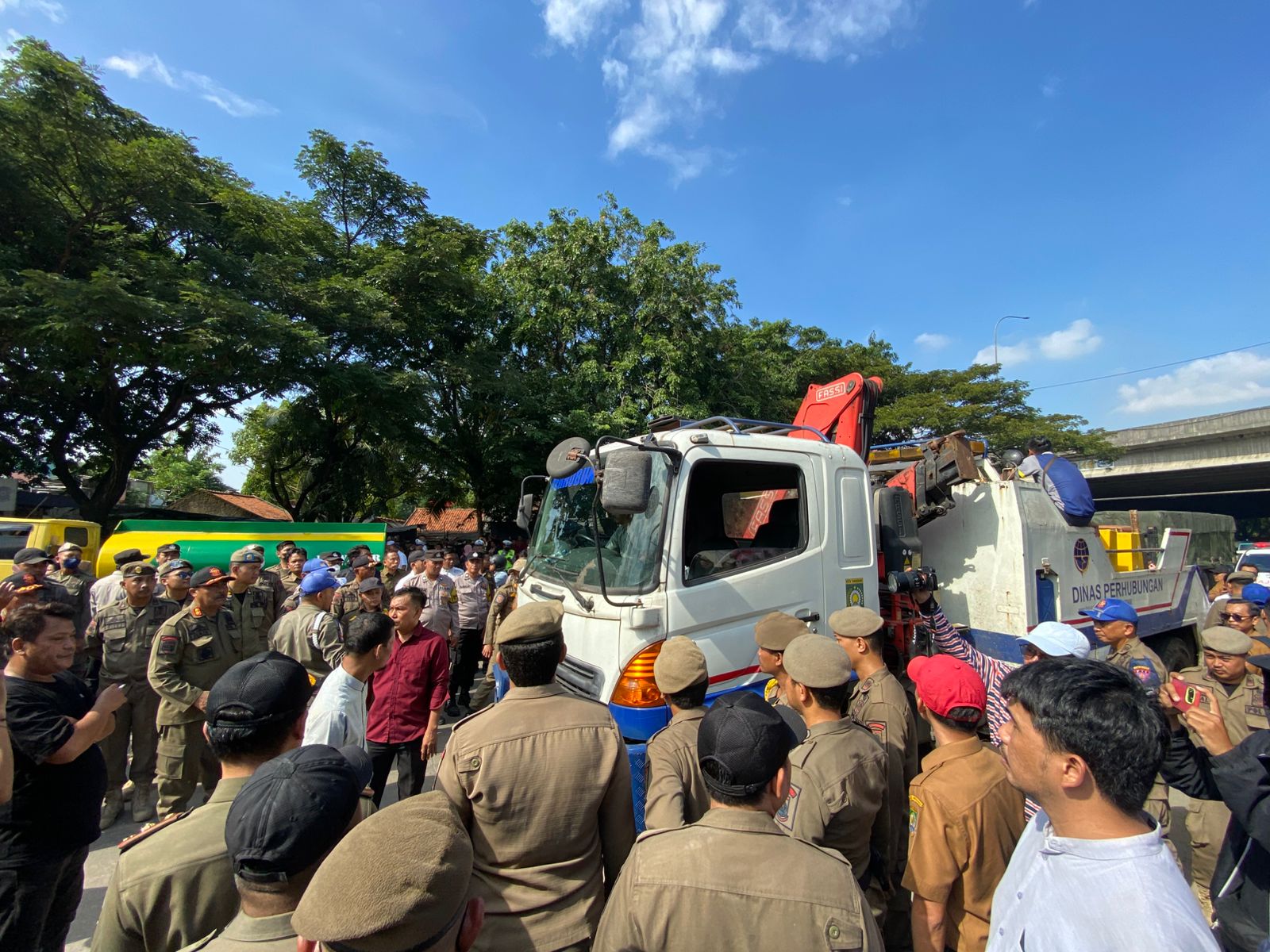
During the operation, dozens of joint officers from Satpol PP, Police, and the Indonesian Military were deployed to the location due to resistance from residents claiming to be heirs of the land.
The residents resisted by blocking the officers, leading to verbal altercations and pushing.
Residents also blocked heavy equipment from the Tangerang City Transportation Agency that was brought in for demolition.
“As heirs, we have the right to protect our land. This is ours, so we will defend it,” one resident asserted.
At the scene, the land was enclosed with a zinc fence. The front displayed graffiti and a sign claiming ownership of the land.
The legal counsel for the Tangerang City Government stated that the land, with an area of approximately 1,580 square meters, is a city government asset based on the Right to Use Certificate Number 4 dated January 24, 2004.
However, the land was controlled by parties claiming to be heirs, so this execution was carried out under a strong legal framework, namely Law No. 51/1960 concerning the Prohibition of Land Use Without Permission from the Authorized Party or Their Representative.
“This land is a state asset intended for the public interest. Therefore, the state is present to regulate and protect its citizens. The city government has a valid legal basis in the form of a Right to Use Certificate,” he said.
Persuasive Process Has Been Undertaken
Before taking enforcement action with heavy equipment, it was explained that the authorities had prioritized humane and administrative steps.
The Tangerang City Government had sent a series of warning letters to parties still occupying the land.
“The city government provided grace periods ranging from 7×24 hours, 3×24 hours, to 2×24 hours for occupants to vacate the land voluntarily,” he said.
It was revealed that a hearing with the parties claiming to be heirs had been facilitated at the district level. “However, because no agreement was reached and activities at the location continued, firm action was taken,” he concluded.
Legal Channels Invited
In response to the opposing party’s claim of possessing a girik document for the land, the Tangerang City Government invited them to pursue legal channels.
“As a rule-of-law state, we do not restrict citizens’ rights. Please take legal steps; we will present the evidence in court. Not all state secrets can be disclosed now, but we stand firmly on the applicable regulations,” he asserted.
Heirs’ Claim
Meanwhile, the legal counsel for the heirs explained that the residents’ action was an effort to defend their legal ownership rights, supported by strong evidence in the form of Girik Number 436 Persil 77 in the name of Biar Bin Koentoel, dated October 20, 1971.
According to the Girik, the heirs’ land is recorded as covering 5,580 square meters. Meanwhile, the area used by the Tangerang City Government for the school is 1,580 square meters.
“We have the original Girik, while the city government only claims through a Right to Use Certificate whose purpose has expired. Moreover, a Right to Use Certificate could not simply be issued without a prior ownership certificate,” he said.
When asked about the possibility of a lawsuit, the heirs’ legal counsel explained that they are the legal owners, so the lawsuit should be filed by the city government. Execution cannot proceed without a court ruling.
“We are the ones who own and control this land. It is not us who should sue