Five Days After Eid, Return Flow Passengers at Soetta Airport Terminal Grow More Crowded at Night
The return flow of the 2026 Eid holiday at Soekarno-Hatta International Airport (Soetta) in Tangerang City was still ongoing on H+5, or the evening of Thursday, March 26, 2026.
Records show that 98,729 passengers arrived from their hometowns or holiday destinations.
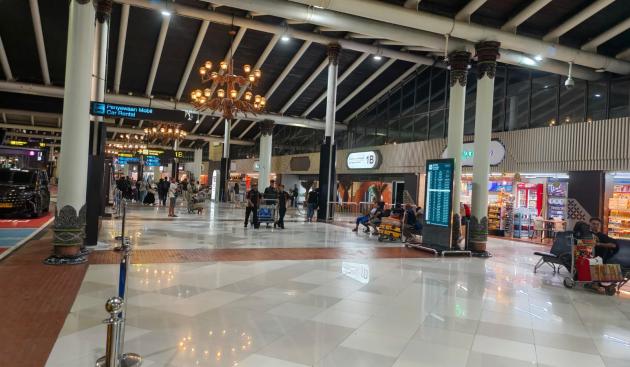
Observations at Terminal 1 showed passenger congestion at several points, specifically in the baggage claim area, arrival gates, and the pick-up zone.
Information from the Flight Information Display System (FIDS) screens at Terminal 1B Arrivals at 7:30 PM local time showed that arriving passengers were predominantly from Makassar, Denpasar, and Medan.
It is estimated that the total number of passengers from Terminals 1, 2, and 3 of Soekarno-Hatta Airport today will reach 176,517 people, an increase of approximately 27% compared to a normal day.
This number consists of 77,788 departing passengers and 98,729 arriving passengers.
Meanwhile, the total number of flights was 1,144, both domestic and international, along with 18 cargo flights.
The high number of passengers indicates that the Eid return flow is still ongoing and is dominated by passengers arriving in the Jakarta, Bogor, Depok, Tangerang, and Bekasi (Jabodetabek) region.
In addition to the surge in domestic passenger return flow, international passenger movement also recorded a significant number, reaching 48,672 people today.
It is predicted that the 2026 Eid return flow will continue until its peak on March 28, 2026. Passengers are advised to arrive earlier and check their schedules to avoid delays.
Soekarno-Hatta International Airport
Soekarno-Hatta International Airport is Indonesia’s primary international gateway, located in Jakarta. Named after the country’s first president and vice president, it opened in 1985 to replace the overburdened Kemayoran Airport. The airport is notable for its distinctive terminal design, which incorporates traditional Indonesian architectural elements like *joglo* roofs.
Makassar
Makassar is the capital of South Sulawesi, Indonesia, historically known as a major port city and the center of the powerful Gowa Sultanate from the 16th century. Its most famous cultural site is Fort Rotterdam, a 17th-century Dutch fort built upon the foundations of an earlier Gowanese fortification, symbolizing the city’s role in the spice trade and colonial history. Today, it remains a vibrant economic hub and gateway to eastern Indonesia.
Denpasar
Denpasar is the bustling capital city of Bali, Indonesia, which historically served as the seat of the Badung kingdom. While not a single ancient monument, its cultural heart is the **Pura Jagatnatha**, a state temple dedicated to the supreme god Sang Hyang Widi, and the site of the tragic 1906 *Puputan* battle where Balinese royalty and subjects chose mass ritual suicide against Dutch colonial forces. Today, it is a vibrant modern gateway where traditional Balinese Hindu culture coexists with rapid urban development.
Medan
Medan is the capital and largest city of Indonesia’s North Sumatra province, historically a key trading hub due to its strategic location on the Strait of Malacca. Its modern development was significantly shaped by the 19th-century Dutch colonial plantation industry, particularly for tobacco, which led to the construction of landmarks like the grand Maimun Palace, the former Sultanate of Deli’s seat of power. Today, it is a bustling commercial center and gateway to the natural wonders of Sumatra, known for its diverse culinary scene and multicultural heritage.
Jakarta
Jakarta is the capital and largest city of Indonesia, located on the northwest coast of Java. Historically known as Sunda Kelapa and later Batavia under Dutch colonial rule, it became the center of the Dutch East India Company’s trading empire in the 17th century before being renamed Jakarta after Indonesia’s independence. Today, it is a bustling, sprawling metropolis that serves as the nation’s political and economic hub.
Bogor
Bogor is a city in West Java, Indonesia, historically known as “Buitenzorg” during the Dutch colonial era when it served as a summer retreat for colonial governors. It is most famous for the Bogor Botanical Gardens (Kebun Raya Bogor), established in 1817, which is one of the oldest and largest botanical gardens in the world. The city’s cool, rainy climate and its presidential palace, originally built as a residence for the Dutch Governor-General, remain key features of its identity.
Depok
Depok is a city in West Java, Indonesia, originally established in the 18th century as a private agricultural estate by Cornelis Chastelein, a Dutch East India Company official. Historically known as a Christian settlement, it has transformed from a quiet town into a major university city and bustling satellite city of Jakarta. Today, it is recognized for its educational institutions, such as the University of Indonesia, and its rapid urban development.
Tangerang
Tangerang is a major city in Indonesia’s Banten province, located just west of Jakarta on the island of Java. Historically, it was a significant settlement for Chinese immigrants in the 17th century, earning it the nickname “Benteng” (Fortress) and shaping its cultural heritage. Today, it is a key industrial and manufacturing hub within the Jakarta metropolitan area.